On this page
Key takeaways
- Test the water before every soak and at least 2–3 times a week. The CDC recommends checking chlorine and pH twice a day, more often with many bathers. Keep free chlorine at 3 ppm or higher or bromine at 4 ppm or higher, with pH between 7.2 and 7.8.
- Shock the hot tub once a week and after every heavy-use session.
- Rinse the filter every 1–2 weeks, deep-clean it every 1–3 months and replace it every 1–2 years.
- Drain and refill every 3–4 months. The rule of thumb: gallons ÷ 3 ÷ average daily bathers = days between drains.
- Most problems (cloudy water, foam, smells, itchy skin) come from low sanitizer, off-balance pH or a dirty filter, so fix those three first.
Hot tub maintenance comes down to three habits: keep the sanitizer and pH in range, keep the filter clean, and change the water before it wears out. Get those right and you’ll spend about 20 minutes a week on your tub, not your weekend.
This guide gives you the exact numbers to aim for, a printable daily, weekly and monthly schedule, and quick fixes for the problems every owner runs into.
Hot tub maintenance at a glance
| Task | How often | Time | |---|---|---| | Check sanitizer and pH | Before each soak; at least 2–3 times a week (CDC: twice a day) | 2 min | | Adjust chemicals | When a test is out of range | 5 min | | Shock | Weekly and after heavy use | 2 min | | Rinse filter | Every 1–2 weeks | 5 min | | Deep-clean filter (chemical soak) | Every 1–3 months | Overnight soak | | Clean waterline and cover | Weekly to monthly | 10 min | | Drain, clean and refill | Every 3–4 months | 2–3 hours | | Replace filter | Every 1–2 years | 2 min | | Replace cover | Every 5–7 years | — |
Hot tub maintenance schedule
A schedule beats memory. Stick this checklist on the inside of a cabinet door near the tub.
Every time you use it
- Shower before getting in. Lotions, deodorant and hair products are the main cause of foam and cloudy water.
- Run the jets for 15–20 minutes after a session so the filter catches what bathers leave behind.
- Put the cover back on and lock the straps. It saves heat and keeps leaves and rain out.
2–3 times a week
- Test sanitizer, pH and alkalinity. The CDC recommends testing chlorine and pH twice a day; at minimum, test before every soak and daily if the tub gets used every day or by more than two people.
- Top up sanitizer to keep free chlorine at 3 ppm or higher (or bromine at 4 ppm or higher).
- Check the water level: it should cover the skimmer opening by at least an inch.
Weekly
- Shock the water (see how to shock a hot tub).
- Rinse the filter with a garden hose.
- Wipe the scum line at the waterline with a soft cloth or a non-scratch sponge.
Monthly
- Test calcium hardness.
- Deep-clean the filter with a cartridge cleaner, or swap in a spare filter while the dirty one soaks.
- Clean and condition the cover’s vinyl top.
- Inspect jets, pillows and the GFCI breaker. Press the GFCI test button: the tub should shut off.
Every 3–4 months
- Drain, clean the shell and refill. Flush the plumbing with a line cleaner before draining (see draining).
Every 1–2 years
- Replace the filter cartridge. Pleats that look frayed, flattened or permanently gray won’t filter well anymore.
Ideal hot tub chemical levels
These are the target ranges for a home hot tub. The sanitizer and pH numbers follow the CDC’s guidance for hot tubs; alkalinity and calcium are standard spa industry ranges.
| Reading | Target | Why it matters | |---|---|---| | Free chlorine | 3–5 ppm (CDC minimum: 3 ppm) | Kills bacteria, including the germs behind “hot tub rash” and Legionnaires’ disease | | Bromine (if used instead) | 4–6 ppm (CDC minimum: 4 ppm) | Same job as chlorine, more stable at high temperatures | | pH | 7.2–7.8 | Low pH corrodes heaters and irritates skin; high pH makes sanitizer weaker and water cloudy | | Total alkalinity | 80–120 ppm | Buffers pH so it doesn’t swing every time you add something | | Calcium hardness | 150–250 ppm | Too low and water attacks the shell; too high and you get scale | | Cyanuric acid (stabilizer) | As low as possible | The CDC advises against stabilizer in hot tubs because it slows chlorine down |
Safety note
Hot water helps germs grow, and jets turn them into mist you breathe in. The CDC’s Legionella guidance for hot tubs puts free chlorine between 3 and 10 ppm or bromine between 4 and 8 ppm. Never let sanitizer drop to zero, even when you aren’t using the tub.
The order matters. When several readings are off, fix them in this order: alkalinity first, then pH, then sanitizer. Alkalinity pulls pH with it, so adjusting pH first often means doing it twice.
To raise pH and alkalinity, use a spa increaser such as Spa Up (sodium bicarbonate, per its listing). To lower them, use a sodium bisulfate product such as Spa Down. Add small doses, run the jets for 20–30 minutes, and test again before adding more.
Leisure Time Spa Up (pH increaser, 2 lb)
- Raises
- pH and total alkalinity
- Active ingredient
- Sodium bicarbonate
- Dose (listing)
- 1/4 oz (1 1/2 tsp), circulate 30 min
- Size
- 2 lb
Specs from the Amazon listing and manufacturer documentation
Granular increaser made for spas. The listing names sodium bicarbonate as the ingredient and doses it at 1/4 oz (1 1/2 teaspoons) at a time, followed by 30 minutes of circulation.
Leisure Time Spa Down (pH decreaser, 2.5 lb)
- Lowers
- pH and total alkalinity
- Active ingredient
- Sodium bisulfate
- Size
- 2.5 lb
Specs from the Amazon listing and manufacturer documentation
Sodium bisulfate granules that bring pH and alkalinity down. The listing says to circulate for 30 minutes after adding; it gives no dose, so follow the label on the container.
Chlorine vs bromine: which sanitizer should you use?
Both keep the water safe. The right choice depends on how you use the tub.
| | Chlorine (dichlor granules) | Bromine (tablets in a floater) | |---|---|---| | Target level | 3–5 ppm | 4–6 ppm | | Works fast | Yes | Slower to build up | | Stable in hot water | Less stable | More stable above 100 °F | | Smell | Stronger when chloramines build up | Milder | | Effort | Add a dose after each use or every couple of days | Floater releases it slowly; check weekly | | Best for | Occasional use, owners who like quick control | Frequent use, sensitive skin, set-and-forget routines |
One thing to know about chlorine granules: most spa chlorine is sodium dichlor, which adds a little cyanuric acid every time you use it. That’s one more reason to drain on schedule, since stabilizer builds up and the CDC recommends keeping it out of hot tubs.
Don’t switch back and forth between the two without draining. Adding chlorine to bromine water reactivates the bromine instead of adding fresh chlorine, which makes your readings hard to trust. More detail in our guide to bromine vs chlorine for hot tubs.
SpaChoice Chlorine Granules (sodium dichlor, 5 lb)
- Active ingredient
- Sodium dichlor
- Use
- Daily sanitizer and shock
- Size
- 5 lb
Specs from the Amazon listing and manufacturer documentation
Spa-specific dichlor granules. The listing says 1 teaspoon adds about 1.4 ppm of chlorine in 500 gallons, with a startup dose of 6 teaspoons per 500 gallons.
How to test hot tub water
You have two options:
- Test strips: dip for a second, wait 15 seconds, compare colors. Fast and good enough for routine checks. Keep the bottle closed and dry, because moisture ruins them.
- Drop (reagent) kits: more accurate, especially for chlorine. Worth having for diagnosing problems.
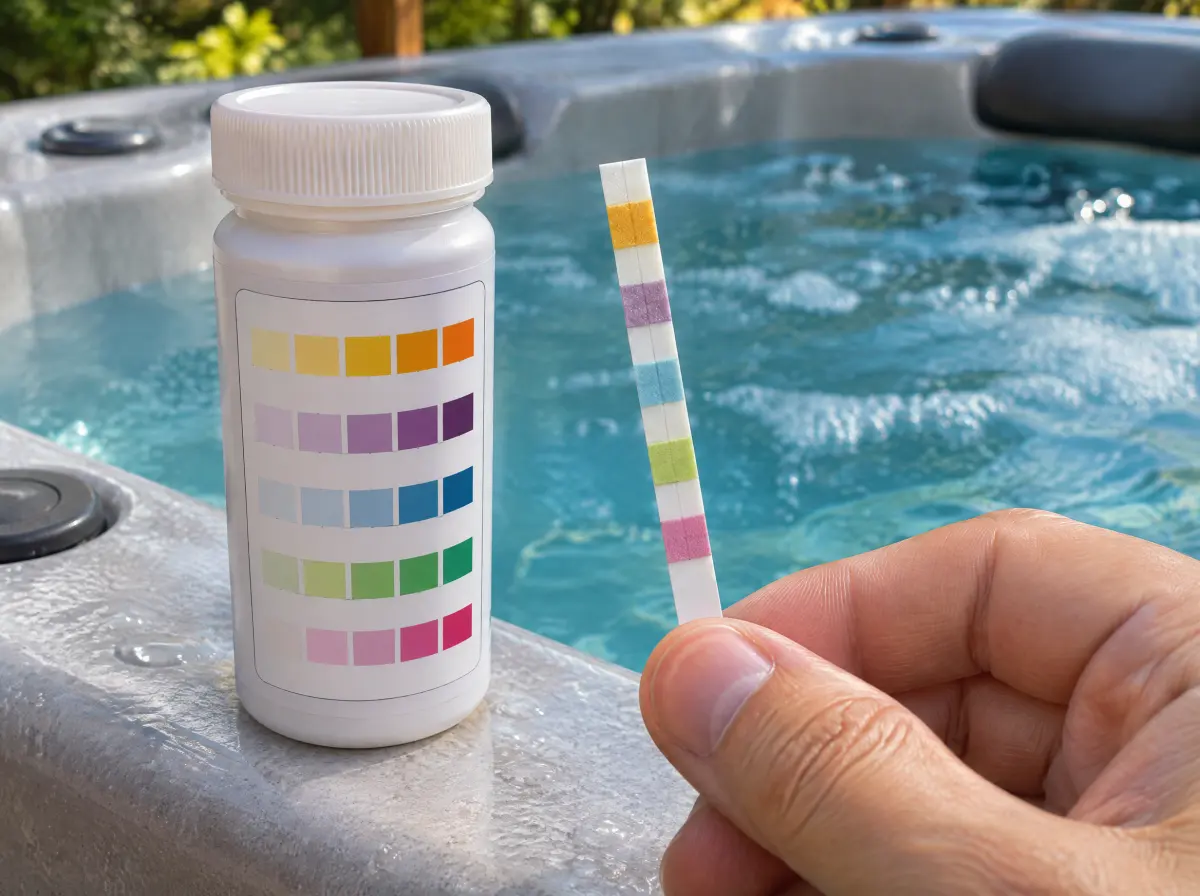
How to get a reliable reading:
- Take the sample from about elbow deep, away from the jets and any chemical floater.
- Test before adding anything, not right after.
- Read the strip in daylight or under white light, within the time on the label.
- Write the results down. A simple log shows you patterns, like pH that always creeps up.
Compare options in our best hot tub test strips guide.
AquaChek 7-Way Pool and Spa Test Strips (100 count)
- Tests
- Free and total chlorine, bromine, pH, alkalinity, hardness, stabilizer
- Count
- 100 strips
Specs from the Amazon listing and manufacturer documentation
Reads seven values on one strip, including both free chlorine and bromine, so it works whichever sanitizer you use.
How to shock a hot tub
Shocking means adding a large dose of oxidizer to break down body oils, sweat and chloramines (the compounds behind the “chlorine smell”). Do it weekly and after heavy use.
- Test and balance pH first. Shock works best with pH between 7.2 and 7.8.
- Take the cover off and leave it off for at least 20 minutes so gases can escape.
- Turn on the jets and add the dose on the label for your tub’s gallons. Pour it in front of a jet, never on the shell.
- Wait before soaking. Follow the label; with chlorine shock, wait until free chlorine drops back to 5 ppm or less.
You can shock with chlorine (dichlor) or with a non-chlorine shock (potassium monopersulfate, often called MPS). Non-chlorine shock usually lets you get back in after a short wait (check the label), but it doesn’t disinfect, so you still need your regular sanitizer.
Hot tub filter care
The filter traps hair, skin flakes and debris that sanitizer can’t remove. A clogged filter means cloudy water, weak jets and a heater that works harder.
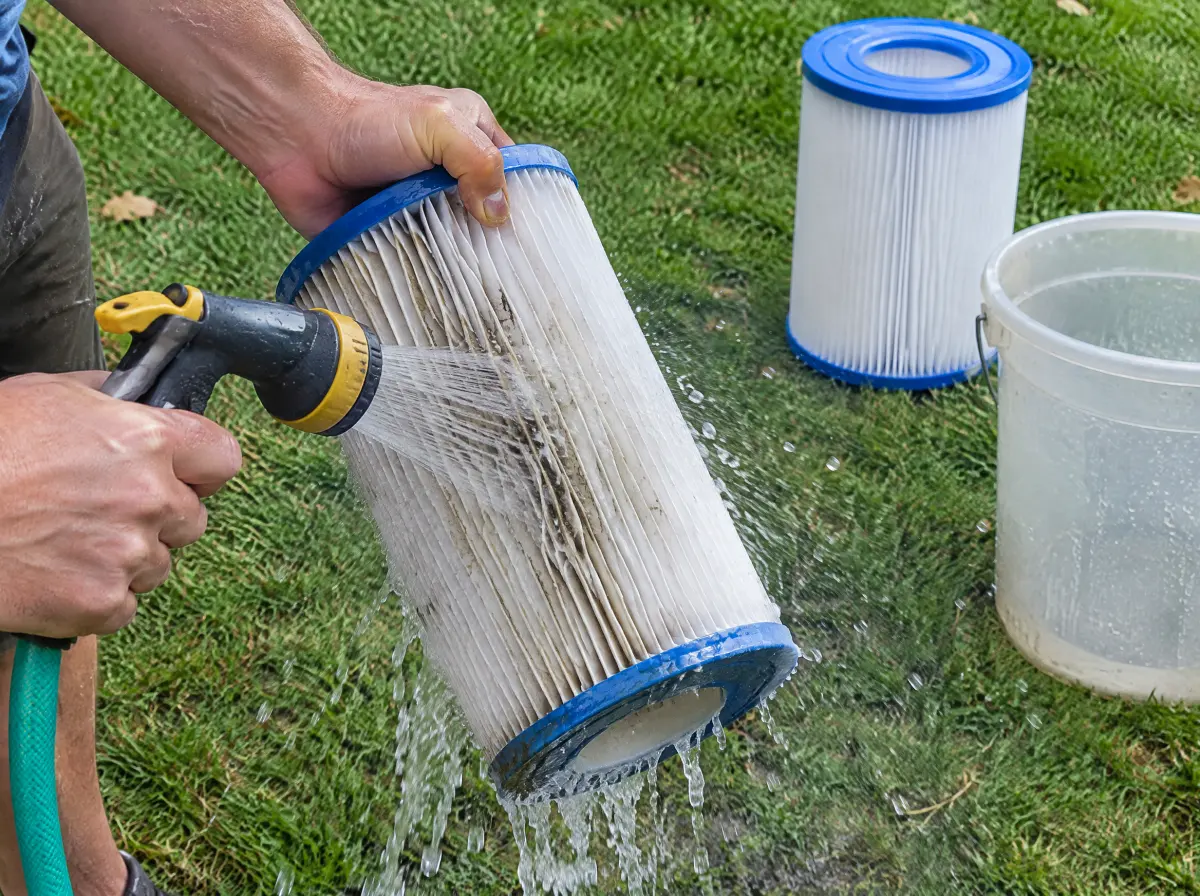
Every 1–2 weeks: rinse. Turn the tub off, pull the cartridge and spray between every pleat from top to bottom at an angle. Skip the pressure washer, which tears the fabric.
Every 1–3 months: deep clean. Soak the cartridge overnight in a filter cleaner solution to dissolve oils and scale that a hose can’t move. Rinse well before reinstalling so the cleaner doesn’t foam in the tub.
Every 1–2 years: replace. Buy a second cartridge and rotate them. While one soaks and dries, the other is working, so the tub never sits without filtration.
Step-by-step in how to clean a hot tub filter, and our picks of replacement hot tub filters and filter cleaners.
Leisure Time Filter Clean (cartridge cleaner, 32 fl oz)
- Method
- Overnight soak
- Size
- 32 fl oz
Specs from the Amazon listing and manufacturer documentation
Soak-type cartridge cleaner for oils and scale. The listing calls for an overnight soak; it gives no dilution, so mix at the rate on the bottle.
How often to drain a hot tub
Even perfectly balanced water wears out. Dissolved solids from chemicals, skin and soap build up until the water stops responding to treatment.
The rule of thumb:
Days between drains = tub volume in gallons ÷ 3 ÷ average daily bathers
| Tub size | 1 bather/day | 2 bathers/day | 4 bathers/day | |---|---|---|---| | 300 gallons | 100 days | 50 days | 25 days | | 450 gallons | 150 days | 75 days | 38 days | | 600 gallons | 200 days | 100 days | 50 days |
For most households that works out to every 3–4 months. Drain sooner if the water stays cloudy or foamy after a shock, or if chemicals stop holding.
How to drain and refill:
- Add a plumbing line flush the day before (or a few hours before) and run the jets, following its label. It loosens biofilm inside pipes that you can’t reach.
- Turn off power at the breaker.
- Drain with the built-in valve or a submersible pump.
- Wipe the shell with a non-abrasive spa cleaner and rinse.
- Clean or replace the filter while the tub is empty.
- Refill through the filter well with a hose filter if your water is hard or has metals.
- Restore power, balance alkalinity and pH, then shock and bring sanitizer into range.
Full walkthrough: how to drain a hot tub.
Hot tub cover care
The cover is your biggest energy saver. A waterlogged or cracked cover lets heat escape and makes the heater run constantly.
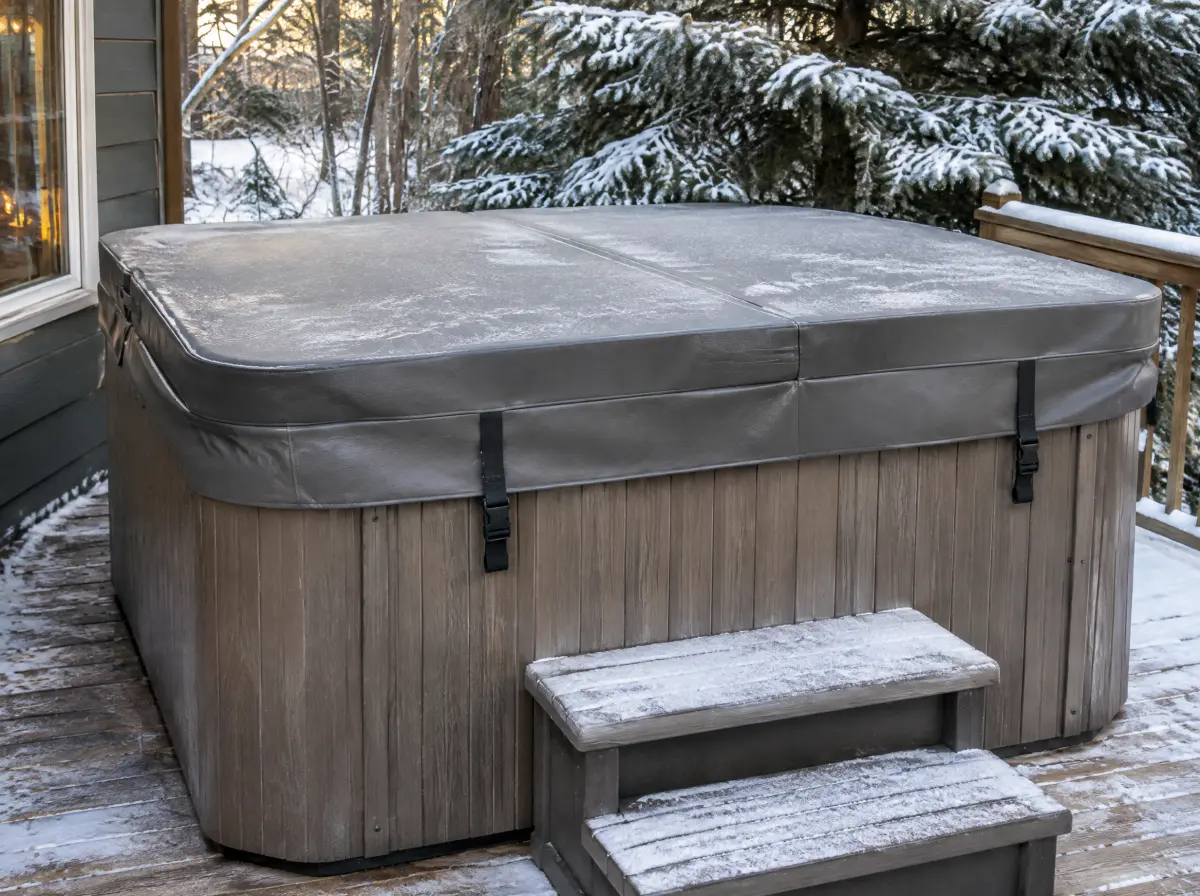
- Monthly: wipe the underside with diluted spa-safe cleaner to prevent mildew, and clean the vinyl top.
- Every 2–3 months: apply a UV protectant on the vinyl.
- Always: use a cover lifter or two people to remove it. Dragging it by the edge breaks the foam core and the hinge seam.
- Replace when it feels heavy (waterlogged foam), sags in the middle or the vinyl cracks. That’s usually 5–7 years.
See our picks for replacement hot tub covers and cover lifters.
Fixing common hot tub water problems
| Problem | Most likely cause | Fix | |---|---|---| | Cloudy water | Low sanitizer, high pH or a dirty filter | Balance pH, shock, clean the filter. If it persists, drain | | Foam | Lotions, soap or detergent residue on swimsuits; old water | Shower first, rinse swimsuits in plain water, shock. Drain if the water is old | | Strong chlorine smell | Chloramines, which means too little free chlorine | Shock to burn them off | | Green water | Algae from sanitizer at zero | Shock heavily, scrub, clean the filter | | Itchy skin or rash | Low sanitizer or pH out of range | Bring sanitizer and pH into range before the next soak | | Scale on the shell | High calcium or high pH | Lower pH and alkalinity; use a scale control product | | Weak jets | Clogged filter or low water level | Clean the filter, top up the water |
Deeper fixes: cloudy hot tub water and hot tub foam.
The tennis ball trick
A clean tennis ball floating in the tub absorbs some of the oils that cause scum and foam. Swap it every couple of weeks. It helps, but it won’t fix low sanitizer or a dirty filter.
Inflatable and plug-and-play hot tubs
Inflatable and plug-and-play (120-volt) hot tubs follow the same chemistry rules, with a few differences:
- Smaller water volume means chemicals act faster and readings swing more. Dose in smaller amounts and test more often.
- Smaller filters clog faster. Rinse them every few days of regular use and keep spares on hand.
- Heating is slower, and most inflatable models aren’t rated for freezing temperatures. Check the manual before using one in winter.
- Drain and dry them completely before storing for the season.
Compare models in our guides to the best inflatable hot tubs and plug-and-play hot tubs.
Winter hot tub care
You can use a hard-shell hot tub all winter. Keeping it running is safer than shutting it down, because still water in the pipes can freeze and crack them.
- Keep the tub running and the cover locked. Check that the cover seals all the way around.
- Keep the water level up: evaporation is higher in cold, dry air.
- Drain on schedule before deep cold if you can, so you don’t have to do it in freezing weather.
- If you must shut it down, drain it completely and blow out the lines. A spa technician can do this if you aren’t sure.
The hot tub maintenance starter kit
If you’re setting up a new tub, this is everything you need for the first few months.
Scroll sideways to see every column →
| Product | Best for | What it does | How often | Price | Buy |
|---|---|---|---|---|---|
| AquaChek 7-Way Test Strips | Testing | Reads sanitizer, pH, alkalinity and hardness | 2–3 times a week | Check price | |
| SpaChoice Chlorine Granules | Sanitizing and shock | Keeps free chlorine at 3–5 ppm | After use and weekly | Check price | |
| Leisure Time Spa Up | Raising pH | Raises pH and alkalinity | When low | Check price | |
| Leisure Time Spa Down | Lowering pH | Lowers pH and alkalinity | When high | Check price | |
| Leisure Time Filter Clean | Filter care | Dissolves oils and scale | Every 1–3 months | Check price |
Specs from Amazon listings and manufacturer documentation. Prices change often, so we link to the live listing.
Also worth having: a spare filter cartridge, a soft sponge for the waterline and a cover lifter. Browse our full list of hot tub chemicals, and print the hot tub maintenance schedule for your tub.
How we put this guide together
We didn’t soak-test these products in our own tub. This guide is built from sources you can check: the CDC’s hot tub guidance for sanitizer and pH levels, the US National Electrical Code for the shut-off rule, manufacturer care guides, and the label directions of each product we mention. Where sources disagree, we use the more cautious number. Every source is listed at the end of the page.
Hot tub steps and a good cover make day-to-day use easier, but the routine above is what keeps the water clean. Test, balance, shock weekly, keep the filter clean and drain on schedule.
Sources
- CDC: Home Pool and Hot Tub Water Treatment and Testing · cdc.gov
- CDC: Controlling Legionella in Hot Tubs (Legionella Control Toolkit) · cdc.gov
- CDC: What You Can Do to Stay Healthy in Hot Tubs · cdc.gov
Frequently asked questions
Should you shock your hot tub every week?
Yes. A weekly shock burns off body oils, sweat and the chloramines that cause the chemical smell. Shock again after a party or any session with more bathers than usual, and always after a long period without use.
How often should you change hot tub water?
Every 3 to 4 months for most home hot tubs. Divide the tub's volume in gallons by 3, then divide by the average number of bathers per day: a 450-gallon tub used by 2 people a day works out to 75 days. Drain sooner if the water stays cloudy or foamy after shocking.
What is the 5-foot rule for hot tubs?
It's the US electrical code requirement (NEC Article 680) that the emergency shut-off switch for a hot tub be in sight of the tub and at least 5 feet away from the water's edge, so no one can reach it from inside the tub. Have a licensed electrician check local requirements before installation.
Why do people put a tennis ball in a hot tub?
A clean tennis ball floating in the water soaks up some surface oils from skin, lotions and hair products, which can reduce scum lines and foam. It's a cheap helper, not a replacement for a clean filter, sanitizer and weekly shock.
What should you never put in a hot tub?
Avoid bubble bath, bath bombs, essential oils and household cleaners: they cause foam, clog filters and throw off the chemistry. Don't use pool chemicals designed for large pools unless the label covers spas, and never mix chemicals together before adding them to the water.
How much does hot tub maintenance cost?
For a typical home hot tub, budget roughly $20–$40 a month for sanitizer, shock, balancers and test strips, plus a replacement filter once or twice a year and electricity. Prices vary by region, tub size and how often you use it.