On this page
Key takeaways
- Most hot tub foam is caused by soaps, lotions, hair products and laundry detergent left in swimsuits. Jets whip those residues into bubbles.
- A defoamer clears foam in minutes, but it only masks the problem. The real fix is to remove the cause: shock, clean the filter and balance the water.
- Check the basics first: free chlorine 3–5 ppm (or bromine 4–6 ppm), total alkalinity 80–120 ppm, pH 7.2–7.8 and calcium hardness 150–250 ppm. Soft water below 150 ppm foams more easily.
- If foam keeps coming back with balanced readings, the water is worn out. Flush the lines, drain and refill. For most tubs that means every 3–4 months.
- Foam itself isn't toxic, but it means the water is loaded with contaminants. Skip the soak until sanitizer is back above the CDC minimum of 3 ppm chlorine or 4 ppm bromine.
Step-by-step checklist
-
Knock down the foam if you need to
For an immediate fix, add a spa defoamer directly to the foam per the label, about 1/2 oz at a time for Leisure Time Foam Down. This only hides the foam.
-
Test the water
Read free chlorine or bromine, pH, total alkalinity and calcium hardness with a test strip or drop kit.
-
Balance alkalinity, then pH
Bring total alkalinity to 80–120 ppm first, then pH to 7.2–7.8, running the jets for 20–30 minutes between additions.
-
Check calcium hardness
If calcium is below 150 ppm, raise it with a calcium increaser to the 150–250 ppm range.
-
Shock the water
With the cover off and jets running, add the shock dose on the label for your tub's gallons to burn off oils and soap residue.
-
Clean the filter
Rinse the cartridge between every pleat with a hose. If you soak it in a filter cleaner, rinse until no suds come out before putting it back.
-
Drain and refill if foam returns
If foam comes back within a few days with balanced readings, add a plumbing line flush, run the jets per its label, then drain, clean the shell and refill.
Retest after the wait time in the guide below before adding anything else.
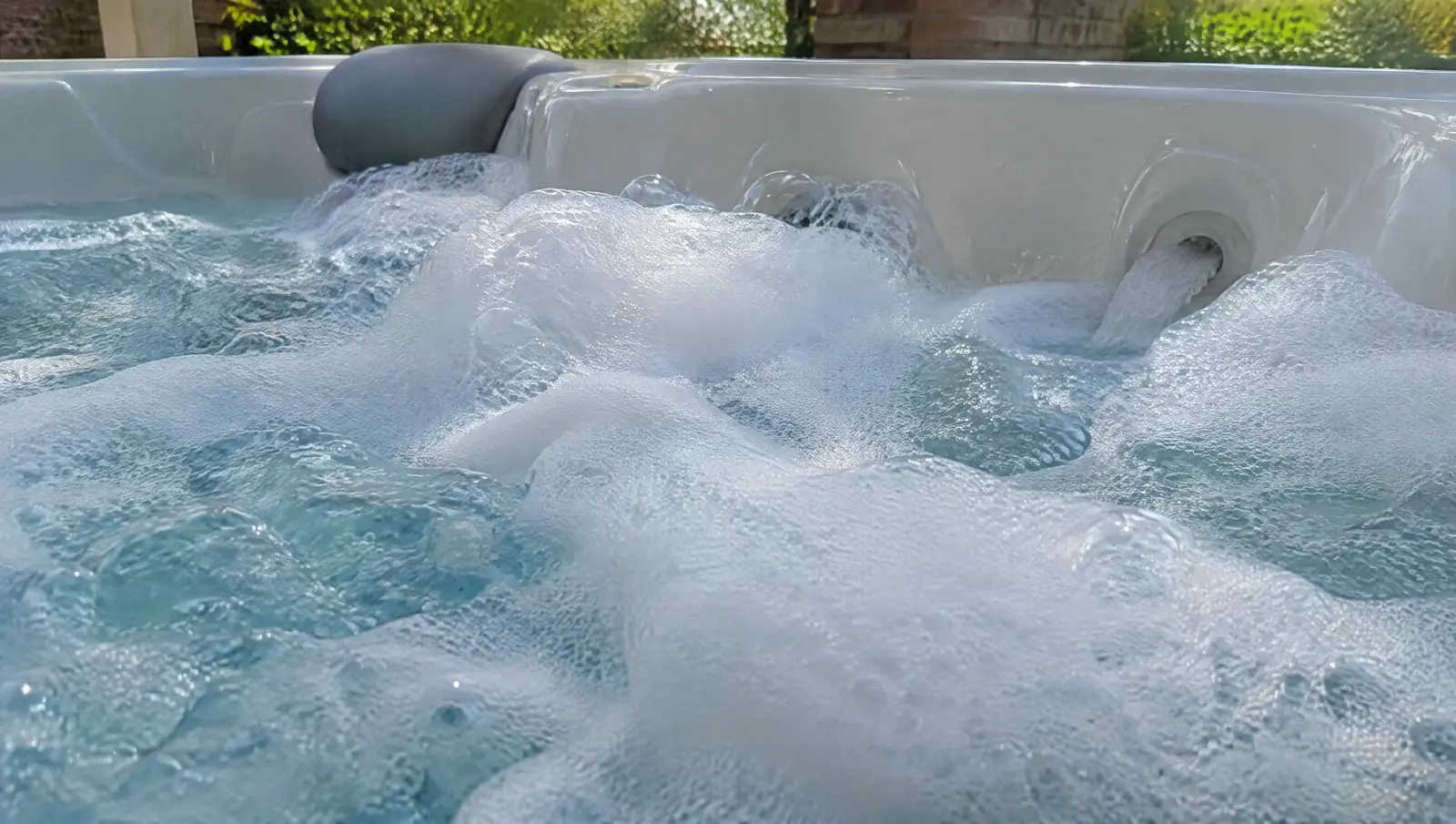
Hot tub foam is almost always caused by soaps, lotions, hair products and laundry detergent that rinse off bathers and their swimsuits, then get whipped into bubbles by the jets. A defoamer makes it disappear in minutes, but the foam comes back until you remove the residue with a shock, a clean filter and balanced water, or replace water that’s simply worn out.
This guide shows you how to tell which cause you’re dealing with, the quick fix versus the real fix, and the habits that keep foam from coming back. It’s especially useful after parties and holiday guests, when foam tends to show up.
Why is my hot tub foamy?
Foam forms when something lowers the surface tension of the water, so the air bubbles from the jets don’t pop. In a hot tub, those “somethings” are surfactants: the same ingredients that make soap, shampoo and detergent lather.
They come from:
- Bodies: body oils, sweat, lotion, sunscreen, deodorant, makeup, hair gel and perfume.
- Swimsuits: laundry detergent and fabric softener that stay in the fabric after a wash.
- Drinks and food: spilled soda, beer or cocktails add sugars and other organics.
- The tub itself: leftover filter cleaner that wasn’t fully rinsed out, and biofilm in the plumbing.
Hot water and jets make this worse than in a bathtub or pool. The water is small in volume, so a little residue goes a long way, and the jets agitate it constantly.
A few bubbles that vanish as soon as the jets stop are normal. Thick, white foam that lingers on the surface, or a gray scum line that builds up at the waterline, means residue is building up faster than your sanitizer and filter can remove it.
Hot tub foam causes and fixes at a glance
Use the table to match what you’re seeing to the most likely cause. The target numbers are the same ones we use in our hot tub maintenance guide.
| Cause | How to tell | Real fix | |---|---|---| | Soaps, lotions, hair and body products | Foam appears right after soaks, plus a greasy scum line | Shower before soaking, shock, wipe the waterline, rinse the filter | | Detergent in swimsuits | Foam shows up when guests use the tub or after suits are washed | Rinse suits in plain water; don’t machine-wash them with detergent before use | | Old water / high dissolved solids (TDS) | Foam keeps returning even with balanced readings; it’s been 3–4+ months since the last drain | Line flush, drain and refill | | Low calcium hardness | Calcium below 150 ppm, often with soft or softened fill water | Raise calcium to 150–250 ppm with a calcium increaser | | High alkalinity or pH | Alkalinity above 120 ppm, pH above 7.8, often with cloudy water | Lower alkalinity first, then pH, with a pH decreaser | | Low sanitizer | Free chlorine below 3 ppm or bromine below 4 ppm; may smell stale | Shock and bring sanitizer back into range | | Dirty filter or leftover filter cleaner | Gray, clogged pleats, or foam right after reinstalling a soaked filter | Rinse the cartridge; after a soak, rinse until no suds appear |
Soaps, lotions and personal products
This is the most common cause, and every manufacturer guide we checked puts it first. Jacuzzi, Bullfrog Spas and Arctic Spas all name body oils, lotions, cosmetics and hair products as the main source of foam. The fix is part habit (shower first) and part chemistry (shock to oxidize what’s already in the water).
Laundry detergent in swimsuits
Detergent is designed to foam, and swimsuits hold on to it. One soak with freshly washed suits can be enough. Rinse suits in plain water after each use and let them air dry. If you have a dedicated “hot tub suit,” keep it out of the washing machine.
Old water and high TDS
Total dissolved solids (TDS) is everything dissolved in the water: minerals, spent chemicals, sweat, oils. It only goes up between drains. Once the level is high, the water stops responding to shock and balancers, and foam keeps coming back.
Most test strips don’t read TDS. A digital TDS meter does, and spa chemical maker AquaDoc treats readings above 2,000 ppm as a sign it’s time to drain. Without a meter, use the hub’s rule of thumb: gallons ÷ 3 ÷ average daily bathers = days between drains. For most households that’s every 3–4 months.
Low calcium hardness
Soft water foams more easily than water with some calcium in it. If you fill from a water softener, or your tap water is naturally soft, calcium hardness can sit well below 150 ppm.
Raise calcium to 150–250 ppm with a calcium increaser. Per its listing, Leisure Time CB Calcium Booster raises hardness by about 7 ppm per ounce in 500 gallons. Compare options in our hot tub chemicals guide.
High alkalinity or pH
Jacuzzi lists pH above 7.8 and alkalinity above 120 ppm among the imbalances behind foamy and cloudy water. High pH also weakens chlorine, so oils and soaps linger longer. Lower alkalinity first with a sodium bisulfate pH decreaser, then fine-tune pH.
Low sanitizer
When chlorine or bromine runs low, organic residue isn’t broken down and builds up quickly. You’ll often see foam and cloudy water together. Shock, then keep free chlorine at 3–5 ppm or bromine at 4–6 ppm.
Dirty filter or leftover cleaner
A clogged cartridge stops trapping oils, so they stay in the water. And a filter that was soaked in cleaner but not fully rinsed puts that cleaner straight back into the tub, where it foams. Arctic Spas specifically warns that excess soaps and chemicals, including filter cleaner, can cause foaming.
Is hot tub foam dangerous?
The foam itself isn’t toxic. It’s a warning sign. It tells you the water is carrying more oils, soap and organic waste than your sanitizer and filter can handle, and that the chemistry may be off.
What matters for your health is the sanitizer level underneath the foam. The CDC recommends at least 3 ppm free chlorine in hot tubs, or 4 ppm bromine if you use bromine. Its Legionella guidance for hot tubs puts the ranges at 3–10 ppm chlorine or 4–8 ppm bromine, with pH at 7.2–7.8.
Before you get in
Test the water. If free chlorine is below 3 ppm or bromine below 4 ppm, skip the soak, shock the tub and wait until sanitizer is back in range. Jacuzzi’s advice for foamy water is the same: the soak is off until the water is corrected. After a chlorine shock, wait until free chlorine falls back to 5 ppm or less.
There’s also a cost to ignoring foam. Jacuzzi notes that an unbalanced tub left alone can corrode parts or discolor the shell over time.
Quick fix vs. real fix
There are two very different ways to “get rid of” hot tub foam, and it helps to know which one you’re doing.
| | Quick fix: defoamer | Real fix: remove the cause | |---|---|---| | What it does | Breaks the bubbles’ surface tension | Removes the residue and corrects the chemistry | | How fast | Minutes | A few hours to a day; longer if you drain | | How long it lasts | Until the next soak or jet cycle | Until new residue builds up | | Products | Spa defoamer (foam remover) | Test strips, shock, balancers, filter cleaner, line flush | | When to use it | Guests are coming in an hour | Always, after the quick fix |
Bullfrog Spas and Arctic Spas both describe a defoamer as a temporary fix, and Jacuzzi calls anti-foam products a short-term solution. That matches the logic of the product: a defoamer doesn’t remove soap or oil from the water, it only stops it from forming bubbles. If you use it before every soak, you’re treating a symptom and the residue keeps building.
The quick fix: a spa defoamer
Leisure Time Foam Down (defoamer, 32 fl oz)
- Dose (listing)
- About 1/2 oz at a time, on the foam
- Size
- 32 fl oz
Specs from the Amazon listing and manufacturer documentation
Foam remover for spas. The listing says to add about 1/2 oz at a time directly where the foam is, repeating as needed. It gives no waiting time, so check the label before you soak.
Pros
- Clears foam within minutes, so you can still use the tub tonight
- Small doses: a 32 oz bottle lasts a long time if you only use it occasionally
Cons
- Masks foam without removing the residue that causes it
- Read the label warnings and keep it away from eyes
Add small amounts straight onto the foam rather than dumping a large dose into the water, and stop as soon as the foam breaks up.
How to get rid of hot tub foam, step by step
This is the real fix. It takes about an hour and a half of on-and-off work, plus waiting time for the shock.
- Knock down the foam (optional). If you need the surface clear now, use a defoamer as above. Otherwise, skip it so you can see whether the next steps work.
- Test the water. Read sanitizer, pH, total alkalinity and calcium hardness. A 7-way strip covers all four.
- Balance alkalinity, then pH. Bring total alkalinity to 80–120 ppm first, then pH to 7.2–7.8. Run the jets for 20–30 minutes and retest between additions.
- Check calcium. If it’s below 150 ppm, add a calcium increaser to reach 150–250 ppm.
- Shock. Take the cover off, turn on the jets and add the label dose of shock for your tub’s gallons. Pour it in front of a jet, never onto the shell.
- Clean the filter. Rinse the cartridge between every pleat. If you soak it in a cartridge cleaner, rinse until no suds come out. Step-by-step instructions are in our how to clean a hot tub filter guide.
- Wipe the waterline. Remove the scum ring with a soft cloth so the residue doesn’t go back into the water.
- Watch for 24 hours. Jacuzzi says a shock should clear the water within about a day. If foam returns within a few days of normal use with balanced readings, the water is worn out.
When the real fix is a fresh fill
If foam keeps coming back, stop adding chemicals and change the water. A line flush goes in before you drain. It loosens biofilm inside the pipes, where foam-causing residue also hides, and the gunk leaves with the old water.
Ahh-Some Hot Tub Purge & Jet Line Cleaner (4 oz)
- Dose
- 1 tsp per 125 gal (4 tsp per 500 gal)
- When
- Before each drain
- Size
- 4 oz tube
Specs from the Amazon listing and manufacturer documentation
Gel plumbing cleaner used right before draining. The listing says 1 teaspoon treats 125 gallons and the tube gives 8 purges for tubs up to 400 gallons.
Pros
- Reaches biofilm inside the plumbing that you can’t scrub
- Easy to scale to your tub: 1 teaspoon per 125 gallons
Cons
- Foams heavily on purpose: the label warns soft-water users may need less to keep suds from overflowing
- Not a water treatment: use it only right before draining
Then drain, wipe the shell, clean or replace the filter and refill. After refilling, balance alkalinity, pH and calcium, then bring sanitizer into range. The full process is in how to drain a hot tub.
How to prevent hot tub foam
Prevention is mostly about keeping residue out and catching chemistry drift early.
- Shower before every soak. A quick rinse without soap removes most lotion, deodorant and hair product. Ask guests to do the same.
- Rinse swimsuits in plain water. Skip the washing machine, or rinse suits well in clean water before they go in the tub.
- Keep drinks and food out. Use plastic cups with lids and keep them on the edge.
- Test 2–3 times a week. Keep sanitizer, pH and alkalinity in range so residue is broken down as it arrives. Our hot tub test strips guide compares the options.
- Shock weekly and after parties. Jacuzzi recommends shocking after every big party and at least once a week.
- Rinse the filter every 1–2 weeks and deep-clean it every 1–3 months, rinsing out all the cleaner.
- Keep calcium at 150–250 ppm, especially if you fill with softened water.
- Drain on schedule, every 3–4 months for most tubs, or sooner if you use it heavily.
- Float a tennis ball. It soaks up some surface oils. Swap it every couple of weeks.
The party rule
Foam often shows up the day after you have friends over: more bodies, more lotion, more swimsuits washed in detergent, maybe a spilled drink. Shock the tub the same night, rinse the filter the next morning and you’ll usually head it off.
To keep testing simple, use a strip that reads sanitizer, pH, alkalinity and calcium hardness in one dip.
AquaChek 7-Way Pool and Spa Test Strips (100 count)
- Tests
- Free and total chlorine, bromine, pH, alkalinity, hardness, stabilizer
- Read time
- 15 seconds
- Count
- 100 strips
Specs from the Amazon listing and manufacturer documentation
Reads seven values on one strip, including free chlorine, bromine, pH, alkalinity and total hardness, so one dip tells you which foam cause to rule out.
Pros
- Covers every reading in the foam causes table except TDS
- Works whether you use chlorine or bromine
Cons
- Doesn’t measure total dissolved solids; you need a TDS meter for that
- Strips are less precise than a drop test kit for sanitizer
Common mistakes that keep foam coming back
- Using defoamer as a daily treatment. It hides the foam while residue keeps building. If you reach for it before every soak, it’s time to shock, clean the filter or drain.
- Cleaning the filter with dish soap or laundry detergent. Both leave residue that foams in the tub. Use a cleaner made for spa filters, and see our hot tub filter cleaner picks.
- Skipping the final rinse after a filter soak. Cleaner left in the pleats goes straight into the water.
- Adding baking soda “for foam.” It raises alkalinity. Unless your alkalinity test is below 80 ppm, it can make things worse.
- Bubble bath, bath bombs and essential oils. They’re made to foam or leave oils behind. Keep them out of the hot tub.
- Draining without a line flush. Biofilm in the plumbing reseeds the fresh water.
- Fixing pH before alkalinity. Alkalinity pulls pH with it, so you end up adjusting twice.
When to call a hot tub technician
Most foam is a water problem you can fix yourself. Call a technician or your dealer if:
- Foam comes back within days of a fresh fill, a clean or new filter and balanced readings.
- The jets constantly spit air or the pump sounds like it’s sucking air even with the water at the right level. That points to a mechanical issue, not chemistry.
- The water has an unusual color or smell that doesn’t go away after a shock.
- You see leaks, error codes or a heater that won’t hold temperature alongside the foam.
- The tub is under warranty and you’re unsure whether a fix could affect it. Check the owner’s manual first.
Foam and cloudy water often show up together, since they share causes. If the water is hazy too, see our guide to cloudy hot tub water.
How we put this guide together
We don’t own a hot tub and haven’t tested these products ourselves. This guide is built from sources you can check: the CDC’s hot tub guidance for sanitizer and pH levels, foam and water-care guides from hot tub manufacturers (Jacuzzi, Bullfrog Spas and Arctic Spas), and the Amazon listing directions for each product we mention. Target ranges match our hot tub maintenance hub. Where sources disagree, we use the more cautious number. Every source is listed at the end of the page.
Sources
- CDC: Home Pool and Hot Tub Water Treatment and Testing · cdc.gov
- CDC: Controlling Legionella in Hot Tubs (Legionella Control Toolkit) · cdc.gov
- Jacuzzi: Hot Tub Safety: Can You Soak in Foamy Water? · jacuzzi.com
- Jacuzzi: Troubleshooting Cloudy Hot Tub Water · jacuzzi.com
- Bullfrog Spas: How to Get Rid of Foam in a Hot Tub · bullfrogspas.com
- Arctic Spas: Foamy Hot Tub? Here's How to Fix It · arcticspas.ca
- AquaDoc: How Do I Lower TDS (Total Dissolved Solids) in My Hot Tub? · mavaquadoc.com
Frequently asked questions
What causes a lot of foam in a hot tub?
Surfactants: soap, shampoo, lotion, deodorant, makeup and laundry detergent that rinse off bodies and swimsuits. The jets agitate them into foam. Old water with a lot of dissolved solids, low calcium hardness (soft water), high alkalinity or pH, low sanitizer and a dirty filter, or leftover filter cleaner, all make it worse.
Is hot tub foam dangerous?
The foam itself isn't toxic, but it tells you the water is carrying more oils and residues than the sanitizer and filter can handle. If your test shows free chlorine below 3 ppm or bromine below 4 ppm (the CDC minimums for hot tubs), don't get in until you've shocked and brought sanitizer back into range. Foam can also hide how clear the water really is.
What chemical gets rid of foam in a hot tub?
A spa defoamer (foam remover) such as Leisure Time Foam Down. Defoamers break the surface tension of the bubbles, often with a silicone ingredient. Foam Down's listing says to add about 1/2 oz at a time directly where the foam is; check the label for any wait before soaking. It works within minutes but doesn't remove the residue causing the foam, so follow up with a shock and a filter cleaning.
How do you get rid of hot tub foam naturally?
Remove what's feeding it. Shower before soaking, rinse swimsuits in plain water instead of washing them with detergent, keep drinks out of the tub, rinse the filter and wipe the waterline. A clean tennis ball floating in the water soaks up some oils. If the water is old, a drain and refill is the most complete natural fix. Skip homemade defoamers: dish soap, vinegar mixes and other household products can add more residue or throw off the chemistry.
Is baking soda a defoamer?
No. Baking soda is sodium bicarbonate, which raises total alkalinity. It only helps foam indirectly, when alkalinity is below 80 ppm. If alkalinity is already in range or high, adding baking soda pushes it higher and can make cloudy water and foam worse. Test first and use a defoamer if you need the foam gone right away.
Why do you put a tennis ball in a hot tub?
The fuzzy surface of a clean tennis ball absorbs some of the body oils, lotions and hair products floating on the water, the same residues that cause foam and scum lines. Toss one in, swap it every couple of weeks, and remember it's a helper, not a substitute for sanitizer, shock and a clean filter.