On this page
Key takeaways
- Cloudy hot tub water almost always comes down to one of four things: low sanitizer, high pH or alkalinity, a dirty filter, or old water full of dissolved solids.
- Fix it in order: test, balance total alkalinity to 80–120 ppm, then pH to 7.2–7.8, shock, clean the filter, run the filtration, and only then add a clarifier.
- Don't soak if free chlorine is below 3 ppm or bromine below 4 ppm (the CDC minimums), or if you can't see the seats and floor.
- Cloudiness right after a shock is common and usually clears within a day of continuous filtration. If it lasts past 48 hours, check calcium (150–250 ppm) and the filter.
- If the water stays cloudy after a full treatment, or it's been more than 3–4 months since your last drain, drain and refill. Chemicals can't remove dissolved solids.
Step-by-step checklist
-
Test the water
Read free chlorine or bromine, pH, total alkalinity and calcium hardness with a test strip or drop kit before adding anything.
-
Balance total alkalinity
Bring total alkalinity to 80–120 ppm with an alkalinity increaser or a pH decreaser. Run the jets for 20–30 minutes and retest.
-
Balance pH
Adjust pH to 7.2–7.8 in small doses, circulating 20–30 minutes between additions.
-
Shock the hot tub
With the cover off and jets running, add the label shock dose for your tub's gallons in front of a jet.
-
Clean the filter
Rinse the cartridge between every pleat. If it's greasy or hasn't been deep-cleaned in 1–3 months, soak it in a cartridge cleaner and rinse thoroughly.
-
Run the filtration
Run the pump for several hours or overnight with the cover open a crack at first so gases can escape.
-
Add a clarifier if haze remains
Once sanitizer and pH are in range, add a spa clarifier per its label so the filter can catch particles too small to trap on their own. Clean the filter again the next day.
-
Drain and refill if it won't clear
If the water is still cloudy after a full treatment, or it's been 3–4 months since the last drain, flush the lines, drain, clean the shell and refill.
Retest after the wait time in the guide below before adding anything else.
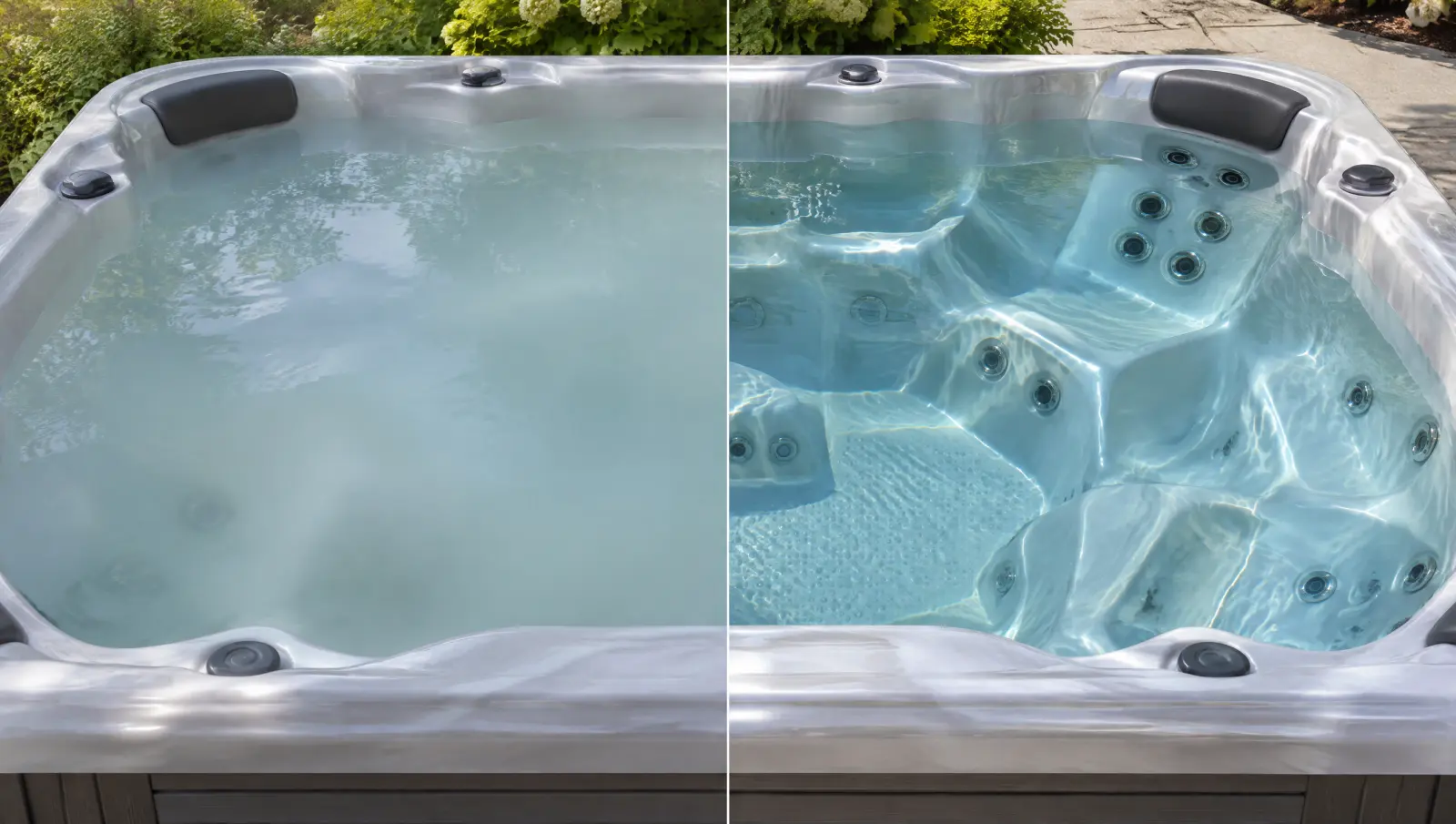
Cloudy hot tub water is almost always caused by low sanitizer, pH or alkalinity that’s too high, a dirty filter, or old water loaded with dissolved solids. The fix is to test, balance alkalinity and then pH, shock, clean the filter and let the pump run, and to drain and refill if the haze won’t budge.
Below you’ll find how to read the type of cloudiness you have (after a shock, after a refill, after a party, milky or green), the step-by-step fix, when it isn’t safe to get in and how to keep the water clear.
Why is my hot tub cloudy?
Cloudiness is millions of tiny particles suspended in the water, too small for the filter to catch and too many for the sanitizer to break down. Those particles can be organic (skin cells, body oils, lotion, bacteria), mineral (calcium or metals coming out of solution) or simply debris that a clogged filter can no longer hold.
Hot tub manufacturers agree on the usual suspects. Jacuzzi lists high pH, low sanitizer, organic contaminants, dirty filters and excess chemicals. Hot Spring’s troubleshooting guide adds suspended particles and “overused or old water.”
| Cause | How to tell | Fix | |---|---|---| | Low sanitizer | Free chlorine below 3 ppm or bromine below 4 ppm | Shock, then keep sanitizer at 3–5 ppm chlorine or 4–6 ppm bromine | | High pH or alkalinity | pH above 7.8, alkalinity above 120 ppm; scale may form | Lower alkalinity first, then pH, with a pH decreaser | | Dirty or worn filter | Gray, greasy pleats; weak jets; not cleaned in weeks | Rinse, soak in a cartridge cleaner or replace | | Body oils, lotions, sweat | Haze after soaks, often with foam or a scum line | Shower before soaking, shock, clean the filter | | High calcium hardness | Calcium above 250 ppm, white flakes or scale | Lower pH and alkalinity; partial drain and refill with softer water | | Old water / high TDS | Won’t clear after a full treatment; 3–4+ months since the last drain | Line flush, drain and refill | | Too much chemical | Cloudy right after a big dose of shock or clarifier | Run the filtration, clean the filter, dose by the label next time |
These overlap. Low sanitizer lets oils build up, high pH makes chlorine weaker, and a clogged filter makes everything worse. That’s why the fix below works through all of them in order.
Diagnose cloudy hot tub water by symptom
When the water turned cloudy tells you a lot about why. Match your situation in the table, then read the details below.
| When it went cloudy | Most likely cause | First thing to do | |---|---|---| | Right after a shock | Oxidized contaminants, high pH or calcium, or too much shock | Run the filtration for 24 hours, then test pH and calcium | | Right after a refill | Minerals or metals in the fill water; alkalinity, pH or calcium off | Test and balance before adding sanitizer | | After a party or heavy use | Oils, lotions and sweat used up the sanitizer | Shock and rinse the filter | | Gradually, over weeks | Old water, high TDS, filter overdue | Clean the filter; plan a drain | | Milky white | Calcium or pH too high, or very fine particles | Test pH, alkalinity and calcium | | Green or green-blue tint | Algae from sanitizer at zero, or metals such as copper | Test sanitizer immediately; shock if it’s low |
Cloudy hot tub after shock
This is the most common “it got worse” moment, and it’s usually temporary. AquaDoc explains that shock breaks organic contaminants into fine particles, and those particles need time to be filtered out. Too much shock at once, a dirty filter, high pH or high calcium can make it worse.
What to do:
- Leave the cover open for the first 20 minutes so gases escape, then run the filtration. AquaDoc suggests running it continuously for 24–48 hours if the water stays hazy.
- Rinse the filter. A clogged cartridge can’t catch the particles the shock just created.
- Test pH and calcium. If pH is above 7.8 or calcium above 250 ppm, adding shock can push calcium out of solution, which gives a milky haze.
- If the haze is still there after a day with balanced readings, add a clarifier.
Cloudy hot tub water after refill
Fresh water isn’t always clean water. Tap or well water can carry minerals and metals, and its alkalinity, pH and calcium are whatever your utility delivers. Heat makes calcium less soluble, so water that looked clear in the hose can turn hazy once the heater runs.
What to do:
- Fill through a hose pre-filter if your water is hard or comes from a well. Jacuzzi recommends filtering refill water this way.
- If your water has iron or copper, add a metal sequestrant first, before anything else.
- Balance alkalinity, then pH, then calcium, running the jets between each.
- Bring sanitizer into range and shock.
- Make sure the filter going back in is clean. A dirty cartridge will cloud fresh water within hours.
If you used a line flush before draining, some loosened gunk can remain in the plumbing. Run the jets and rinse the filter after the first day.
Cloudy after heavy use
A party with six people does to the water in one night what two people do in a week or more. All that sweat, lotion and deodorant uses up the sanitizer and loads the filter. Shock the same night with the jets running and rinse the filter the next morning. Foam often shows up at the same time; see our hot tub foam guide.
Milky white vs. green tint
Milky white water usually means minerals or very fine particles. Check pH (above 7.8?), alkalinity (above 120 ppm?) and calcium (above 250 ppm?). Lower alkalinity and pH first. If calcium is very high, a partial drain and refill with softer water is the only real fix.
Green water means stop and test. Green cloudiness is most often algae, which only grows when sanitizer has dropped to zero. Hot Spring lists high pH and low sanitizer as the causes of algae growth. Shock heavily, scrub the waterline and seats, and clean or replace the filter. A clear green or blue-green tint without haze can also come from metals, such as copper from well water, which sanitizer oxidizes and makes visible. A metal sequestrant such as Leisure Time Metal Gon keeps them dissolved; it’s covered in our hot tub chemicals guide.
Is it safe to soak in a cloudy hot tub?
Cloudy water isn’t automatically dangerous, but you can’t tell by looking. Cloudiness often comes with low sanitizer, and hot water and jets make a hot tub a good place for germs to grow and spread. The CDC’s hot tub guidance and our hot tub maintenance hub use the same minimums.
Don't get in if
- Free chlorine is below 3 ppm or bromine is below 4 ppm. These are the CDC minimums for hot tubs. Its Legionella guidance puts the ranges at 3–10 ppm chlorine or 4–8 ppm bromine, with pH at 7.2–7.8.
- The water has a green tint, which suggests algae and a sanitizer that ran out.
- You can’t see the seats or the floor. You also couldn’t see someone who slipped under the water.
- You just shocked with chlorine and free chlorine is above 5 ppm. Hot Spring notes that levels above 5 ppm can irritate skin, so wait for it to drop.
If sanitizer and pH test in range and the water is only slightly hazy, the risk is low, but fix the haze before your next soak. It usually means sanitizer is losing ground. The CDC recommends testing chlorine and pH twice a day, and more often when many people use the tub.
How to fix cloudy hot tub water, step by step
This sequence works for almost every type of cloudiness. Total hands-on time is about two hours, spread over a day.
1. Test the water
Read sanitizer, pH, total alkalinity and calcium hardness before adding anything. A multi-pad strip such as the AquaChek 7-Way gives you all four in one dip in about 15 seconds; a drop kit is more accurate for chlorine. Compare options in our best hot tub test strips guide.
2. Balance total alkalinity
Bring alkalinity to 80–120 ppm. Lower it with a sodium bisulfate pH decreaser; raise it with an alkalinity increaser (sodium bicarbonate). Run the jets for 20–30 minutes and retest.
3. Balance pH
Then adjust pH to 7.2–7.8 in small doses. High pH is one of the most common causes of cloudy water, and it also makes chlorine less effective, so don’t skip this step.
4. Shock
Take the cover off, turn on the jets and add the label dose of shock for your tub’s gallons, poured in front of a jet. For cloudy water with low sanitizer, use a chlorine shock: it oxidizes oils and disinfects at the same time. A non-chlorine shock (MPS) oxidizes but doesn’t disinfect.
SpaChoice Chlorine Granules (sodium dichlor, 5 lb)
- Active ingredient
- Sodium dichlor
- Dose
- 1 tsp ≈ 1.4 ppm per 500 gal
- Use
- Daily sanitizer and shock
- Size
- 5 lb
Specs from the Amazon listing and manufacturer documentation
Spa dichlor granules that work as both sanitizer and chlorine shock. The listing says each level teaspoon adds about 1.4 ppm of chlorine in 500 gallons, and gives an initial dose of 6 teaspoons per 500 gallons.
Pros
- Disinfects and oxidizes, which is what low-sanitizer cloudiness needs
- Easy to scale to your tub with the per-teaspoon figure
Cons
- Adds cyanuric acid with each dose, so drain on schedule
- Its listing quotes a label line that prohibits re-entry above 3 ppm, the same as the CDC minimum, which leaves little room: dose in small steps, retest and follow your label
5. Clean the filter
Jacuzzi calls dirty, clogged filters a common cause of cloudy water. Pull the cartridge and rinse between every pleat from top to bottom. If it’s greasy or hasn’t had a chemical soak in 1–3 months, soak it overnight in a cartridge cleaner and rinse until no suds come out. A spare cartridge lets the tub keep filtering while the dirty one soaks. Full instructions: how to clean a hot tub filter.
Leisure Time Filter Clean (cartridge cleaner, 32 fl oz)
- Method
- Overnight soak
- Size
- 32 fl oz
Specs from the Amazon listing and manufacturer documentation
Soak-type cartridge cleaner for the oils and scale a hose can't move. The listing calls for an overnight soak; it gives no dilution, so mix at the rate on the bottle.
Pros
- Removes the oily film that keeps a rinsed filter from working
- Pairs well with a drain and refill
Cons
- Needs an overnight soak, so a spare cartridge helps
- Rinse thoroughly: leftover cleaner can foam in the tub
6. Run the filtration
Let the pump run for several hours or overnight. Most cloudiness from organics clears in this window once sanitizer, pH and the filter are right.
7. Add a clarifier if a haze remains
A clarifier is the last step, not the first. It binds particles too small for the filter into clumps large enough to catch. It won’t fix cloudiness caused by low sanitizer or high pH. Jacuzzi describes clarifiers as a temporary fix that doesn’t address root causes, and warns against overusing them.
Leisure Time Bright & Clear (spa clarifier)
- Dose (listing)
- 2–4 oz once a week
- Use
- After sanitizer and pH are in range
Specs from the Amazon listing and manufacturer documentation
Clarifier for hot water that combines fine particles so the filter can trap them. The listing says 2–4 oz once a week and gives no gallon range, so start at the low end in a small tub.
Pros
- Clears the last bit of haze once the chemistry is right
- Simple weekly dose
Cons
- Does nothing for low sanitizer or high pH
- Overdosing can make water cloudier; follow the label
Rinse the filter again the day after using a clarifier, since that’s where the clumped particles end up.
8. Drain and refill if it won’t clear
If the water is still cloudy after all of the above, the problem is the water itself. Over months, dissolved solids build up until chemicals can’t keep it clear, and Jacuzzi says persistent cloudiness with high TDS is a sign it’s time to drain. AquaDoc treats a TDS reading above 2,000 ppm as the point to drain and refill.
Use a line flush before draining, then drain, clean the shell, clean or replace the filter and refill. The full process is in how to drain a hot tub.
How long does cloudy hot tub water take to clear?
| Cause | Typical time to clear | |---|---| | Low sanitizer, after a shock | A few hours to a day | | Right after a shock | Up to 24–48 hours of filtration | | Dirty filter | A few hours after cleaning | | Very fine particles, with clarifier | About a day, then rinse the filter | | High calcium or old water | Won’t clear without a partial or full drain |
These are general expectations from manufacturer and spa-chemical guides, not guarantees. If nothing improves after 48 hours of filtration with balanced readings, move to the drain.
How to keep hot tub water clear
- Test 2–3 times a week and before every soak. The CDC recommends twice a day for chlorine and pH.
- Keep the numbers in range: 3–5 ppm chlorine or 4–6 ppm bromine, pH 7.2–7.8, alkalinity 80–120 ppm, calcium 150–250 ppm.
- Shock weekly and after every heavy-use session.
- Rinse the filter every 1–2 weeks, soak it every 1–3 months and replace it every 1–2 years.
- Shower before soaking and keep lotions, makeup and drinks out of the water.
- Drain every 3–4 months. The rule of thumb: gallons ÷ 3 ÷ average daily bathers = days between drains.
- Keep the cover on to keep out leaves, pollen and rain.
One change at a time
When the water is cloudy, it’s tempting to add shock, clarifier and pH decreaser all at once. Don’t. Add one product, run the jets for 20–30 minutes and retest. You’ll use fewer chemicals and you’ll know what actually worked.
Common mistakes
- Reaching for clarifier first. It can’t fix low sanitizer or high pH, and overdosing it adds to the problem.
- Adjusting pH before alkalinity. Alkalinity pulls pH with it, so you end up doing it twice.
- Shocking with a dirty filter. The shock creates fine particles that a clogged cartridge can’t catch.
- Using pool shock or pool chemicals not labeled for spas. They’re dosed for much larger volumes of water.
- Mixing chemicals. Never combine chlorine and a pH decreaser (an acid) in a scoop or bucket; add each one to the water separately.
- Ignoring calcium. Water that looks milky and won’t clear despite shock often has calcium or pH that’s too high.
- Putting off the drain. After 3–4 months, no amount of chemicals will fully restore old water.
When to call a hot tub technician
Most cloudy water is a chemistry or filter problem you can solve yourself. Call a technician or your dealer if:
- The water clouds again within days of a fresh fill with a clean filter and balanced readings.
- The jets are weak or the pump runs but water barely moves, even after cleaning the filter.
- The heater won’t hold temperature or the control panel shows error codes.
- The water is green or brown after a fresh fill, which can point to metals in your water supply.
- AquaDoc also advises calling a pro if cloudiness persists after several treatments.
How we put this guide together
We don’t own a hot tub and haven’t tested these products ourselves. This guide is built from sources you can check: the CDC’s hot tub guidance for sanitizer and pH levels, troubleshooting guides from Jacuzzi and Hot Spring, water-care articles from spa chemical maker AquaDoc, and the Amazon listing directions for each product we mention. Target ranges match our hot tub maintenance hub. Where sources disagree, we use the more cautious number. Every source is listed at the end of the page.
Sources
- CDC: Home Pool and Hot Tub Water Treatment and Testing · cdc.gov
- CDC: Controlling Legionella in Hot Tubs (Legionella Control Toolkit) · cdc.gov
- Jacuzzi: Troubleshooting Cloudy Hot Tub Water: Causes and Solutions · jacuzzi.com
- Jacuzzi: Hot Tub Safety: Can You Soak in Foamy Water? · jacuzzi.com
- Hot Spring Spas: Water Care and Troubleshooting · hotspring.com
- AquaDoc: Why Is My Hot Tub Water Cloudy After I Shocked It? · mavaquadoc.com
- AquaDoc: How Do I Lower TDS (Total Dissolved Solids) in My Hot Tub? · mavaquadoc.com
Frequently asked questions
How do you cure cloudy hot tub water?
Test the water, then balance total alkalinity to 80–120 ppm and pH to 7.2–7.8. Shock with the cover off and the jets running, rinse or soak the filter, and run the filtration for several hours or overnight. If a slight haze remains once the chemistry is right, add a spa clarifier. If none of that works, drain and refill.
Is it safe to go in a hot tub with cloudy water?
Not until you've tested it. If free chlorine is below 3 ppm or bromine below 4 ppm, the CDC minimums for hot tubs, stay out until you've shocked and sanitizer is back in range. Also stay out if the water is so cloudy you can't see the seats or the floor, or if it has a green tint, which points to algae from sanitizer running out.
How long does it take cloudy hot tub water to clear up?
With balanced chemistry, a shock and a clean filter, most cloudy water clears within a few hours to a day. Jacuzzi says a shock should clear the water within about 24 hours, and AquaDoc suggests running the filtration continuously for 24–48 hours after shocking if it stays hazy. Cloudiness from calcium or old water won't clear on its own: it needs a calcium fix or a drain.
Why is my spa water cloudy?
The most common causes are low sanitizer, pH above 7.8 or alkalinity above 120 ppm, a clogged filter, a buildup of body oils and lotions, and old water with a high level of total dissolved solids. High calcium, metals in the fill water and too much shock can also cloud the water. A test strip narrows it down in a minute.
How do I get crystal clear water in my hot tub?
Keep sanitizer in range (3–5 ppm chlorine or 4–6 ppm bromine), pH at 7.2–7.8 and alkalinity at 80–120 ppm, shock weekly, rinse the filter every 1–2 weeks and soak it every 1–3 months, shower before soaking, and drain every 3–4 months. Clear water is the result of that routine, not of a clarifier.
How do I balance my hot tub water?
Adjust in this order: total alkalinity first (80–120 ppm), then pH (7.2–7.8), then calcium hardness (150–250 ppm), then sanitizer. Add one product at a time, run the jets for 20–30 minutes and retest before adding the next. Alkalinity pulls pH with it, so fixing pH first usually means doing it twice.