On this page
Key takeaways
- Pool stabilizer is cyanuric acid (CYA): it shields chlorine from the sun's UV so it lasts longer outdoors. Aim for 30–50 ppm; public pools must stay at or below 90 ppm under the 2024 MAHC.
- CYA also holds back part of your chlorine, so more CYA needs more free chlorine. We aim for free chlorine of about 7.5% of your CYA reading (3 ppm at CYA 40; 3–5 ppm for most pools at 30–50), never below the CDC's 2 ppm with stabilizer.
- Label doses per 10,000 gallons: Pool Mate granules raise CYA about 10 ppm per 6 oz in 5,000 gallons (about 12 oz per 10,000); one gallon of Lo-Chlor liquid raises it 32 ppm.
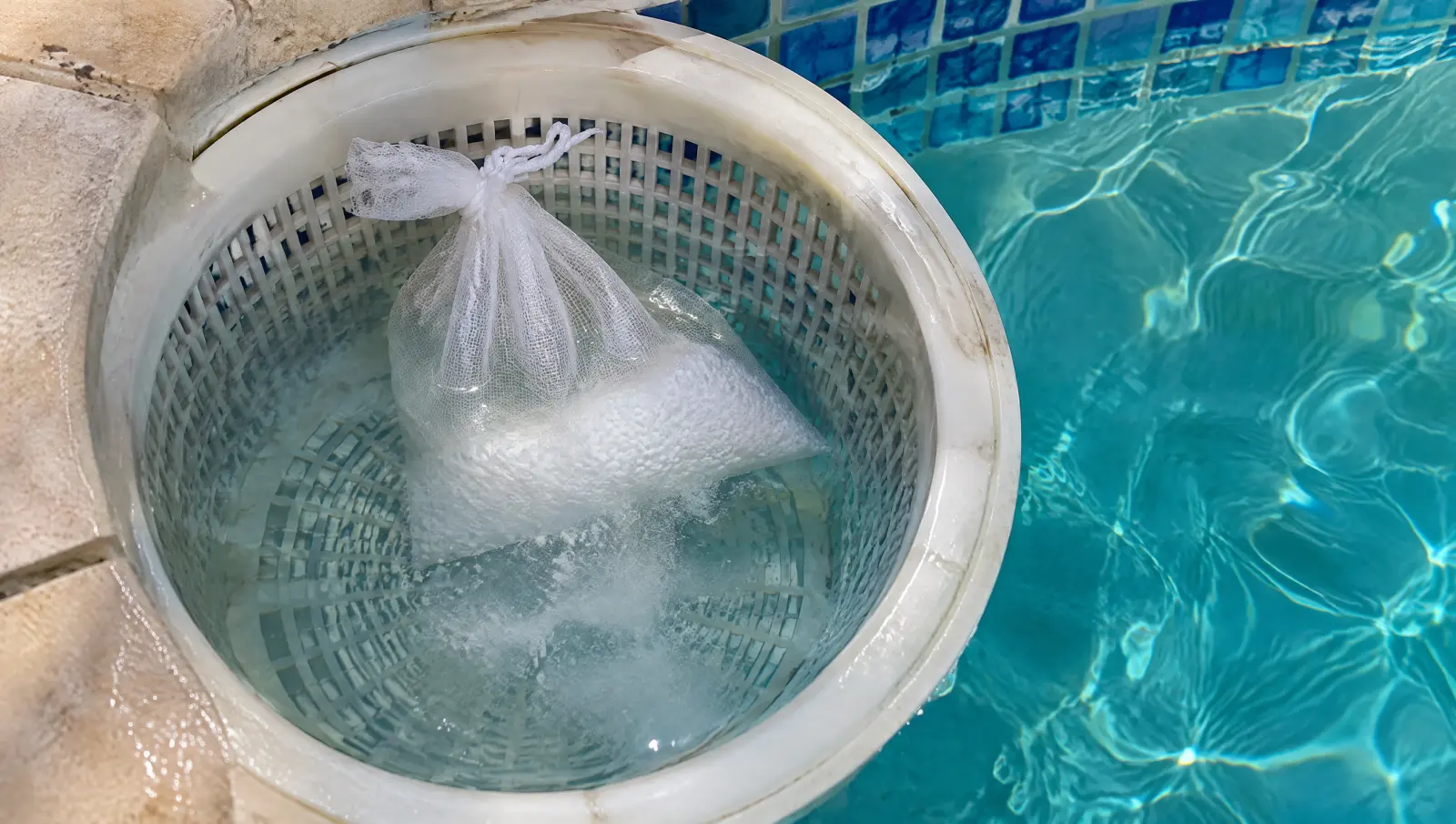
- Granules dissolve slowly: put them in the skimmer or a sock, circulate 24 hours and retest. Don't add more until you've retested.
- The only reliable way to lower CYA is replacing water: drain 1 − (target ÷ current) of the pool. Going from 100 to 50 ppm means replacing about half.
Pool stabilizer is cyanuric acid (CYA), a chemical that protects chlorine from sunlight so it lasts through the day in an outdoor pool. Keep it at 30–50 ppm: too little and the sun eats your chlorine, too much and the chlorine you have works more slowly.
This guide covers what CYA does, how it changes the chlorine level you need, granular vs liquid stabilizer, how to add it, how to test it and the only reliable way to lower it, plus five products. For the rest of your water balance, see our pool chemicals guide.
Best pool stabilizers at a glance
Scroll sideways to see every column →
| Product | Best for | Type | Label rate | Notes | Price | Buy |
|---|---|---|---|---|---|---|
| Best granularPool Mate Premium Stabilizer & Conditioner (7 lb) | Raising CYA at opening | Granular CYA | 6 oz per 5,000 gal = about +10 ppm | Recirculate 24 hours | Check price | |
| Poolife Stabilizer & Conditioner (4 lb) | Small top-ups | Granular CYA | Not stated; follow the label | Label target 20–50 ppm | Check price | |
| Best liquidLo-Chlor EZ-Pour Liquid Stabilizer (128 oz) | No waiting for granules | Liquid CYA | 1 gal = +32 ppm per 10,000 gal | Pour in front of a return jet | Check price | |
| Bio-Active Cyanuric Acid Reducer (8 oz) | Trying to lower very high CYA | Microbial reducer | Up to 50 ppm per treatment; 8 oz treats up to 25,000 gal (listing) | Needs chlorine at 5 ppm or less and warm water | Check price | |
| Test with thisTaylor K-2006 Complete Test Kit | Measuring CYA properly | Drop kit | CYA turbidity test, 30–100 ppm | Also tests chlorine, pH, alkalinity, hardness | Check price |
Specs from Amazon listings and manufacturer documentation. Prices change often, so we link to the live listing.
What pool stabilizer (cyanuric acid) does
Chlorine in sunlit water doesn’t last. Taylor Technologies describes CYA as a way to “stabilize” chlorine by slowing its breakdown under the sun’s ultraviolet rays. Without it, an outdoor pool can lose most of a day’s chlorine before the afternoon.
CYA does this by loosely binding part of the free chlorine. The bound part is protected from UV but isn’t actively killing germs, and the CDC notes that disinfection takes longer when cyanuric acid is present. That’s why the CDC’s minimum free chlorine is 1 ppm without stabilizer and 2 ppm with it.
You’ll see it sold as “stabilizer,” “conditioner” or “cyanuric acid.” It’s all the same chemical. It also arrives built into stabilized chlorine: trichlor tablets and dichlor granules both contain it.
The ideal stabilizer level
Taylor gives an ideal range of 30–50 ppm, within a wider industry minimum–maximum of 10–100 ppm. The 2024 Model Aquatic Health Code, which public pools follow, caps CYA at 90 ppm and requires a pool to close if CYA reaches 300 ppm.
| CYA reading | What it means | What to do | |---|---|---| | 0–20 ppm | Chlorine burns off in sunlight | Add stabilizer to reach 30–50 ppm | | 30–50 ppm | Target for outdoor chlorine pools | Keep free chlorine matched (table below) | | 60–90 ppm | Workable, but needs much more chlorine | Stop adding stabilized chlorine; plan dilution | | Over 90 ppm | Above the public-pool limit | Partial drain and refill |
Saltwater pools also need CYA outdoors, and some salt cell makers recommend their own range. Check your cell’s manual.
How CYA changes the chlorine you need
The more CYA in the water, the higher the free chlorine reading has to be to do the same job. Trouble Free Pool’s chart is the most widely used guide to that ratio:
| CYA (ppm) | Minimum free chlorine (ppm) | Target range (ppm) | |---|---|---| | 30 | 2 | 4–6 | | 40 | 3 | 5–7 | | 50 | 4 | 6–8 | | 60 | 5 | 7–9 | | 70 | 5 | 8–10 | | 80 | 6 | 9–11 |
Two practical takeaways. First, never let free chlorine drop below the CDC’s 2 ppm floor in a stabilized pool. Our everyday target follows the chart’s minimum line: about 7.5% of your CYA reading, so 3 ppm at CYA 40 and 3–5 ppm for most pools at 30–50 ppm CYA. The chart’s higher target ranges are an alternative some owners follow. Second, if your CYA has crept up, fixed label ranges such as Pool Mate’s 2.0–4.0 ppm or Clorox XtraBlue’s 1–4 ppm won’t keep algae away; that’s why we tie the number to CYA. Taylor calls this over-stabilization: too much CYA locks up chlorine and cuts its sanitizing power.
The opposite problem (too much chlorine after a heavy shock) has its own fix: see how to lower chlorine in a pool.
Where your CYA really comes from
If you use chlorine tablets, you may never need to buy stabilizer. PHTA’s water quality committee says trichlor adds 0.6 ppm of CYA for every 1 ppm of chlorine, and Taylor notes that daily dichlor or trichlor use can easily push CYA to 80 ppm. Dichlor shock adds stabilizer too.
So test before you buy. The full trade-off, with the per-tablet math, is in our guide to chlorine tablets for pools. If CYA is already in range, switch to unstabilized chlorine (liquid chlorine or cal-hypo) to keep it there.
Granular vs liquid stabilizer
| | Granular | Liquid | |---|---|---| | What it is | Dry cyanuric acid granules | CYA suspended in liquid | | Strength per pound | High: about 12 oz raises 10,000 gal by 10 ppm (Pool Mate rate) | Lower: 1 gallon raises 10,000 gal by 32 ppm (Lo-Chlor rate) | | Dissolving | Slow: a day or more in the skimmer or a sock | Disperses right away | | When it reads on a test | After it dissolves, so retest after 24 hours or more | Sooner | | Cost per ppm | Usually lower | Usually higher | | Best for | Big raises at opening, budget | Small top-ups, impatient owners, pools without a skimmer |
Granular is the default choice. Liquid makes sense when you want to add stabilizer and see the result the same day, or when you don’t want undissolved granules sitting in the skimmer or filter.
The best pool stabilizers
Best granular: Pool Mate Premium Stabilizer & Conditioner
Pool Mate Premium Pool Stabilizer & Conditioner (7 lb)
- Type
- Granular cyanuric acid
- Label rate
- 6 oz per 5,000 gal = about +10 ppm (about 12 oz per 10,000 gal)
- After adding
- Recirculate 24 hours (listing)
- Label target
- 40–100 ppm
- Size
- 7 lb
Specs from the Amazon listing and manufacturer documentation
Granular cyanuric acid with the clearest dosing we found: the listing says 6 oz raises CYA by about 10 ppm in 5,000 gallons, then recirculate for 24 hours and retest.
Pros
- Per-ppm dose makes it easy to hit a target without overshooting
- 7 lb covers several 10 ppm raises in a typical pool
Cons
- Slow to dissolve, like all granular CYA
- Label range of 40–100 ppm is wider than the 30–50 ppm we recommend
Best for small top-ups: Poolife Stabilizer & Conditioner
Poolife Stabilizer & Conditioner (4 lb)
- Type
- Granular cyanuric acid
- Size
- 4 lb
- Label target
- 20–50 ppm (listing)
Specs from the Amazon listing and manufacturer documentation
Granular cyanuric acid in a smaller 4 lb tub that suits a pool needing only a few ppm. The listing gives a 20–50 ppm target but no per-gallon dose, so read the label before you add it.
Pros
- Listing target range is close to the 30–50 ppm we recommend
- Small tub for small adjustments
Cons
- No dose rate on the listing: you need the container label
Best liquid: Lo-Chlor EZ-Pour Chlorine Stabilizer
Lo-Chlor EZ-Pour Liquid Chlorine Stabilizer (128 oz)
- Type
- Liquid cyanuric acid
- Label rate
- 1 gal = +32 ppm per 10,000 gal
- How to add
- In front of a return jet
- Size
- 128 oz (1 gal)
Specs from the Amazon listing and manufacturer documentation
Liquid cyanuric acid that skips the wait for granules. The listing says one gallon raises CYA by 32 ppm in 10,000 gallons, poured in front of a return jet, with a 40–100 ppm target.
Pros
- No socks, no granules in the filter
- Easy to measure partial doses
Cons
- Costs more per ppm than granules
- One gallon in a small pool is a big jump: measure partial doses
For very high CYA: Bio-Active Cyanuric Acid Reducer
Bio-Active Cyanuric Acid Reducer (8 oz)
- Type
- Microbial CYA reducer
- Treats
- Up to 25,000 gal per 8 oz; up to 50 ppm per treatment (listing)
- Works at
- CYA 30–330 ppm (listing)
- Conditions
- Chlorine at or below 5 ppm; water 65–105 °F (data sheet)
- Works for
- Up to 10 days (data sheet)
Specs from the Amazon listing and manufacturer documentation
A microbial product (active cultures in dextrose) meant to break down cyanuric acid instead of draining. The Amazon listing says one treatment lowers CYA by up to 50 ppm, a bottle treats up to 25,000 gallons, and it works at CYA 30–330 ppm. Its older technical data sheet adds that it works for up to 10 days, only with chlorine at 5 ppm or less and water at 65–105 °F. Treat it as something to try, not a guaranteed fix.
Pros
- Can save water where draining is restricted or expensive
Cons
- Results depend on temperature and chlorine level; the maker's notice says it may be ineffective in some conditions
- Chlorine has to be held at 5 ppm or less while it works, which is low for a high-CYA pool
- Retest afterward: dilution is still the only sure method
Test with: Taylor K-2006
Taylor K-2006 Complete FAS-DPD Test Kit
- Tests
- Free and combined chlorine, pH, acid/base demand, alkalinity, hardness, CYA
- CYA range
- 30–100 ppm (dilute above 100)
- Type
- Liquid reagents
Specs from the Amazon listing and manufacturer documentation
Drop-test kit that includes a turbidity CYA test reading 30 to 100 ppm, plus free and combined chlorine, pH, alkalinity and calcium hardness. Before adding or diluting, you need a real CYA number, and strips only estimate it.
Pros
- FAS-DPD chlorine test reads the high chlorine levels a high-CYA pool needs
Cons
- Takes a few minutes per test; reagents need replacing
How to add pool stabilizer
Start from a real CYA test, then work out the dose. These amounts come straight from the two labels above, for 10,000 gallons. For other pool sizes, use the pool chemical calculator.
| Raise CYA by | Granular (Pool Mate rate) | Liquid (Lo-Chlor rate) | |---|---|---| | 10 ppm | About 12 oz | About 40 fl oz | | 20 ppm | About 24 oz (1.5 lb) | About 80 fl oz | | 30 ppm | About 36 oz (2.25 lb) | About 120 fl oz |
Aim low and top up later: it takes a minute to add stabilizer and a partial drain to remove it.
- Test CYA and only add stabilizer if it’s below 30 ppm.
- Measure the dose for your gallons from your product’s label.
- Add it with the pump running. For granules, follow the label; if it says to pre-mix, always add the granules to the water, not the other way around. A common way to use the skimmer is to put the granules in a clean sock or mesh bag in the skimmer basket, so they dissolve gradually instead of landing in the pump basket. Pour liquid stabilizer in front of a return jet.
- Circulate for at least 24 hours. Avoid backwashing or cleaning the filter until the granules have fully dissolved, so you don’t flush undissolved stabilizer to waste.
- Retest after 24 hours (the MAHC has public pools test 24 hours after adding CYA), then raise your free chlorine target to match the new level.
How to test cyanuric acid
Most drop kits use a turbidity test. Taylor’s procedure: fill the CYA bottle to 7 mL with pool water, add the CYA reagent to the 14 mL mark and mix for 30 seconds. The reagent reacts with CYA to form a cloudy precipitate. Then pour the cloudy sample slowly into the comparator tube while looking down into it, and stop when the black dot at the bottom disappears. The level on the scale is your CYA in ppm.
Two tips. Above 100 ppm the scale runs out: Taylor says to mix one part pool water with one part CYA-free tap water, retest and multiply by 2. And read the dot in good light with your back to the sun, since the endpoint is a judgment call. Strips give a rougher number; for a side-by-side, see our best pool test kit guide.
How to lower cyanuric acid
CYA doesn’t evaporate or get used up, and chlorine doesn’t destroy it. The only reliable way down is replacing water: drain part of the pool and refill with fresh water (assuming your tap water has little or no CYA). Taylor recommends partial draining plus a temporary switch to unstabilized chlorine, and PHTA’s trichlor guidance also points to a partial drain and refill when CYA is too high.
The math: fraction to replace = 1 − (target ÷ current).
| Current CYA | Target 50 ppm: replace about | Target 40 ppm: replace about | |---|---|---| | 70 ppm | 29% | 43% | | 80 ppm | 38% | 50% | | 100 ppm | 50% | 60% | | 150 ppm | 67% | 73% |
Big drains carry risks: vinyl liners can shift or shrink when exposed, and in-ground shells can be pushed up by groundwater. For large reductions, drain and refill in stages, and ask your pool builder or liner installer before going low. Rain overflow and backwashing also dilute CYA a little at a time.
What about CYA reducer products? Microbial reducers like Bio-Active’s can lower CYA under the right conditions. Its listing claims up to 50 ppm per treatment, but its own data sheet limits it to chlorine at 5 ppm or less and water at 65–105 °F, and its notice says results can fall short. If you try one, keep the old water plan as backup and retest after 10 days. Skimmer pouches that claim to filter CYA out also exist; we haven’t found independent data on them, so the same caution applies.
Stabilizer safety
Chemical safety rules
- Never mix chemicals. The CDC warns that chlorine products mixed with acid can create toxic gases. Cyanuric acid is an acid: keep it away from your chlorine, and use a separate clean scoop or bucket.
- Add chemicals to water, never water to chemicals. If you pre-dissolve granules, pour them into the bucket of water.
- Muriatic acid needs protection. If you’re lowering pH too, wear goggles and gloves, work in fresh air and add it separately, never in the same bucket.
- Wear gloves and goggles and pour low to keep dust down; open one container at a time.
- Store separately, in the original closed containers, cool, dry and locked away from kids and pets.
How we chose these products
We don’t own a pool and haven’t used these products ourselves. This list is built from research you can check:
- Target levels come from the CDC (free chlorine with and without stabilizer), the 2024 Model Aquatic Health Code (90 ppm CYA cap, testing after additions), Taylor Technologies (ideal range and test method) and Trouble Free Pool’s chlorine/CYA chart.
- Products had to be sold on Amazon.com and cover one job each: granular and liquid stabilizer to raise CYA, a reducer for the rare case where draining isn’t possible, and a test kit to measure it. We favored listings with a clear dose per gallons.
- Doses and specs are taken from each product’s Amazon listing (checked November 29, 2026), label directions or the manufacturer’s technical sheet, never estimated. The dose and dilution tables are our arithmetic from those label rates.
- Safety guidance comes from the CDC’s pool chemical safety poster.
We don’t show prices because they change daily. All sources are listed at the end of the page.
How we compared
We gathered the Amazon listing and manufacturer documentation for each product, put the specs side by side and matched each one to the job it suits. We don’t test products hands-on: the figures come from the documents listed in Sources. How we research.
- Products compared
- 5
- Sources cited
- 8
- Compared on
- Type, Label rate, Notes
- Last updated
- Nov 2026
- Hands-on testing
- No
- Paid placements
- None
Sources
- CDC: Home Pool and Hot Tub Water Treatment and Testing · cdc.gov
- CDC: Model Aquatic Health Code, 2024 (5th Edition), Code (PDF) · cdc.gov
- Trouble Free Pool: Chlorine/CYA Chart · troublefreepool.com
- Taylor Technologies: Why Monitoring Cyanuric Acid (CYA) in a Pool Is Important · taylortechnologies.com
- Taylor Technologies: How and When to Use Dilutions in Pool and Spa Water Testing · taylortechnologies.com
- PHTA Recreational Water Quality Committee: Trichlor, the Dependable Pool Performer (ICC Building Safety Journal) · iccsafe.org
- Bio-Active Cyanuric Acid Reducer: Technical Data Sheet (PDF) · doheny.com
- CDC: Use Pool Chemicals Safely (poster, PDF) · cdc.gov
Frequently asked questions
What does a stabilizer do in a pool?
It protects chlorine from sunlight. Ultraviolet light breaks down unprotected chlorine quickly, and cyanuric acid binds part of the chlorine so it survives the day. The trade-off is that bound chlorine works more slowly: the CDC notes that disinfection takes longer when cyanuric acid is present, which is why its minimum free chlorine rises from 1 ppm to 2 ppm in stabilized pools.
Do I really need a stabilizer for my pool?
For an outdoor pool sanitized with chlorine, yes. Without it, sunlight burns off chlorine so fast that holding a steady level is a struggle. You may not need to add it separately, though: trichlor tablets and dichlor bring their own. Indoor pools that don't get direct sun usually don't need it.
When should I put chlorine stabilizer in my pool?
At opening or after a refill, and whenever a test shows CYA below about 30 ppm. Test first: if you use trichlor tablets, CYA rises on its own through the season and you may not need any. Add it with the pump running so it circulates, and retest after 24 hours before adding more.
Does baking soda act as a chlorine stabilizer?
No. Baking soda (sodium bicarbonate) raises total alkalinity, which helps hold pH steady, but it does nothing to protect chlorine from sunlight. Only cyanuric acid, alone or in stabilized chlorine like trichlor and dichlor, does that.
Should you put chlorine in a salt water pool?
A saltwater pool makes its own chlorine from salt, so day to day you only add chlorine to shock or to help the cell catch up. It still needs stabilizer outdoors, because sunlight destroys chlorine the same way whatever made it. Check your salt cell's manual for its recommended CYA range.
Can I swim immediately after adding stabilizer to my pool?
Follow the label on the product you use. With granular stabilizer, it's simplest to wait until it has dissolved and circulated (Pool Mate's listing says to recirculate for 24 hours), and with liquid stabilizer until it has mixed in. Either way, check that chlorine and pH are in range before anyone gets in.