On this page
Key takeaways
- Chlorine tablets are almost always trichlor: about 90% available chlorine, slow-dissolving and made for a floater, feeder or skimmer, never for tossing loose into the pool.
- Labels dose them per 10,000 gallons: the HTH 3-inch listing says 1 tablet a week, Clorox XtraBlue says 2 tablets a week. Adjust to your test results, not the calendar.
- Every 1 ppm of chlorine from trichlor also adds about 0.6 ppm of cyanuric acid (CYA). By our arithmetic, an 8 oz 3-inch tablet (a typical weight we assume; check your bucket) at 90% available chlorine adds about 5.4 ppm of chlorine to 10,000 gallons and leaves roughly 3 ppm of CYA behind.
- Keep CYA at 30–50 ppm and free chlorine at about 7.5% of your CYA reading (3 ppm at CYA 40; 3–5 ppm for most pools), never below the CDC's 2 ppm with stabilizer. Public pools must stay at or below 90 ppm CYA (MAHC 2024).
- Trichlor is acidic, so pH and alkalinity drift down. Keep pH at 7.2–7.8, and never put tablets in the same feeder or bucket as cal-hypo shock: Hayward's feeder manual warns of fire or explosion.
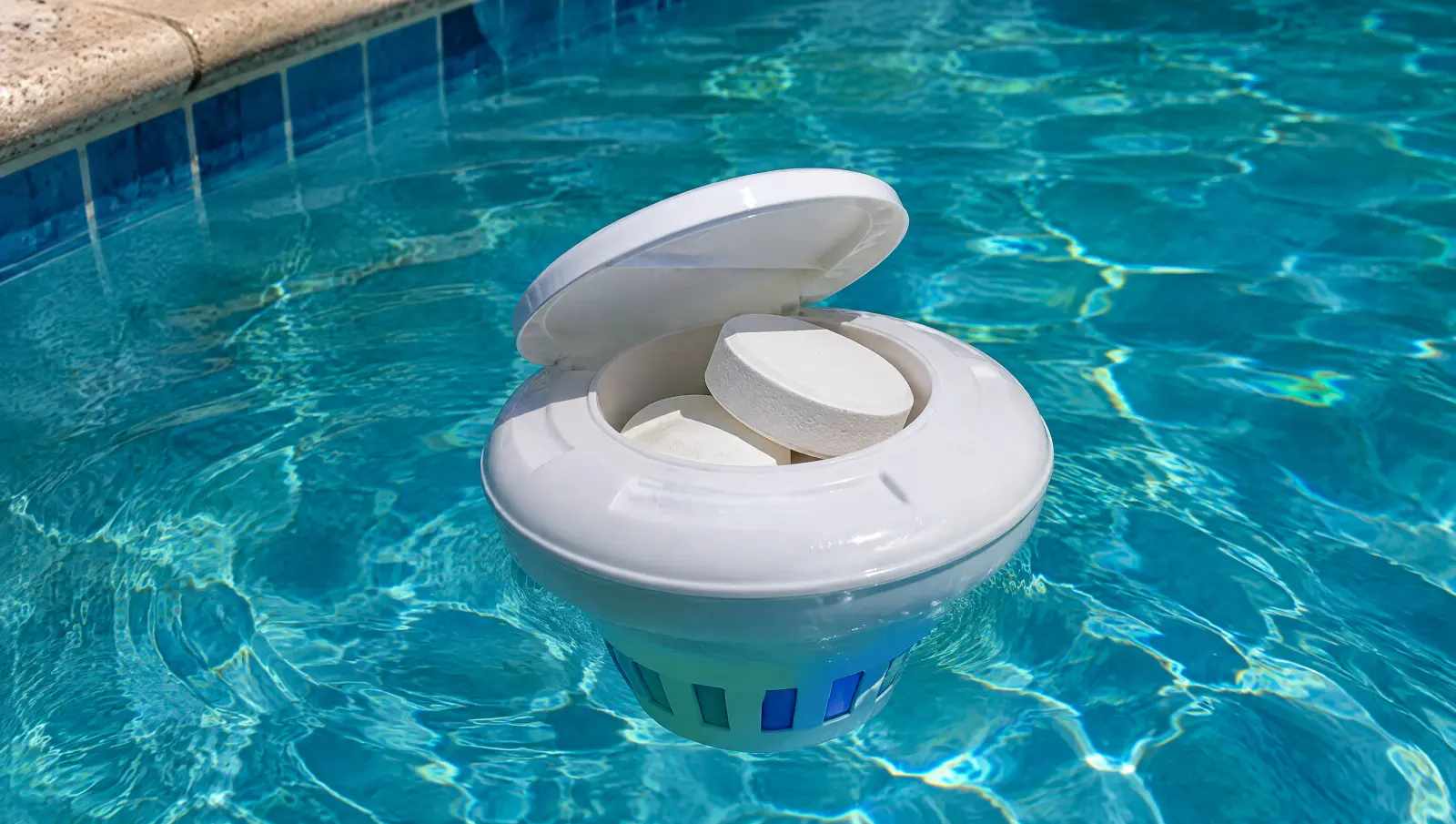
Chlorine tablets for pools are slow-dissolving trichlor tablets that sit in a floater, an automatic chlorinator or the skimmer and release chlorine around the clock. The labels we found that give a dose call for 1–2 three-inch tablets per 10,000 gallons a week. The catch is that every tablet also adds stabilizer (cyanuric acid) and acid, so you need to watch CYA and pH as the season goes on.
Below: 3-inch vs 1-inch tablets, floaters vs in-line and off-line feeders, how many tablets your pool needs, the stabilizer build-up nobody mentions on the bucket, and six products worth buying. For the full balancing routine, start at our pool chemicals guide.
Best chlorine tablets at a glance
Scroll sideways to see every column →
| Product | Best for | Size | Label dose per 10,000 gal | Notes | Price | Buy |
|---|---|---|---|---|---|---|
| Best overallHTH Super 3" Chlorinating Tablets (8 lb) | Most in-ground pools | 3-inch | 1 tablet, lasts up to a week | Listing says vinyl- and salt-system compatible | Check price | |
| Clorox Pool&Spa XtraBlue 3" Tablets (25 lb) | Higher-demand pools | 3-inch | 2 tablets a week | Label target: 1–4 ppm free chlorine | Check price | |
| In The Swim 3" Stabilized Chlorine Tablets (25 lb) | Plain trichlor, no extras | 3-inch | Not stated; replace every 5–7 days | 90% available chlorine | Check price | |
| Best 1-inchIn The Swim 1" Stabilized Chlorine Tablets (10 lb) | Small and above ground pools | 1-inch (about 0.5 oz each) | Not stated; follow the label | 90% available chlorine | Check price | |
| Swimline HydroTools 8720 Floating Dispenser | Floating feeder | Takes 1" and 3" | Holds about 3 lb | Floating dispenser | Check price | |
| Hayward CL200 In-Line Chlorinator | In-ground pools with plumbing access | Takes 1" and 3" | 9 lb capacity (Hayward) | Dial-controlled feed rate | Check price |
Specs from Amazon listings and manufacturer documentation. Prices change often, so we link to the live listing.
What chlorine tablets are (and why they’re different)
Almost every pool chlorine tablet is trichlor (trichloro-s-triazinetrione). The pool industry’s own trade group (PHTA) describes it as the solid chlorine with the highest available chlorine content, about 90%, and it’s compressed into dense pucks that dissolve slowly. That’s the whole appeal: you load them once and they feed chlorine for days.
Trichlor comes with two side effects that the other chlorine types don’t share in the same way:
| Chlorine type | Adds stabilizer (CYA)? | Adds calcium? | Effect on pH | |---|---|---|---| | Trichlor tablets | Yes, about 0.6 ppm per ppm of chlorine | No | Lowers pH and alkalinity | | Dichlor granules | Yes | No | Close to neutral | | Cal-hypo shock | No | Yes | Raises pH | | Liquid chlorine (sodium hypochlorite) | No | No | Raises pH at first |
In short: tablets are the best “set and forget” chlorine while CYA is low, and the wrong one once it’s high.
3-inch vs 1-inch chlorine tablets
The chemistry is the same; the difference is size and dissolve speed. In The Swim’s 1-inch tablets weigh about half an ounce each, and smaller tablets dissolve faster than 3-inch pucks. The usual split is 1-inch tablets for above ground and small pools and 3-inch tablets for in-ground pools.
| | 3-inch tablets | 1-inch tablets | |---|---|---| | Typical pool | In-ground, roughly 10,000 gallons and up | Above ground, small pools | | Dissolve speed | Slow: up to about a week | Faster: days | | Dosing precision | Coarse (one tablet is a big step in a small pool) | Fine (easy to add one more) | | Fits | Most floaters, feeders and skimmers | Everything, including small floaters | | Cost per pound | Usually lower in large buckets | Usually higher |
Floater vs in-line vs off-line chlorinator
Tablets need a place to dissolve. You have four options:
| Method | How it works | Good for | Watch out for | |---|---|---|---| | Floating dispenser | Floats on the surface; vents set the release rate | Above ground pools, low budgets | Drifts and can park near steps or get stuck against a wall; can bleach vinyl if it tips | | Skimmer basket | Tablets dissolve in water entering the skimmer | Quick start, no extra gear | Sends concentrated, acidic water straight through the pump, filter and heater; check your heater’s manual | | In-line chlorinator | Plumbed into the return line after the filter and heater | In-ground pools, steady feed | Needs plumbing; flow must stop safely (see below) | | Off-line chlorinator | Mounted beside the plumbing, fed by small tubes | Retrofits where the pipe can’t be cut | Same rules as in-line; tubing and check valve to maintain |
Hayward’s CL200/CL220 manual says to install the feeder after the heater (or after the filter if there’s no heater), since concentrated chlorine can damage both, with a corrosion-resistant check valve to limit chlorine gas backflow. It also says to turn the dial to zero before stopping the pump and keep swimmers out until full flow is back.
How many chlorine tablets does a pool need?
Labels give the dose per 10,000 gallons. If you don’t know your gallons, use our pool volume calculator first; to scale any dose, the pool chemical calculator does the multiplication.
| Product (label) | Per 10,000 gallons | 20,000-gallon pool | |---|---|---| | HTH Super 3” | 1 tablet, lasts up to a week | 2 tablets a week | | Clorox XtraBlue 3” | 2 tablets a week | 4 tablets a week |
Those label doses are starting points; In The Swim’s 3-inch listing gives no per-gallon dose at all, only to replace tablets every 5–7 days, so set its feeder by your free chlorine reading. Chlorine demand rises with sun, heat, rain, swimmers and leaves, so most pools need more in July than in May. The goal is a free chlorine reading, not a tablet count: the CDC sets the floor at 2 ppm in pools that use stabilizer, and our everyday target is about 7.5% of your CYA reading, which is 3 ppm at CYA 40 and 3–5 ppm for most pools at CYA 30–50. Labels print their own fixed ranges (Clorox XtraBlue says 1–4 ppm); we tie the number to CYA instead.
The trade-off: trichlor tablets and cyanuric acid
Trichlor carries its stabilizer with it, and the stabilizer doesn’t get used up. According to PHTA’s water quality committee, trichlor adds 0.6 ppm of cyanuric acid for every 1 ppm of chlorine it delivers.
Put that in tablet terms, with our own arithmetic. Listings don’t give tablet weights, so assume a typical 8 oz 3-inch tablet: at 90% available chlorine it carries about 7.2 oz of chlorine, which is about 5.4 ppm in 10,000 gallons, and leaves about 3 ppm of CYA behind (5.4 × 0.6). At two tablets a week for a 16-week season, that’s roughly 100 ppm of CYA added to a 10,000-gallon pool if no water were ever lost. Rain, splash-out and backwashing dilute some of it, but the direction is always up.
Why it matters: CYA protects chlorine from sunlight, but it also holds on to part of it. Taylor Technologies notes that too much CYA leaves chlorine “overstabilized,” with weaker sanitizing power. The more CYA you have, the more free chlorine you need:
| CYA (ppm) | Our target: about 7.5% of CYA (ppm) | Trouble Free Pool minimum (ppm) | Trouble Free Pool target range (ppm) | |---|---|---|---| | 30 | About 2.3 (3 in practice) | 2 | 4–6 | | 40 | 3 | 3 | 5–7 | | 50 | About 3.8 (up to 5 in practice) | 4 | 6–8 | | 60 | 4.5 | 5 | 7–9 | | 80 | 6 | 6 | 9–11 |
Sources: Trouble Free Pool’s chlorine/CYA chart; the 7.5% column is our arithmetic. Trouble Free Pool’s higher target ranges are an alternative some owners follow. Never go below the CDC’s 2 ppm with stabilizer.
How to live with it:
- Test CYA at least monthly, more often on tablets. The 2024 Model Aquatic Health Code requires public pools that rely on stabilized chlorine to test CYA weekly, and caps CYA at 90 ppm.
- Start the season low. If CYA is already 30–50 ppm at opening, you don’t need to add pool stabilizer: the tablets will supply it.
- Switch when CYA tops out. Once CYA reaches the top of your range, Taylor’s advice is to move to unstabilized chlorine (liquid chlorine or cal-hypo) for daily sanitizing. Put the tablets away until a partial drain and refill brings CYA back down, because no chemical reliably lowers it.
Trichlor tablets and low pH
Trichlor is strongly acidic. PHTA notes that pools treated with trichlor can see pH and alkalinity “drift down,” and the CDC recommends keeping pH between 7.0 and 7.8; 7.4–7.6 is the usual sweet spot. Low pH etches plaster, wrinkles vinyl, corrodes heaters and ladders and stings eyes.
Check pH at least a few times a week while you’re on tablets. When it slips below 7.2, raise alkalinity first if it’s under 80 ppm, then pH: our guide on how to raise pH in a pool has the doses.
The best chlorine tablets for pools
Best overall: HTH Super 3” Chlorinating Tablets
HTH Super 3-Inch Chlorinating Tablets (8 lb, model 42037)
- Size
- 3-inch tablets, 8 lb
- Label dose
- 1 tablet per 10,000 gal, up to a week
- Compatible with
- Vinyl pools and salt systems (listing)
- Sun protection
- "Sun protected" (listing)
Specs from the Amazon listing and manufacturer documentation
Widely sold 3-inch tablets with the simplest dosing on this page: the listing says one tablet treats 10,000 gallons for up to a week. It also says they're compatible with vinyl pools and salt systems and calls them sun protected.
Pros
- Low dose per 10,000 gallons makes the math easy
- Listing confirms vinyl and salt-system compatibility
Cons
- Sun protection in tablets comes from stabilizer, so watch CYA
- Only 8 lb: a large pool will need more than one container a season
HTH’s 25 lb pail of 3-inch tabs is currently unavailable on Amazon, which is why we’ve listed the smaller 8 lb container here.
Best for high-demand pools: Clorox XtraBlue 3” Tablets
Clorox Pool&Spa XtraBlue 3-Inch Chlorinating Tablets (25 lb)
- Size
- 3-inch tablets, 25 lb
- Label dose
- 2 tablets weekly per 10,000 gal
- Target on label
- 1–4 ppm free chlorine
Specs from the Amazon listing and manufacturer documentation
Clorox's 3-inch tablets with a heavier label dose: 2 tablets a week per 10,000 gallons, adding more as needed to hold 1–4 ppm free chlorine. That label range starts lower than our CYA-based target, so go by your test kit.
Pros
- Higher dose suits hot, sunny, busy pools
- Clear weekly dose and free chlorine range on the label
Cons
- Two tablets a week adds CYA twice as fast as a one-tablet dose
- Label range of 1–4 ppm is lower than you need once CYA passes about 50 ppm
Best plain trichlor: In The Swim 3” Stabilized Tablets
In The Swim 3-Inch Stabilized Chlorine Tablets (25 lb)
- Size
- 3-inch tablets, 25 lb
- Available chlorine
- 90% (listing)
- Label guidance
- Replace every 5–7 days; no per-gallon dose
Specs from the Amazon listing and manufacturer documentation
Straight stabilized trichlor with 90% available chlorine, from a pool-supply brand. The listing gives no dose per gallons, only to replace tablets every 5–7 days, so you set the feeder or floater by your free chlorine reading.
Pros
- Big 25 lb bucket means fewer reorders
- Plain trichlor, nothing extra to account for
Cons
- No per-gallon dose on the listing, so you dose by testing
Best 1-inch tablets: In The Swim 1” Stabilized Tablets
In The Swim 1-Inch Stabilized Chlorine Tablets (10 lb)
- Active ingredient
- Trichlor, 90% available chlorine
- Tablet weight
- About 0.5 oz
- Size
- 10 lb
Specs from the Amazon listing and manufacturer documentation
Half-ounce trichlor tablets for above ground and small pools, where a single 3-inch puck is too big a step. Smaller tablets dissolve faster, so you refill more often. The listing gives no dose per gallons.
Pros
- Fine control in pools under about 10,000 gallons
- Fits small floaters that won't take 3-inch pucks
Cons
- Faster dissolving means refilling more often
- Higher cost per pound than big 3-inch buckets
Best floater: Swimline HydroTools 8720
Swimline HydroTools 8720 Floating Chlorine Dispenser
- Tablets
- 1-inch and 3-inch
- Capacity
- About 3 lb
Specs from the Amazon listing and manufacturer documentation
Simple floating dispenser that takes both 1-inch and 3-inch tablets and holds about 3 lb, per the listing.
Pros
- No plumbing, works in any pool
- Cheap way to start using tablets
Cons
- Drifts: remove it while people swim so no one handles it
- A floater that tips or parks in one spot can bleach a vinyl liner
Best in-line chlorinator: Hayward CL200
Hayward CL200 In-Line Automatic Chlorine Feeder
- Capacity
- 9 lb (Hayward)
- Tablets
- Slow-dissolving trichlor, 1-inch or 3-inch
- Connections
- 1 1/2 in female threads
- Install
- Return line, after heater and filter
Specs from the Amazon listing and manufacturer documentation
Plumbed into the return line after the filter and heater, it meters tablets with a dial instead of leaving them to float. Hayward lists it as a 9 lb in-line feeder for large or small slow-dissolving trichlor or bromine tablets.
Pros
- Steadier chlorine than a floater, and nothing loose in the pool
- Holds enough for a week or more in most pools
Cons
- Needs plumbing work; an off-line model (CL220) avoids cutting the pipe
- Manual requires a check valve and a flow indicator setup
Chlorine tablet safety
Chemical safety rules
- Never mix chemicals. The CDC warns that chlorine and acid together can create toxic gases. Hayward’s feeder manual adds that trichlor mixed with cal-hypo or any other concentrated chlorine can cause fire or explosion. Never put shock in a feeder, floater or skimmer that holds tablets.
- Add chemicals to water, never water to chemicals. If a label tells you to pre-dissolve, pour the product into a bucket of water.
- Muriatic acid needs protection. If you lower pH with acid, wear goggles and gloves, work in fresh air and add it to the pool separately from chlorine.
- Open one container at a time, wear gloves and goggles, and don’t lean over a feeder when you open it: trapped gas can puff out.
- Store separately: tablets, shock and acid apart, in their original closed containers, cool, dry and locked away from kids and pets.
How to use chlorine tablets, step by step
- Know your gallons. Every label dose is per 10,000 gallons.
- Test and balance first. Bring pH to 7.2–7.8 and check CYA. If CYA is already 50 ppm or more, use liquid chlorine instead for now.
- Load the tablets in a floater, feeder or (if the label allows) the skimmer basket, wearing gloves. Never drop them loose on the floor of the pool.
- Set the release rate partway open, run the pump and retest free chlorine after 24 hours.
- Adjust weekly: open or close the vents or dial to stay in range, refill as tablets shrink and keep an eye on pH and CYA.
Shock, stabilizer and the rest of the kit
Tablets are one part of the routine. You’ll still need a shock for weekly or after-party oxidizing (an unstabilized cal-hypo or liquid shock keeps CYA from climbing faster; see our best pool shock picks), a pH increaser for trichlor’s acidity, and a test kit that reads CYA, which most strips do only roughly. Our best pool test kit guide covers drop kits with a proper CYA test.
Own a hot tub too? Pool tablets aren’t made for spas; see our hot tub chemicals guide instead.
How we chose these products
We don’t own a pool and haven’t used these products ourselves. This list is built from research you can check:
- Target levels come from the CDC (free chlorine and pH), the 2024 Model Aquatic Health Code (CYA limit and testing), PHTA’s trichlor guidance (available chlorine, CYA added per ppm, pH drift) and Trouble Free Pool’s chlorine/CYA chart.
- Products had to be sold on Amazon.com and fit a specific job: 3-inch tablets for most in-ground pools, 1-inch tablets for small pools, and one floater and one in-line feeder to put them in. We favored listings that state a clear dose per gallons.
- Doses and specs are taken from each product’s Amazon listing (checked November 29, 2026) or the manufacturer’s site, never estimated. Where a label’s chlorine range differs from ours (Clorox XtraBlue says 1–4 ppm), we explain why we tie chlorine to CYA instead. The chlorine and CYA per tablet are our own arithmetic from the 90% figure and an assumed 8 oz tablet.
- Safety guidance comes from the CDC’s pool chemical safety poster and Hayward’s feeder manual.
We don’t show prices because they change daily. All sources are listed at the end of the page.
How we compared
We gathered the Amazon listing and manufacturer documentation for each product, put the specs side by side and matched each one to the job it suits. We don’t test products hands-on: the figures come from the documents listed in Sources. How we research.
- Products compared
- 6
- Sources cited
- 8
- Compared on
- Size, Label dose per 10,000 gal, Notes
- Last updated
- Nov 2026
- Hands-on testing
- No
- Paid placements
- None
Sources
- CDC: Home Pool and Hot Tub Water Treatment and Testing · cdc.gov
- CDC: Model Aquatic Health Code, 2024 (5th Edition), Code (PDF) · cdc.gov
- PHTA Recreational Water Quality Committee: Trichlor, the Dependable Pool Performer (ICC Building Safety Journal) · iccsafe.org
- Trouble Free Pool: Chlorine/CYA Chart · troublefreepool.com
- Hayward: CL100/CL200 Automatic Chlorine Feeders Owner's Manual (PDF) · hayward.com
- Hayward: CL200 Automatic Chlorine Feeder, 9 lbs, In-Line · hayward.com
- Taylor Technologies: Why Monitoring Cyanuric Acid (CYA) in a Pool Is Important · taylortechnologies.com
- CDC: Use Pool Chemicals Safely (poster, PDF) · cdc.gov
Frequently asked questions
Do chlorine tablets actually work?
Yes. Trichlor tablets release chlorine slowly and steadily, and the cyanuric acid they contain shields that chlorine from sunlight. What they don't do is run unattended forever: the stabilizer builds up over the season and the acid pulls pH down, so you still need to test free chlorine, pH and CYA and correct them.
Which pool chlorine is best?
It depends on your water. Trichlor tablets are the most convenient for daily chlorine in an outdoor pool whose CYA is still low. Liquid chlorine (sodium hypochlorite) adds no stabilizer and no calcium, which makes it the better choice once CYA reaches the top of the 30–50 ppm range. Cal-hypo adds calcium, and dichlor adds stabilizer. Many owners combine tablets for steady chlorine with an unstabilized shock.
How often should you put a chlorine tablet in a pool?
Follow the label and your test kit. The HTH 3-inch listing says one tablet per 10,000 gallons lasts up to a week; Clorox XtraBlue says two tablets a week per 10,000 gallons; In The Swim's listing gives no per-gallon dose and says to replace tablets every 5–7 days. Top up the floater or feeder when free chlorine starts falling below your target (about 7.5% of your CYA reading), not just on a fixed day.
Do I need to shock my pool if I use chlorine tablets?
Yes. Tablets keep a steady background level, but they dissolve too slowly to break down a burst of sweat, sunscreen and chloramines after heavy use, or to knock out algae. Shock when combined chlorine climbs (public pools must act above 0.4 ppm under the MAHC), after parties and storms, and whenever the water turns cloudy or green. Pick an unstabilized shock if your CYA is already high.
What is the cheapest way to put chlorine in a pool?
There's no single answer, because prices vary by region and pack size. Compare products by the cost per pound of available chlorine: trichlor is about 90% available chlorine, while liquid chlorine is much weaker by weight. Also count the hidden cost: tablets add stabilizer that may eventually force a partial drain and refill, which liquid chlorine does not.
What is the best time of day to put chlorine in a pool?
For liquid chlorine or shock, evening is best: sunlight's UV breaks chlorine down quickly, so adding it after sunset gives it the whole night to work. Tablets are less sensitive to timing because they dissolve continuously and carry their own stabilizer, so load them whenever you check the floater or feeder.