On this page
Key takeaways
- Every hot tub needs four things: a sanitizer (chlorine or bromine), a shock, pH and alkalinity balancers, and test strips. Everything else is optional.
- Keep free chlorine at 3–5 ppm (CDC minimum: 3 ppm) or bromine at 4–6 ppm (CDC minimum: 4 ppm). Pick one sanitizer and stick with it until you drain.
- Balance in this order: total alkalinity to 80–120 ppm, then pH to 7.2–7.8, then sanitizer. Calcium hardness belongs at 150–250 ppm.
- Shock once a week and after heavy use. A non-chlorine shock such as Leisure Time Renew is dosed at 2 oz per 250 gallons per its label.
- Never mix chemicals together. The CDC warns that chlorine plus acid (like a pH decreaser) can release toxic gas. Add each product to the water separately, with the jets running.
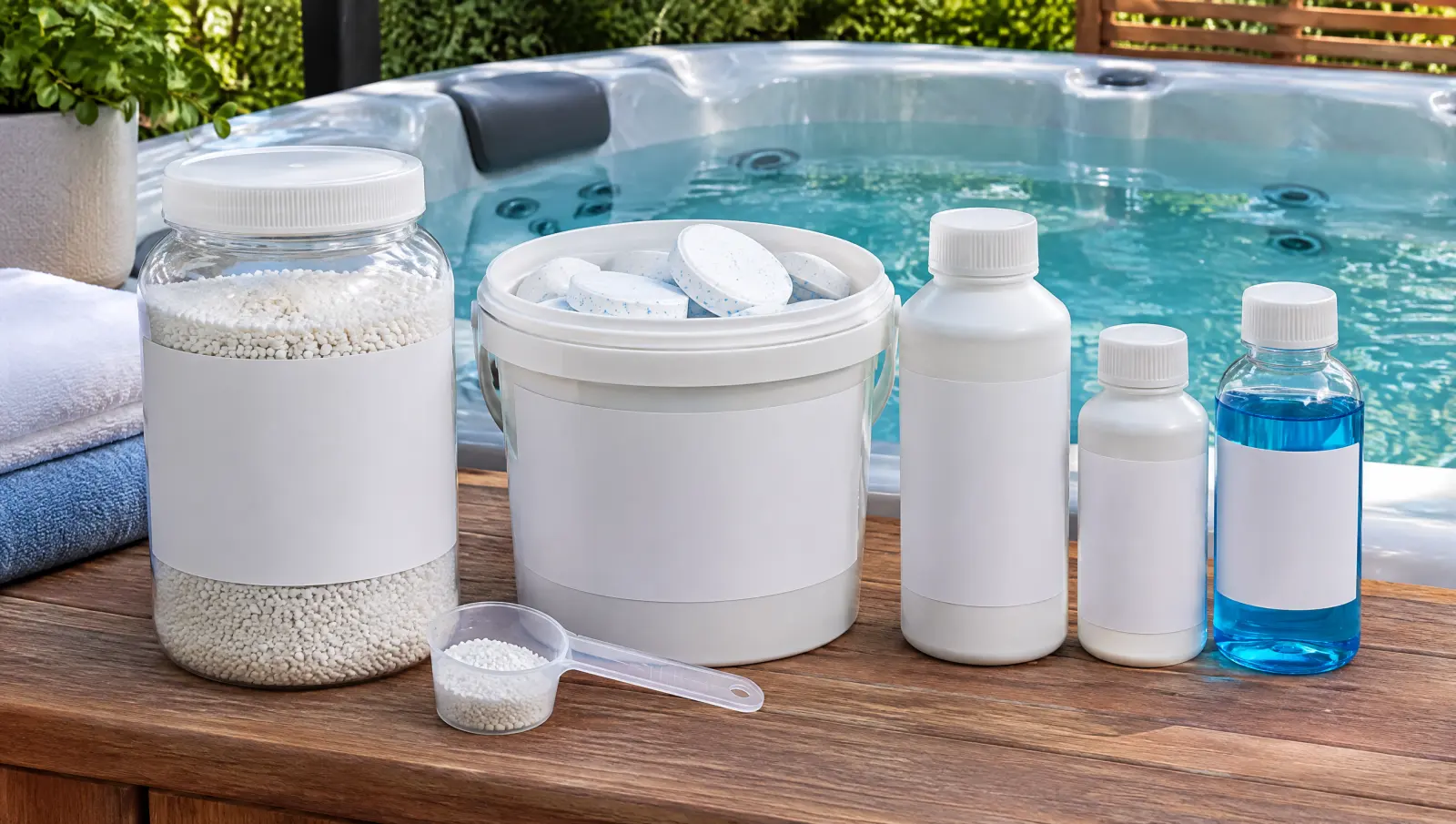
The hot tub chemicals you actually need fit on one shelf: a sanitizer (chlorine or bromine), a weekly shock, a pH increaser and decreaser, and test strips. Everything else, from defoamer to metal control, is for fixing a specific problem when it shows up.
Below you’ll find what each chemical does, the product we’d pick for each job, a starter kit table, the label doses for a typical 500-gallon tub and a weekly routine that takes about 15 minutes. For the bigger picture (filters, draining, covers), see our hot tub maintenance guide.
The hot tub chemical starter kit
If you’re a beginner and want one list to buy from, this is it. It assumes a chlorine routine; if you’d rather use bromine, swap the chlorine granules for bromine tablets plus sodium bromide (both covered below).
Scroll sideways to see every column →
| Product | Best for | What it does | How often | Price | Buy |
|---|---|---|---|---|---|
| AquaChek 7-Way Test Strips | Testing | Reads chlorine, bromine, pH, alkalinity, hardness and stabilizer | 2–3 times a week | Check price | |
| SpaChoice Chlorine Granules | Sanitizer and chlorine shock | Keeps free chlorine at 3–5 ppm | After use and weekly | Check price | |
| Leisure Time Renew | Non-chlorine shock | Oxidizes oils and sweat; label dose 2 oz per 250 gal | Weekly | Check price | |
| Leisure Time Spa Up | Raising pH | Sodium bicarbonate; 1/4 oz per dose | When low | Check price | |
| Leisure Time Spa Down | Lowering pH | Lowers pH and alkalinity | When high | Check price | |
| SpaChoice Alkalinity Increaser | Raising alkalinity | 1 oz at a time, retest after 30 minutes | At fill and when low | Check price | |
| Leisure Time Filter Clean | Filter care | Soak cleaner for oils and scale | Every 1–3 months | Check price |
Specs from Amazon listings and manufacturer documentation. Prices change often, so we link to the live listing.
Add a calcium increaser if your fill water is soft, and a defoamer if foam shows up.
Sanitizers: chlorine or bromine
The sanitizer is the only chemical that actually kills germs. Hot water and jets make a hot tub a better home for bacteria than a pool, which is why the CDC’s minimums are higher for spas: free chlorine of 3 ppm or bromine of 4 ppm, and its Legionella guidance for hot tubs puts the ranges at 3–10 ppm chlorine or 4–8 ppm bromine. For everyday use, aim for 3–5 ppm chlorine or 4–6 ppm bromine.
Pick one and stay with it until your next drain. Adding chlorine to bromine water reactivates the bromide instead of adding fresh chlorine, which makes test readings hard to trust. The full comparison is in bromine vs chlorine for hot tubs; the short version is in the table.
| | Chlorine (sodium dichlor) | Bromine (tablets + bromide reserve) | |---|---|---| | Target | 3–5 ppm free chlorine | 4–6 ppm bromine | | How you add it | Granules after each use or every couple of days | Tablets in a floater, slow release | | Speed | Fast | Slower to build up | | Side effect | Adds cyanuric acid (stabilizer) with every dose | Needs a bromide reserve at every refill | | Best for | Occasional use, quick control | Frequent use, set-and-forget routines |
Best chlorine sanitizer: SpaChoice dichlor granules
SpaChoice Chlorine Granules (sodium dichlor, 5 lb)
- Active ingredient
- Sodium dichlor
- Dose (listing)
- 1 tsp ≈ 1.4 ppm per 500 gal; startup 6 tsp per 500 gal
- Use
- Daily sanitizer and shock
- Size
- 5 lb
Specs from the Amazon listing and manufacturer documentation
Spa-specific dichlor granules that work as both your daily sanitizer and your chlorine shock. The listing says 1 teaspoon (0.17 oz) adds about 1.4 ppm of chlorine in 500 gallons, with a startup dose of 6 teaspoons per 500 gallons.
Pros
- One product covers sanitizing and chlorine shock
- Dose is easy to scale: about 1.4 ppm per teaspoon per 500 gallons
Cons
- Adds cyanuric acid with every dose, so drain on schedule
- Its listing quotes a label line that prohibits re-entry above 3 ppm, the same as the CDC minimum, which leaves little room: dose in small steps, retest and follow your label
Why dichlor and not pool chlorine? Pool tablets (trichlor) are acidic and add stabilizer, and they’re sized for large pools. Dichlor dissolves quickly in a small volume of water, which is what a hot tub needs. The catch is the cyanuric acid it leaves behind: the CDC advises against stabilizer in hot tubs, so changing the water every 3–4 months matters more on a chlorine routine.
Best bromine sanitizer: Leisure Time Brom Tabs + Sodium Bromide
Bromine is a two-part system. Sodium bromide builds a “bank” of bromide ions in the water, and the tablets (plus your weekly shock) turn that bank into active bromine. Skip the bromide at startup and it takes much longer to reach a reading.
Leisure Time Brom Tabs (brominating tablets, 4 lb)
- Form
- Tablets for a floater or feeder
- Active ingredient
- BCDMH
- Use
- Continuous sanitizer
- Size
- 4 lb
Specs from the Amazon listing and manufacturer documentation
BCDMH bromine tablets for a floating dispenser; the listing says they fit all floaters. Pair them with Leisure Time Sodium Bromide: add the bromide reserve first, then the tabs.
Pros
- Slow, continuous release: check and refill the floater weekly
- Listing says the tablets fit all floaters
Cons
- Needs sodium bromide at every refill
- Keep bromine at the CDC minimum of 4 ppm or higher (aim for 4–6 ppm)
Leisure Time Sodium Bromide (bromide reserve, 16 oz)
- Dose
- 1/2 oz per 100 gal (2.5 oz per 500 gal)
- When
- At startup and after every refill
- Size
- 16 oz
Specs from the Amazon listing and manufacturer documentation
Builds the bromide reserve at startup. The listing dose is 1/2 oz per 100 gallons for a 30 ppm bromide level, repeated after each drain and refill. It is not a sanitizer on its own.
Shock: chlorine and non-chlorine
Shocking means adding a big dose of oxidizer to burn off body oils, sweat, lotion and the chloramines that cause the “chlorine smell.” Do it weekly and after heavy use, with the cover off and the jets running.
You have two options:
- Chlorine shock (dichlor): the same granules you sanitize with, in a larger dose per the label. It both oxidizes and disinfects. Wait until free chlorine falls back to 5 ppm or less before soaking.
- Non-chlorine shock (potassium monopersulfate, or MPS): oxidizes without raising chlorine, so you can get back in sooner. It does not disinfect, so your regular sanitizer still has to be in range. On a bromine routine it also reactivates spent bromide.
Leisure Time Renew Non-Chlorine Shock (2.2 lb)
- Type
- Non-chlorine oxidizer
- Active ingredient
- Potassium monopersulfate (MPS)
- Dose
- 2 oz per 250 gal (4 oz per 500 gal)
- Size
- 2.2 lb
Specs from the Amazon listing and manufacturer documentation
Granular non-chlorine oxidizer (potassium monopersulfate, MPS) for spas. The listing dose is 2 oz per 250 gallons, and it says the product does not sanitize.
Pros
- Oxidizes oils and sweat without raising the chlorine reading
- Useful on both chlorine and bromine routines
Cons
- Not a disinfectant: you still need sanitizer in range
- One more product to store and dose, on top of your sanitizer
Balancers: pH, alkalinity and calcium
Balancers decide whether your sanitizer works and whether your equipment lasts: chlorine weakens as pH rises, low pH corrodes heaters, and the wrong calcium level etches surfaces or leaves scale.
| Reading | Target | Raise with | Lower with | |---|---|---|---| | Total alkalinity | 80–120 ppm | Alkalinity increaser (sodium bicarbonate) | pH decreaser | | pH | 7.2–7.8 | pH increaser (Spa Up) | pH decreaser (Spa Down) | | Calcium hardness | 150–250 ppm | Calcium increaser | Partial drain and refill |
Alkalinity first, then pH. Alkalinity is the buffer that holds pH in place, so if you fix pH first, it drifts back. Add small doses, run the jets for 30 minutes, and retest before adding more. Spa Up’s listing doses 1/4 oz (1 1/2 teaspoons) at a time and SpaChoice Alkalinity Increaser’s 1 oz at a time; follow the label on your container.
Leisure Time Spa Up (pH increaser, 2 lb)
- Raises
- pH and total alkalinity
- Active ingredient
- Sodium bicarbonate
- Dose (listing)
- 1/4 oz (1 1/2 tsp), circulate 30 min
- Size
- 2 lb
Specs from the Amazon listing and manufacturer documentation
Granular increaser made for spas. The listing names sodium bicarbonate as the ingredient and doses it at 1/4 oz (1 1/2 teaspoons) at a time, followed by 30 minutes of circulation.
Leisure Time Spa Down (pH decreaser, 2.5 lb)
- Lowers
- pH and total alkalinity
- Active ingredient
- Sodium bisulfate
- Size
- 2.5 lb
Specs from the Amazon listing and manufacturer documentation
Sodium bisulfate granules that bring pH and alkalinity down. The listing says to circulate for 30 minutes after adding but gives no dose, so follow the label. This is an acid: store it away from your chlorine and never scoop one with the other's measuring cup.
SpaChoice Alkalinity Increaser (2 lb)
- Raises
- Total alkalinity
- Dose (listing)
- 1 oz, retest after 30 min
- Size
- 2 lb
Specs from the Amazon listing and manufacturer documentation
Granules for raising total alkalinity, useful at startup when alkalinity is low. The listing says to add 1 oz at a time, retest every 30 minutes and aim for 80–140 ppm (we use 80–120 ppm).
Leisure Time CB Calcium Booster (32 fl oz)
- Raises
- Calcium hardness
- Dose
- 1 oz = about 7 ppm per 500 gal
- Size
- 32 fl oz
Specs from the Amazon listing and manufacturer documentation
Liquid calcium increaser for soft fill water. Per the listing, 1 oz raises calcium hardness by about 7 ppm in 500 gallons, so going from 100 to 150 ppm takes roughly 7 oz.
Specialty chemicals (only when you need them)
Buy these only when you see the problem they solve.
Defoamer: Leisure Time Foam Down
Foam comes from lotions, soap residue on swimsuits and old water. A defoamer knocks it down in minutes, but it treats the symptom: if foam keeps coming back, shock, check calcium and plan a drain. More in how to get rid of hot tub foam.
Leisure Time Foam Down (defoamer, 32 fl oz)
- Dose (listing)
- About 1/2 oz at a time, on the foam
- Size
- 32 fl oz
Specs from the Amazon listing and manufacturer documentation
Foam suppressant for hot water. The listing says to add about 1/2 oz at a time directly where the foam is, repeating as needed.
Clarifier: Leisure Time Bright & Clear
A clarifier clumps particles too small for the filter into bigger ones it can catch. It helps with haze once sanitizer and pH are already right; it won’t fix cloudy water caused by low sanitizer. Troubleshooting steps are in cloudy hot tub water.
Leisure Time Bright & Clear (spa clarifier)
- Dose (listing)
- 2–4 oz once a week
Specs from the Amazon listing and manufacturer documentation
Clarifier for hot water that combines fine particles so the filter can trap them. The listing says 2–4 oz once a week and gives no gallon range, so start at the low end in a small tub.
Metal sequestrant: Leisure Time Metal Gon
If you fill from a well or your water has iron or copper, metals can stain the shell and tint the water once sanitizer oxidizes them. A sequestrant such as Leisure Time Metal Gon keeps them dissolved. Add it when you first fill, before the sanitizer, at the dose on its label.
Line flush: Ahh-Some
Biofilm grows inside the plumbing where you can’t scrub. A line flush goes in before you drain, loosens it, and the gunk leaves with the old water.
Ahh-Some Hot Tub Purge & Jet Line Cleaner (4 oz)
- Dose
- 1 tsp per 125 gal (4 tsp per 500 gal)
- When
- Before each drain
- Size
- 4 oz tube
Specs from the Amazon listing and manufacturer documentation
Gel line cleaner used right before draining. The listing says 1 teaspoon treats 125 gallons and the tube gives 8 purges for tubs up to 400 gallons.
Cons
- The label warns soft-water users may need less to keep suds from overflowing
For the filter itself, a soak cleaner like Leisure Time Filter Clean (in the starter kit above) dissolves oils a hose won’t move. Compare options in our hot tub filter cleaner guide.
Hot tub chemical safety
The CDC estimates that pool chemical injuries send 3,000 to 5,000 people to US emergency departments every year, most often from breathing fumes or dust while opening containers. Hot tub chemicals are the same compounds in smaller packages.
Chemical safety rules
- Never mix chemicals. The CDC warns that chlorine and acid together can create toxic gases. Dichlor granules and a sodium bisulfate pH decreaser are exactly that pair.
- Add chemicals to water, never water to chemicals. If a label says to pre-dissolve, pour the chemical into a bucket of water, not the other way around.
- One product at a time. Add it with the jets running, let it circulate (usually 20–30 minutes) and retest before adding the next.
- Store separately, in the original labeled containers, closed, dry, cool, out of sunlight and locked away from kids and pets. Keep liquids below dry products.
- Use a clean, dry scoop for each product and open containers away from your face.
How to add hot tub chemicals in the right order
At startup (fresh fill)
- Metal sequestrant, if your water has metals.
- Total alkalinity to 80–120 ppm.
- pH to 7.2–7.8.
- Calcium hardness to 150–250 ppm.
- Sanitizer. Bromine users: sodium bromide first (2.5 oz in 500 gallons per the Leisure Time label), then tablets in the floater. Chlorine users: dichlor until free chlorine reads 3–5 ppm.
- Shock to finish.
Run the jets for 20–30 minutes between steps and retest.
Label doses for common tub sizes
These come from each product’s listing. Always check the label on the container you buy, since formulas and package sizes change.
| Product | Per 100 gallons | Per 500 gallons | |---|---|---| | SpaChoice dichlor (about 1.4 ppm chlorine at 500 gal) | 1/5 tsp | 1 tsp | | Leisure Time Sodium Bromide (startup) | 1/2 oz | 2.5 oz | | Leisure Time Renew (weekly shock) | 0.8 oz | 4 oz | | Leisure Time CB Calcium Booster | — | 1 oz raises about 7 ppm | | Ahh-Some line flush (before draining) | 0.8 tsp | 4 tsp |
Don’t know your gallons? Check the owner’s manual or the manufacturer’s spec sheet before you dose anything.
A weekly hot tub chemical routine
| When | What to do | Time | |---|---|---| | 2–3 times a week | Test strip; top up sanitizer; adjust pH if outside 7.2–7.8 | 5 min | | Weekly | Shock; check the bromine floater; rinse the filter | 10 min | | Monthly | Test calcium hardness; deep-clean the filter | Overnight soak | | Every 3–4 months | Line flush, drain, refill, repeat the startup steps | 2–3 hours |
Test with strips that read both chlorine and bromine so they still work if you switch sanitizers at your next drain. Our best hot tub test strips guide compares the options.
AquaChek 7-Way Pool and Spa Test Strips (100 count)
- Tests
- Free and total chlorine, bromine, pH, alkalinity, hardness, stabilizer
- Count
- 100 strips
Specs from the Amazon listing and manufacturer documentation
Reads seven values on one strip, including both free chlorine and bromine, so it works whichever sanitizer you use.
How we chose these products
We don’t own a hot tub and haven’t used these products ourselves. This list is built from research you can check:
- Target levels come from the CDC’s hot tub guidance (sanitizer and pH) and standard spa ranges for alkalinity and calcium, matching our hot tub maintenance hub.
- Products had to be sold on Amazon.com, labeled for spas or hot tubs, and match a specific job in a basic routine. We favored products whose listings give clear dosing per gallon, so you can scale them to your tub.
- Doses and specs are taken from each product’s Amazon listing or label directions, never estimated. Where a listing gives no dose, we say so and point you to the label. Where a product and the CDC disagree, we use the more cautious CDC figure.
- Safety guidance comes from the CDC’s pool chemical safety posters and the CPSC.
We don’t show prices because they change daily. All sources are listed at the end of the page.
How we compared
We gathered the Amazon listing and manufacturer documentation for each product, put the specs side by side and matched each one to the job it suits. We don’t test products hands-on: the figures come from the documents listed in Sources. How we research.
- Products compared
- 13
- Sources cited
- 6
- Compared on
- What it does, How often
- Last updated
- Nov 2026
- Hands-on testing
- No
- Paid placements
- None
Sources
- CDC: Home Pool and Hot Tub Water Treatment and Testing · cdc.gov
- CDC: Controlling Legionella in Hot Tubs (Legionella Control Toolkit) · cdc.gov
- CDC: Use Pool Chemicals Safely (poster, PDF) · cdc.gov
- CDC: Store Pool Chemicals Safely (poster, PDF) · cdc.gov
- CDC MMWR: Pool Chemical Injuries in Public and Residential Settings, 2008–2017 · cdc.gov
- CPSC: CPSC Warns of Hot Tub Temperatures · cpsc.gov
Frequently asked questions
What chemicals do you put in a hot tub to keep it clean?
A sanitizer to kill germs (chlorine at 3–5 ppm or bromine at 4–6 ppm), a weekly shock to break down oils and sweat, and pH and alkalinity balancers to keep pH at 7.2–7.8 and alkalinity at 80–120 ppm. Test strips tell you which of them you need on a given day. Defoamer, clarifier and metal control are extras for specific problems.
What chemicals do you put in a hot tub to start it up?
After filling, add a metal sequestrant if your water has iron or copper, then balance total alkalinity, pH and calcium hardness, running the jets between additions. Next, bring the sanitizer into range: for bromine, add a sodium bromide reserve (Leisure Time's label says 1/2 oz per 100 gallons) and then bromine tablets in a floater; for chlorine, dose dichlor granules. Finish with a shock.
Should I adjust alkalinity or chlorine first?
Alkalinity first, then pH, then chlorine. Alkalinity acts as a buffer that pulls pH with it, and chlorine works far better when pH is between 7.2 and 7.8, so sanitizer comes last.
What two pool chemicals should not be mixed?
The CDC singles out chlorine and acid: mixing them can create toxic gases. In a hot tub that means dichlor granules and a sodium bisulfate pH decreaser, which most owners keep side by side. In practice, never mix any two chemicals, never put them in the same scoop or bucket, and add each one to the water separately.
Why is there a 15-minute hot tub rule?
It's a common guideline to keep soaks short in very hot water so your body temperature doesn't climb too high. The CPSC says spa water should never exceed 104 °F and treats 100 °F as safe for a healthy adult, with lower temperatures for pregnant women. Separately, check the re-entry wait on any chemical you add: it's printed on the label.
What will ruin a hot tub?
Low pH that corrodes the heater and metal parts, high pH or calcium that leaves scale, letting sanitizer drop to zero, and adding things that don't belong in spa water, such as bubble bath, household cleaners or pool tablets not labeled for spas. A neglected filter and water that's never changed make every one of those problems worse.