On this page
Key takeaways
- Both are safe when kept in range: free chlorine at 3 ppm or higher (aim for 3–5 ppm) or bromine at 4 ppm or higher (aim for 4–6 ppm). The CDC's Legionella guidance for hot tubs allows up to 10 ppm chlorine or 8 ppm bromine.
- Bromine holds up better in hot water and at higher pH. Hypobromous acid is still about half active at pH 8.65, while hypochlorous acid is already down to half at pH 7.54.
- Chlorine works faster and costs less per pound, but spa chlorine (dichlor) adds cyanuric acid with every dose, which the CDC says shouldn't be used in hot tubs.
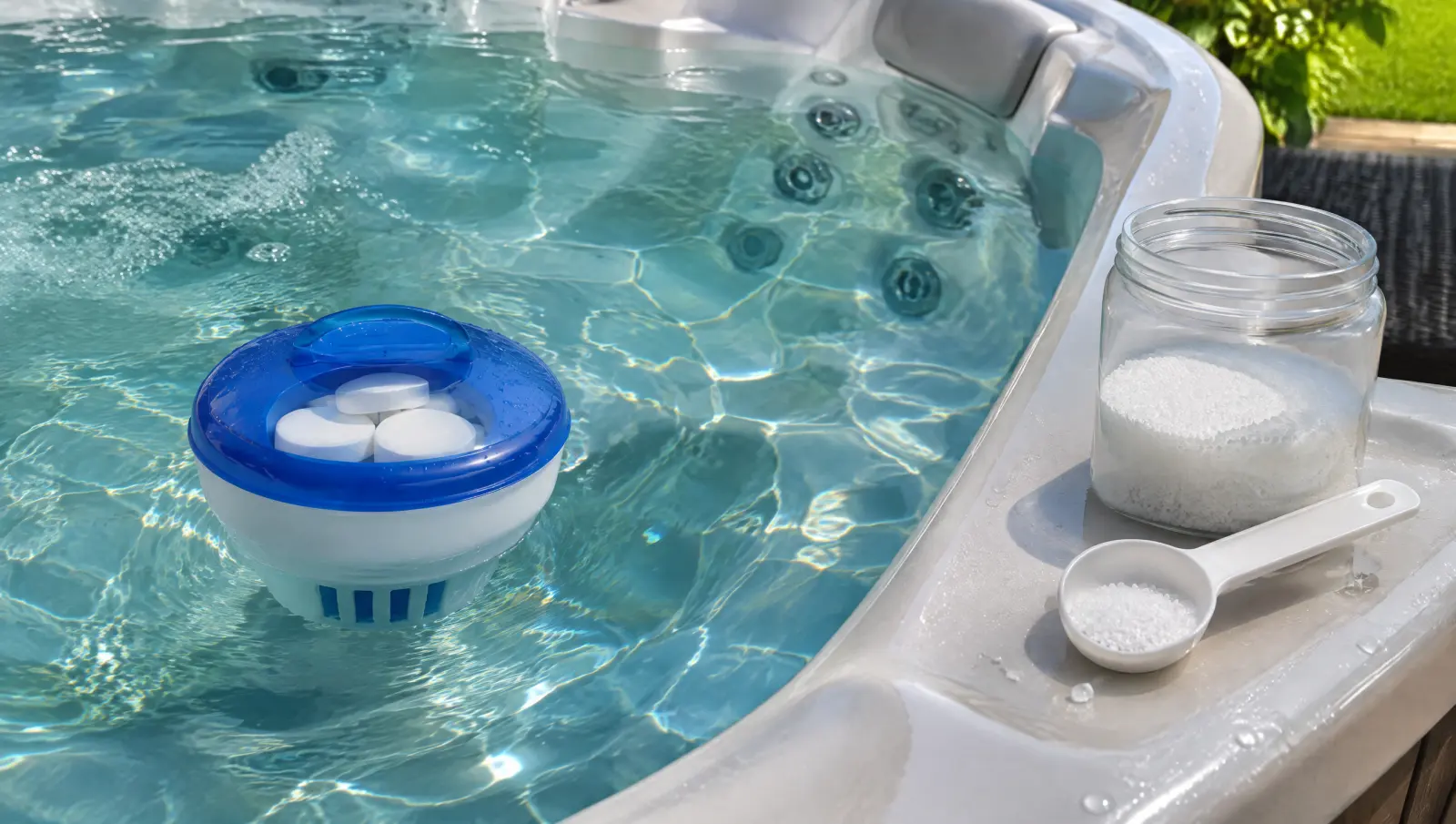
- Bromine is a two-part system: a bromide reserve (Leisure Time's label: 1/2 oz per 100 gallons for 30 ppm) plus tablets in a floater.
- Don't switch back and forth. Drain and refill before changing sanitizers, and treat bromine → chlorine as a must-drain: the bromide stays in the water and turns new chlorine back into bromine.
Step-by-step checklist
-
Use up or stop adding the old sanitizer
Stop adding chlorine or bromine a day or two before the drain and remove any floater or tablets from the tub, skimmer and filter well.
-
Flush the plumbing
Add a spa line cleaner and run the jets as the label directs to loosen biofilm and old chemical residue in the pipes.
-
Drain and clean
Turn off power at the breaker, drain completely, wipe the shell and footwell, and rinse out the remaining water.
-
Deal with the filter
Replace the filter cartridge or give it a full chemical soak and rinse so it doesn't carry the old sanitizer into the new water.
-
Refill and balance
Refill through the filter well, restore power, then bring total alkalinity to 80–120 ppm and pH to 7.2–7.8.
-
Start the new sanitizer
For bromine, add sodium bromide (1/2 oz per 100 gallons on the Leisure Time label), then tablets in a floater. For chlorine, add dichlor granules until free chlorine reads 3–5 ppm.
-
Shock and test
Shock per the label with the cover off and jets running, then test before the first soak and keep testing at least 2–3 times a week.
Retest after the wait time in the guide below before adding anything else.
In the bromine vs chlorine hot tub debate, bromine is usually the better fit for tubs that get used often and for people bothered by chlorine smell, because it stays active in hot water and at higher pH. Chlorine is faster, cheaper per pound and simpler to read, which makes it a good match for occasional use.
Both are safe when you keep them in range: at least 3 ppm of free chlorine or at least 4 ppm of bromine. Below you’ll find how each one works, the levels to aim for, what they cost you in effort and smell, how to switch between them without wrecking your water, and a verdict by type of owner. For the full routine, see our hot tub maintenance guide.
Bromine vs chlorine at a glance
| | Chlorine (dichlor granules) | Bromine (tablets in a floater) | |---|---|---| | Target level | 3–5 ppm free chlorine | 4–6 ppm bromine | | CDC minimum | 3 ppm | 4 ppm | | Works fast | Yes | Slower to build up | | Stable in hot water | Less stable | More stable above 100 °F | | Works at higher pH | Weakens quickly above 7.8 | Stays mostly active up to about 8 | | Smell | Stronger when chloramines build up | Milder | | Effort | Add a dose after each use or every couple of days | Floater releases it slowly; check weekly | | Side effect | Adds cyanuric acid (stabilizer) with every dose | Needs a bromide reserve at every refill | | Cost per pound | Lower | Higher | | Best for | Occasional use, owners who like quick control | Frequent use, sensitive skin, set-and-forget routines |
The short version: if you soak a few times a month and like to dose by hand, chlorine is easy and inexpensive. If the tub runs daily and you want the water to look after itself between checks, bromine is usually less work.
How each sanitizer works
Both chemicals kill germs the same basic way: in water they form a weak acid that attacks bacteria and oxidizes the oils and sweat bathers leave behind.
Chlorine forms hypochlorous acid (HOCl). It acts fast, and once it’s used up, it’s gone: you replace it with fresh chlorine. When it reacts with sweat and urine it forms chloramines (combined chlorine), which are weak sanitizers and the real source of the “chlorine smell.” A strong smell usually means too little free chlorine, not too much.
Bromine forms hypobromous acid (HOBr). Cal Spas describes its germ-killing power as comparable to chlorine’s. The big difference is what happens after it works. Spent bromine turns back into bromide ions, a reserve often called the bromide bank. Any oxidizer (your weekly shock, a chlorine dose, or an ozonator) turns that bromide back into active bromine. Orenda, a pool chemistry manufacturer, notes that bromamines (combined bromine) still have some sanitizing power and are less harsh than chloramines.
That’s why bromine is a two-part routine:
- Sodium bromide builds the bank when you fill the tub. It isn’t a sanitizer on its own.
- Bromine tablets in a floater keep a steady level, and the weekly shock regenerates the bank.
The catch with bromine: because it regenerates, it never really leaves. Orenda notes that it only takes a few ppm of bromide to turn chlorinated water into bromine water, and the only practical way back is to remove the bromide, which in a hot tub means a full drain.
The catch with chlorine: spa chlorine is almost always sodium dichlor, which adds cyanuric acid (stabilizer) every time you dose. The CDC’s Legionella guidance says stabilized chlorine products “should not be used in hot tubs as they slow disinfection.” Draining every 3–4 months keeps it from building up.
Why pH matters more for chlorine
Only the undissociated acid (HOCl or HOBr) does the heavy lifting. As pH rises, more of it splits into a much weaker form. Orenda puts the 50/50 point at pH 7.54 for chlorine and pH 8.65 for bromine. Here’s what that means at typical hot tub readings:
| pH | Chlorine in its strong form (HOCl) | Bromine in its strong form (HOBr) | |---|---|---| | 7.2 | About 69% | About 97% | | 7.5 | About 52% | About 93% | | 7.8 | About 35% | About 88% | | 8.0 | About 26% | About 82% |
Calculated from the 50/50 points Orenda gives (pH 7.54 and 8.65). Real water also depends on temperature and dissolved solids, so treat these as approximate.
Hot tubs tend to drift up in pH because the jets drive carbon dioxide out of the water. With chlorine, a pH of 8.0 leaves you with roughly a quarter of the sanitizing power you’d have at 7.2. Bromine barely notices. Bullfrog Spas puts bromine’s effective range at about 7.2 to 8.4, against 7.2 to 7.8 for chlorine.
You should still keep pH at 7.2–7.8 with either sanitizer: high pH also causes scale and cloudy water, and low pH corrodes heaters. Bromine just gives you more margin between tests.
Target levels: what the CDC says
The CDC sets higher minimums for hot tubs than for pools because hot water helps germs grow and jets turn them into mist you breathe in.
| | Free chlorine | Bromine | pH | |---|---|---|---| | CDC minimum (hot tub users’ guidance) | 3 ppm | 4 ppm | 7.0–7.8 | | CDC Legionella control limits for hot tubs | 3–10 ppm | 4–8 ppm | 7.2–7.8 | | Our everyday target | 3–5 ppm | 4–6 ppm | 7.2–7.8 |
Test before every soak and at least 2–3 times a week. The CDC recommends checking sanitizer and pH twice a day, more often with many bathers.
Safety note
Whatever a product label or app suggests, keep bromine at or above the CDC’s 4 ppm minimum for hot tubs (aim for 4–6 ppm) and free chlorine at or above 3 ppm (aim for 3–5 ppm). And never let either sanitizer drop to zero, even when the tub isn’t being used.
Testing tip: bromine test strips read total bromine, because bromamines still sanitize. Chlorine strips should read free chlorine separately from total chlorine. A strip that reads both, such as AquaChek 7-Way, still works if you switch at your next drain. Our best hot tub test strips guide compares options for each sanitizer.
Smell, skin and comfort
This is where most people make up their minds.
- Smell. Chlorine’s strong odor comes from chloramines, so a well-shocked chlorine tub with free chlorine in range smells less than people expect. Bromine has a milder, different smell, but Bullfrog Spas notes that it can smell too, especially with a heavy organic load, and that sources disagree on which is worse.
- Skin and eyes. Many people find bromine gentler, and chloramines are known to irritate skin and eyes. Reactions vary from person to person, though. If you get itchy after a soak, check the basics first: low sanitizer or pH out of range irritates skin with either chemical.
- After the soak. Some owners say bromine lingers on skin and swimsuits longer and is harder to rinse off. A quick shower after soaking helps with either one.
If one sanitizer clearly bothers you or someone in your household, that alone is a good reason to try the other at your next drain.
Cost and effort
We couldn’t find a credible, current cost comparison in dollars, so we won’t invent one. What spa makers agree on:
- Chlorine costs less per pound than bromine (Cal Spas, Bullfrog Spas).
- Cal Spas notes the total cost gap often narrows in practice, because bromine’s regeneration and stability mean you add it less often, though chlorine usually stays somewhat cheaper overall.
- Bromine adds one product: sodium bromide at every refill. A 16 oz bottle at 1/2 oz per 100 gallons covers about six startups for a 500-gallon tub.
Effort is a trade-off:
| Task | Chlorine | Bromine | |---|---|---| | Daily or per-use dosing | Usually yes, a scoop of granules | No, the floater feeds it | | Correcting a low reading quickly | Easy: granules act in minutes | Slower to build back up | | Weekly shock | Yes | Yes (it also regenerates the bromide) | | Extra startup step | None | Sodium bromide after each refill | | Watching pH | Closely | Still needed, more forgiving |
Can you mix bromine and chlorine?
Not in the way people usually mean. There are two separate questions here.
Mixing the products: never. Don’t put chlorine tablets in a bromine floater, don’t combine granules in the same scoop or bucket, and don’t store them together. The CDC warns that mixing pool chemicals can cause dangerous reactions, including toxic gases. Add each product to the water on its own, with the jets running.
Adding chlorine to bromine water: it turns into bromine. Chlorine oxidizes the bromide bank back into active bromine. That’s why a dichlor shock works on a bromine tub: it regenerates your bromine. But it also means you can’t “switch” to chlorine by simply adding it. As long as bromide is in the water, your chlorine readings won’t mean what you think they mean.
Adding bromine to chlorine water turns your chlorine tub into a bromine tub, with leftover cyanuric acid from the dichlor along for the ride. It works chemically, but it’s not a clean start.
The rule that keeps it simple: pick one sanitizer and stay with it until your next drain. Our hot tub chemicals guide lists what to buy for each routine.
How to switch from chlorine to bromine (or back)
Drain and refill either way. Cal Spas and AquaDoc both say chlorine and bromine shouldn’t be mixed and that switching starts with an empty tub. Going from bromine to chlorine, draining is not optional: the bromide bank stays in the water and keeps turning your new chlorine into bromine.
- Stop adding the old sanitizer. Take the floater and any tablets out of the tub, skimmer and filter well a day or two before.
- Flush the plumbing. Add a spa line cleaner and run the jets as the label directs. It loosens biofilm and old residue in pipes you can’t reach.
- Turn off power and drain completely. Wipe the shell and footwell, and sponge out what’s left. A little water always stays in the lines; a wet-dry vacuum on the jets or a quick rinse-and-drain helps dilute it.
- Replace the filter or give it a full soak. A cartridge that’s spent months in bromine water can carry residue into the new fill.
- Refill and balance. Bring total alkalinity to 80–120 ppm, then pH to 7.2–7.8, running the jets for 20–30 minutes between additions.
- Start the new sanitizer.
- Bromine: add sodium bromide (1/2 oz per 100 gallons on the Leisure Time label, or 2.5 oz for 500 gallons), then load the floater with bromine tablets.
- Chlorine: dose dichlor granules (SpaChoice’s label: 1 teaspoon per 500 gallons for about 1.4 ppm) until free chlorine reads 3–5 ppm.
- Shock, then test before the first soak, and keep testing at least 2–3 times a week while the new routine settles.
The step-by-step drain is in our guide to how to drain a hot tub. Before switching, check your owner’s manual: some manufacturers specify which sanitizers their warranty or built-in systems support.
Ozone, mineral and other add-ons
Add-ons don’t replace a sanitizer; they help it.
- Ozone. Cal Spas says both chlorine and bromine work with common ozone and UV systems. Orenda adds a caution for bromine: when ozone oxidizes bromide, some of it (Orenda says about 23% of the time) becomes bromate instead of bromine, and it advises against pairing bromine with ozone or UV. Many spas come with an ozonator built in, so follow your tub’s manual, and if your tub has ozone and you’re undecided, that’s one point for chlorine.
- Mineral systems. These release silver and other minerals so you can run a lower sanitizer level. Most are built around one specific sanitizer. Bullfrog’s FROG @ease system, for example, uses its own SmartChlor chlorine cartridges. Check which sanitizer your mineral cartridge is designed for before you switch, and still keep the CDC minimums in mind.
- Non-chlorine shock (MPS). Works with both. On bromine it also regenerates the bromide bank, and on either system it oxidizes without raising the sanitizer reading.
Verdict: which sanitizer fits you?
| If you… | Choose | Why | |---|---|---| | Soak a few times a month | Chlorine | Cheap, fast, and frequent drains keep stabilizer low | | Use the tub daily or have a big household | Bromine | Steady release and better tolerance for pH drift | | Have sensitive skin or dislike chlorine smell | Bromine | Many people find it gentler; bromamines are milder | | Want the lowest cost per pound | Chlorine | Spa makers agree it’s cheaper | | Like to fix readings fast | Chlorine | Granules act within minutes | | Want set-and-forget between checks | Bromine | A floater feeds it; check weekly | | Own a small inflatable tub you drain often | Either; often chlorine | Dissolves fast in small volumes; check the manual | | Have a mineral system or ozonator | Whatever the system is designed for | Some are built for one sanitizer only |
There’s no wrong answer if you keep the numbers in range. The only wrong move is mixing them in the same water without draining.
What you need for each routine
These are the products we’d start with for each sanitizer. All are sold on Amazon.com and labeled for spas.
For a chlorine routine
SpaChoice Chlorine Granules (sodium dichlor, 5 lb)
- Active ingredient
- Sodium dichlor
- Use
- Daily sanitizer and shock
- Size
- 5 lb
Specs from the Amazon listing and manufacturer documentation
Spa-specific dichlor granules that work as your daily sanitizer and your chlorine shock. The listing says 1 teaspoon adds about 1.4 ppm of chlorine in 500 gallons, so the dose is easy to scale to your tub.
Pros
- One product covers sanitizing and chlorine shock
- Dissolves quickly, so readings respond fast
Cons
- Adds cyanuric acid with every dose, so drain on schedule
- Usually needs a dose after each use or every couple of days
For a bromine routine
Leisure Time Sodium Bromide (bromide reserve, 16 oz)
- Dose
- 1/2 oz per 100 gal (2.5 oz per 500 gal)
- When
- At startup and after every refill
- Size
- 16 oz
Specs from the Amazon listing and manufacturer documentation
Builds the bromide bank at startup. The listing dose is 1/2 oz per 100 gallons for a 30 ppm bromide level, repeated after each drain and refill. It isn't a sanitizer by itself.
Leisure Time Brom Tabs (brominating tablets, 4 lb)
- Form
- Tablets for a floater or feeder
- Active ingredient
- BCDMH (bromochlorodimethylhydantoin)
- Size
- 4 lb
Specs from the Amazon listing and manufacturer documentation
BCDMH brominating tablets for spa floaters and feeders; the listing says they fit all floaters. Build the bromide reserve with sodium bromide first, then let the floater keep bromine at 4–6 ppm.
Pros
- Slow, continuous release: check and refill the floater weekly
- Listing says the tablets fit all floaters
Cons
- Needs sodium bromide at every refill
- Slower to raise a low reading than chlorine granules
AquaAce Hot Tub and Spa Floater Dispenser (1-inch tablets)
- Tablet size
- 1 inch
- Adjustment
- 13 release settings
- Works with
- Bromine or chlorine tablets
Specs from the Amazon listing and manufacturer documentation
A floating dispenser for 1-inch bromine or chlorine tablets with an adjustable release (13 settings, per the listing). Start on a low setting, test after a day or two and turn it up until bromine holds at 4–6 ppm.
Cons
- Use it for one sanitizer only: never load chlorine tablets into a floater that has held bromine
AquaChek Red 4-Way Spa Test Strips (bromine, 50 count)
- Tests
- Total bromine, pH, alkalinity, hardness
- Count
- 50 strips
Specs from the Amazon listing and manufacturer documentation
Bromine-specific strips that read total bromine, pH, total alkalinity and total hardness. Per the listing, bromine reads from 0 to 20 ppm and pH from 6.2 to 8.4.
Common mistakes
- Switching without draining. Especially bromine to chlorine: the bromide bank stays and your chlorine readings stop making sense.
- Using pool tablets in a spa. Pool trichlor tablets are acidic, add stabilizer and are sized for big pools. Use products labeled for spas.
- Skipping the bromide at startup. Without a reserve, tablets take a long time to reach a reading.
- Reading the wrong scale. Use the bromine scale for bromine and free chlorine for chlorine.
- Chasing the smell with less chemical. A strong chlorine smell means chloramines, which you fix by shocking, not by cutting back.
- Letting pH drift on chlorine. Above 7.8, chlorine loses much of its strength.
- Ignoring stabilizer on a chlorine routine. Drain every 3–4 months so dichlor’s cyanuric acid doesn’t build up.
When to call a technician
Most sanitizer issues are fixable with a test strip and a shock. Call a spa technician if:
- Sanitizer won’t hold in range even after shocking, a fresh fill and a clean filter.
- Your tub has a built-in ozonator, salt or mineral system and you aren’t sure it’s compatible with the sanitizer you want.
- Water stays cloudy or foamy right after a fresh fill. See cloudy hot tub water and hot tub foam first.
- Anyone in the household gets a rash or breathing problems after soaking, even with levels in range. See a doctor, too.
How we put this guide together
We don’t own a hot tub and haven’t run either sanitizer ourselves. This guide is built from sources you can check: the CDC’s hot tub and Legionella guidance for sanitizer and pH levels, the CDC’s chemical safety poster, chemistry explanations from Orenda, sanitizer guides from spa makers Cal Spas and Bullfrog Spas, AquaDoc’s switching guide, and the label directions on each product’s Amazon listing. The pH table is our own calculation from the figures Orenda publishes. Where sources disagree, we use the more cautious CDC number. All sources are listed at the end of the page.
Whichever sanitizer you pick, the rest of the routine is the same: test, balance, shock weekly, keep the filter clean and drain on schedule. Our hot tub maintenance schedule puts it all on one printable page.
Sources
- CDC: Controlling Legionella in Hot Tubs (Legionella Control Toolkit) · cdc.gov
- CDC: What You Can Do to Stay Healthy in Hot Tubs · cdc.gov
- CDC: Home Pool and Hot Tub Water Treatment and Testing · cdc.gov
- CDC: Use Pool Chemicals Safely (poster, PDF) · cdc.gov
- Orenda: Understanding Bromine Pools and Spas · blog.orendatech.com
- Cal Spas: Chlorine vs Bromine, Choosing the Right Hot Tub Sanitizer · calspas.com
- Bullfrog Spas: Bromine vs Chlorine, Choosing the Right Sanitizer for Your Hot Tub · bullfrogspas.com
- AquaDoc: How Do I Switch From Chlorine to Bromine in My Hot Tub? · mavaquadoc.com
Frequently asked questions
Is bromine or chlorine better for a hot tub?
Neither is better for everyone. Bromine suits tubs that get used often, owners with sensitive skin or a dislike of chlorine smell, and anyone who wants a slow-release, set-and-forget routine, because it stays active at higher pH and in hot water. Chlorine suits occasional use and owners who want fast, cheap, easy-to-read control. Both keep water safe at the CDC levels: at least 3 ppm free chlorine or at least 4 ppm bromine.
Can I switch my hot tub from chlorine to bromine?
Yes. The cleanest way is to flush the plumbing, drain, clean the shell, replace or deep-clean the filter and refill. Then balance alkalinity and pH, add sodium bromide to build a bromide reserve, put bromine tablets in a floater and shock. Draining also gets rid of the cyanuric acid that dichlor chlorine leaves behind.
What are the disadvantages of bromine in a hot tub?
Bromine costs more per pound than chlorine and builds up more slowly, so it's harder to correct a low reading in a hurry. It needs a sodium bromide reserve after every refill, it can't be protected from sunlight with stabilizer, and some people find bromine harder to rinse off their skin. Once you've used it, the only practical way back to chlorine is a full drain.
Is it bad to mix bromine and chlorine together?
Never mix the products themselves: don't put chlorine tablets in a bromine floater or combine granules in a scoop or bucket, since the CDC warns that mixing pool chemicals can cause dangerous reactions. In the water, chlorine added to a bromine tub doesn't stay chlorine: it oxidizes the bromide back into bromine. That's why many bromine owners can shock with chlorine, but it also means you can't run a chlorine tub until you drain.
What's better for an inflatable hot tub, chlorine or bromine?
Either works, so check your inflatable tub's manual first. Dichlor granules dissolve quickly in a small volume, and inflatable tubs are usually drained often, which keeps dichlor's cyanuric acid from building up. Bromine tablets in a small floater are a good fit if the tub runs every day and you want a slower, steadier release. Smaller volumes swing faster either way, so dose small and test often.
Why don't pools use bromine?
Mostly because of sunlight and cost. Chlorine can be shielded from the sun with cyanuric acid, but there's no stabilizer for bromine, so it burns off quickly in an uncovered outdoor pool. Bromine is also more expensive per pound, which adds up across thousands of gallons. A covered hot tub avoids most of the sun problem, which is why bromine is common in spas.