On this page
Key takeaways
- Drain and refill every 3–4 months. The rule of thumb: gallons ÷ 3 ÷ average daily bathers = days between drains.
- Before you start, add a line flush and run the jets, then turn the power off at the breaker so the pumps and heater never run dry.
- Jacuzzi puts a gravity drain through the built-in spigot at about 45–90 minutes for a 400–500 gallon spa. A submersible pump does it in about 10–15 minutes.
- Don't send the water down a storm drain. The sanitary sewer or your own lawn is usually the right place, and Portland, Oregon, for example, only allows storm drain discharge after water is dechlorinated to 0.1 mg/L or less. Check your city's rules.
- Refill through the filter well to avoid airlocks, then balance alkalinity first, then pH, then sanitizer.
Step-by-step checklist
-
Flush the plumbing lines
Add a hot tub line flush at the label dose and run the jets as the label directs, so biofilm loosened from the pipes leaves with the old water.
-
Turn off the power at the breaker
Switch the hot tub off at the circuit breaker so the pumps and heater can't run while the water level drops.
-
Remove the filters
Lift the cartridges out of the filter compartment and set them to soak in filter cleaner while you work.
-
Plan where the water goes
Route the hose to a sanitary sewer cleanout or a spot on your own property where water can soak in, never to a storm drain or the street. Follow your city's rules.
-
Drain the tub
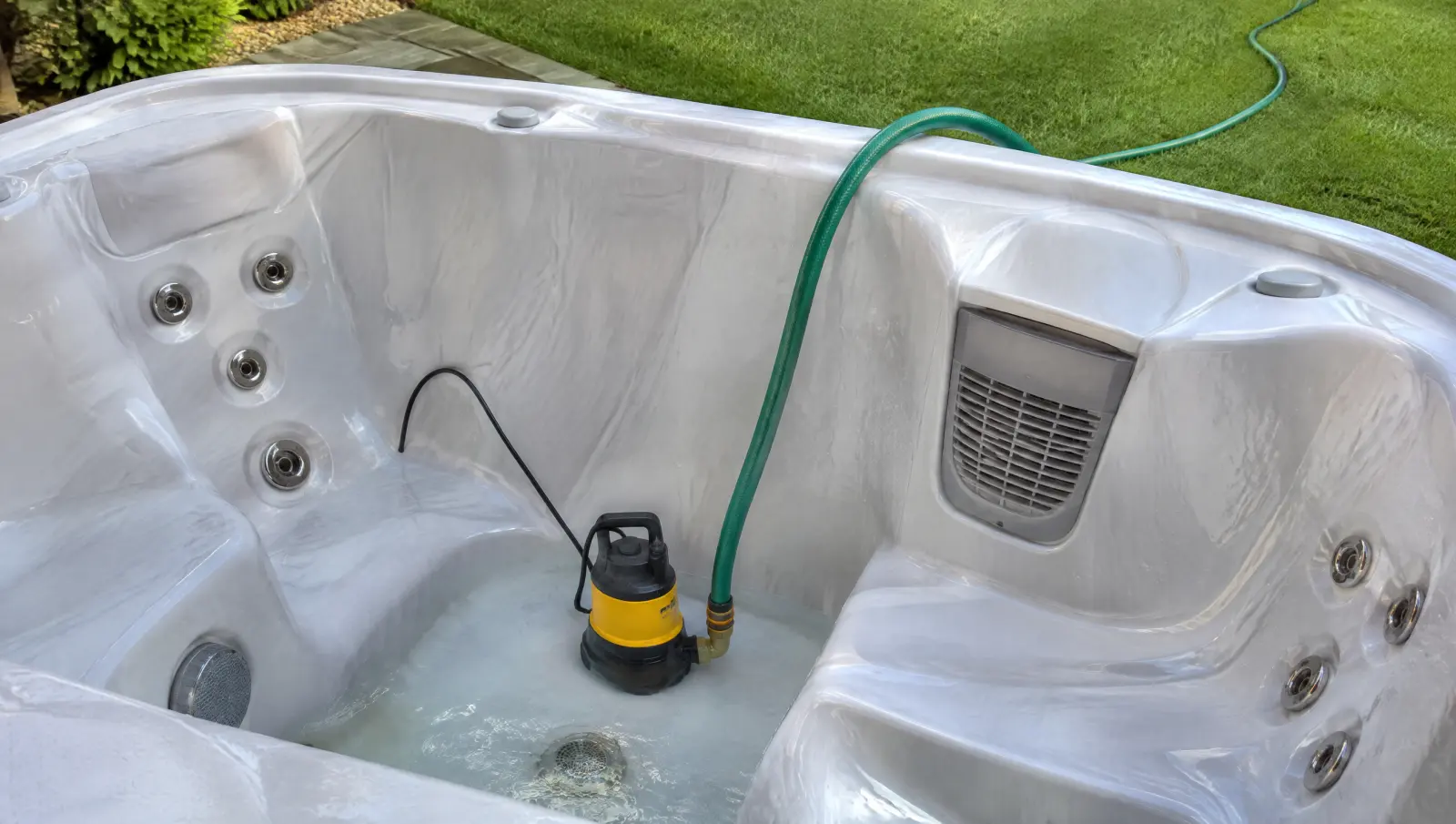
Attach a garden hose to the drain spigot and open the valve, or set a submersible pump in the footwell. Turn the pump off as soon as the water drops below its intake.
-
Remove the last of the water
Open the secondary spigot if your tub has one, then pick up remaining puddles with a wet/dry vacuum or towels.
-
Clean the shell and jets
Wipe the shell with a spa surface cleaner or a 4:1 mix of warm water and white vinegar, rinse, and brush residue from the jets.
-
Refill through the filter well
Reinstall the clean filters, put the hose in the filter compartment or standpipe and fill slowly to the level in your manual.
-
Restore power and balance the water
Turn the breaker back on, let the system prime, then adjust alkalinity, then pH, then bring sanitizer into range.
Retest after the wait time in the guide below before adding anything else.
To drain a hot tub, add a line flush and run the jets, turn the power off at the breaker, then empty the tub through its drain spigot or with a submersible pump into a sanitary sewer cleanout or a spot on your own property, never a storm drain. Clean the shell and filters while it’s empty, refill through the filter well and rebalance the water.
The whole job takes about two to three hours, most of it waiting. Below you’ll find how often to do it, the nine steps in order, where the water can legally go, and what changes for inflatable tubs and winter drains.
How often to drain a hot tub
Every 3–4 months for most home hot tubs on chlorine or bromine. Jacuzzi and Hot Spring both give that interval, and both say saltwater systems can go longer (about once a year).
Use, not the calendar, is what wears water out. Every soak adds sweat, skin oils and lotion residue, and every dose of chemicals adds dissolved solids. The standard rule of thumb turns that into a number:
Days between drains = tub volume in gallons ÷ 3 ÷ average daily bathers
| Tub size | 1 bather/day | 2 bathers/day | 4 bathers/day | |---|---|---|---| | 210 gallons (typical 4-person inflatable) | 70 days | 35 days | 18 days | | 300 gallons | 100 days | 50 days | 25 days | | 450 gallons | 150 days | 75 days | 38 days | | 600 gallons | 200 days | 100 days | 50 days |
Intex publishes the same formula for its inflatable spas, with the example of a 210-gallon tub used by two people a day needing new water every 35 days. Small tubs hit the limit fast.
Drain early if any of these show up:
- Water stays cloudy or foamy a day after you shock it.
- Sanitizer won’t hold, even with pH in range.
- A smell that shocking doesn’t clear.
- You use chlorine granules (sodium dichlor) heavily. Each dose adds a little stabilizer, and the CDC advises keeping stabilizer out of hot tubs. Fresh water is the only way to remove it.
If the problem is cloudy water or foam, try the fixes in cloudy hot tub water and hot tub foam first. If they don’t hold for more than a day or two, the water is done.
What you’ll need
- Line flush (plumbing cleaner) for the hour before draining
- Garden hose, at least 25 ft. Jacuzzi recommends 3/4-inch over 5/8-inch for faster flow
- Submersible utility pump (optional, but it cuts drain time to about 15 minutes)
- Wet/dry vacuum or old towels for the last inch of water
- Soft cloths and a spa-safe surface cleaner, or white vinegar
- Filter cleaner and a bucket for the cartridges
- Hose prefilter for the refill (optional, useful with well water or sediment)
- Test strips and your balancing chemicals for the restart
How to drain a hot tub, step by step
1. Flush the plumbing lines
Biofilm grows inside the pipes and jets where you can’t scrub. A line flush loosens it so it leaves with the old water instead of seeding the new fill. Add it at the label dose for your tub’s gallons, run the jets as the label directs, and don’t soak while it’s in. Expect some brownish gunk on the surface: that’s what came out of the lines. Skim or wipe it off.
Ahh-Some Hot Tub Purge & Jet Line Cleaner (4 oz)
- Dose (listing)
- 1 tsp per 125 gal
- Size
- 4 oz tube, about 8 purges for tubs up to 400 gal (listing)
- When
- Just before each drain
Specs from the Amazon listing and manufacturer documentation
A gel line cleaner you add right before draining. It's the same flush we list in our hot tub chemicals guide, and it's the one product here that does a job nothing else in your kit can.
Pros
- Reaches plumbing you can’t clean by hand
- Eight purges is two years of quarterly drains on a tub up to 400 gallons
Cons
- The label warns soft-water users may need less to keep suds from overflowing
- Follow the dose printed on the tube you buy, since labels can change
2. Turn off the power at the breaker
Switch the tub off at the circuit breaker, not just the control panel. Jacuzzi’s guide is blunt about why: pumps and heaters running while the water drops below their intakes can be badly damaged. Some control panels restart pumps on a schedule, so the breaker is the only reliable off switch.
Jacuzzi also suggests letting the water cool below 100 °F before draining, which makes the job safer if you’re handling hoses and pumps in hot water.
3. Remove the filters
Lift the cartridges out and start their deep clean now. Soak them in a filter cleaner solution while the tub drains and gets cleaned, and they’ll be ready (or close) when it’s time to refill. Our guide on how to clean a hot tub filter walks through the soak.
4. Plan where the water goes
Decide before you open the valve. The short version: a sanitary sewer cleanout or your own lawn, never a storm drain, the street or a neighbor’s yard. Rules vary by city, so see where to drain hot tub water below.
5. Drain the tub
With the drain spigot: Most hard-shell tubs have a drain spigot behind a removable panel near the base of the cabinet. Remove the cap, attach the hose by hand (plastic threads crack if you overtighten or cross-thread them), run the hose downhill and open the valve fully. Jacuzzi estimates 45–90 minutes for a 400–500 gallon spa. Check on it now and then to make sure the hose hasn’t popped off.
With a submersible pump: Set the pump in the deepest part of the footwell, connect a garden hose to its outlet and run the hose to your drain spot. Plug it into a GFCI-protected outdoor outlet (the tub’s own circuit is off). Jacuzzi says this takes about 10–15 minutes. Stay with it, and switch the pump off as soon as the water drops below the intake: running dry can burn out the motor.
6. Remove the last of the water
No drain gets everything. If your tub has a secondary spigot, Hot Spring says to open it to empty the internal bleed lines. Then pick up the puddles in the footwell and seats with a wet/dry vacuum or towels.
7. Clean the shell and jets
With the tub empty, you can reach the waterline scum and the corners where it collects.
- Shell: Use a hot tub surface cleaner, or Jacuzzi’s suggested mix of 4 parts warm water to 1 part white vinegar. Wipe with a soft cloth, paying attention to the waterline, then rinse. Hot Spring warns that many household cleaners can damage a spa shell, so check your manual before using anything else.
- Jets: Brush residue out of the jet faces with a soft brush.
- Cover: Wipe the underside while it’s easy to get at. More in our guide to hot tub covers.
- Inspect: Look at gaskets, visible plumbing connections and the cover for wear while everything is dry.
Rinse well and drain the rinse water out. Cleaner residue left in the shell causes foam in the new water.
8. Refill through the filter well
Reinstall the clean filters first. Then put the hose into the filter compartment or the fill standpipe, not straight into the shell, and fill slowly to the level in your manual (usually just above the highest jets). Details in how to refill a hot tub.
9. Restore power and balance the water
Turn the breaker back on and let the system prime. Some gurgling and air purging is normal. Then:
- Test with strips or a drop kit.
- Adjust total alkalinity to 80–120 ppm.
- Adjust pH to 7.2–7.8.
- Bring sanitizer into range: free chlorine 3 ppm or higher, or bromine 4 ppm or higher. If you use bromine, rebuild the bromide reserve with sodium bromide after every fresh fill.
Run the jets 20–30 minutes between additions and test again before adding more. Jacuzzi suggests adding chemicals once the water reaches operating temperature. Product picks and doses for each step are in our hot tub chemicals guide.
Drain spigot vs submersible pump
| | Built-in drain spigot | Submersible utility pump | |---|---|---| | Time for 400–500 gal | About 45–90 minutes (Jacuzzi) | About 10–15 minutes (Jacuzzi) | | Cost | Free, it’s on the tub | One-time purchase | | Needs | Hose that runs downhill | Outdoor GFCI outlet, someone watching | | Leaves behind | Water in the footwell and seats | About the last inch, depending on the pump | | Risk | Slow or partial drain if the hose runs uphill | Motor damage if it runs dry | | Best for | Patient owners, tubs on a slope | Anyone who drains on a schedule or in cold weather |
A pump earns its keep if your drain spot is uphill or far away, or if you just don’t want to spend an afternoon on it. It’s also handy for draining a flooded window well or a pool cover, which is why most utility pumps are sold for basements.
Superior Pump 91250 Thermoplastic Submersible Utility Pump (1/4 HP)
- Motor
- 1/4 HP, 120 V, 10 ft cord
- Flow (maker)
- Up to 1,800 GPH at 0 ft; max lift 25 ft
- Outlet
- 1-1/4" NPT, 3/4" garden hose adapter included
- Pumps down to
- 1/8 in. (maker)
- Warranty
- 1-year limited
Specs from the Amazon listing and manufacturer documentation
A plain, manual-switch utility pump with a garden hose adapter in the box. The maker rates it at up to 1,800 gallons per hour at zero lift, and its 35–120 °F liquid range covers hot tub water.
Pros
- Hose adapter included, so it works with the hose you already own
- Manual switch: no float to fiddle with in a shallow footwell
Cons
- Rated flow drops with a long or narrow garden hose and with lift
- You have to watch it and shut it off before it runs dry
- 10 ft cord: plan where the outlet is before you start
Where to drain hot tub water
Hot tub water is warm and full of sanitizer, which is fine for your skin and bad for streams. The EPA notes that chlorine-, bromine- and salt-treated water harms water quality and wildlife when it reaches surface waters, and that many communities ban chlorinated pool and hot tub water from storm drains outright. Storm drains usually lead straight to a creek or lake with no treatment.
| Where | Usually allowed? | What to know | |---|---|---| | Sanitary sewer cleanout | Often the preferred option | Portland, for example, lets home owners do this without prior authorization. Some cities restrict it: the EPA notes Virginia Beach bans private pool water from its public sewer | | Your own lawn or landscape | Often allowed | Only if it soaks in on your property. Spread it out so it doesn’t run off; treated water can harm sensitive plants | | Storm drain or street gutter | Usually prohibited | Some cities allow it only after dechlorination and sometimes only with permission | | Sidewalk, street, a neighbor’s yard | No | Portland’s rule is typical: never let water flow onto the sidewalk, street or right-of-way |
What “dechlorinated” means in practice. Portland’s rules are a good example of how strict a city can be. If there’s truly no other option and water goes to a storm drain, the city requires that you:
- cool the water for at least 12 hours,
- let it sit at least two weeks,
- test it down to 0.1 mg/L total residual chlorine or less,
- make sure the pH is neutral, and
- discharge at less than 50 gallons per minute.
Salt-treated water can never go to Portland’s storm drains.
Saltwater tubs: expect tighter rules. Portland bans salt-treated water from storm drains entirely, and other cities may limit it to the sanitary sewer.
Check your own city first
Rules differ from town to town, and fines are possible. Search your city or county name plus “pool and spa discharge” or “stormwater,” or call public works. Look for where treated water may go, any dechlorination threshold, and whether you need permission.
How to drain a hot tub fast
If you want it done in under half an hour:
- Use a submersible pump in the footwell. It’s the single biggest speedup, from over an hour to about 15 minutes.
- Open the spigot too. Gravity keeps working while the pump runs.
- Use a 3/4-inch hose, as short as practical, laid flat and downhill with no kinks. Skip expandable hoses on a pump outlet; at least one pump maker warns they can reduce output.
- Have the wet/dry vac ready so the last inch doesn’t hold you up.
No pump and no usable spigot? Some owners start a siphon by filling a garden hose with water, capping one end, and releasing it at a point lower than the tub. It works, but slowly, and only if the hose end sits well below the water line.
How to refill a hot tub
The refill is where an airlock happens. Hot Spring describes an airlock as an air bubble trapped in the plumbing that can stop the tub working properly and damage the pumps.
- Fill through the filter well. Put the hose in the filter compartment or the standpipe under the filter (the exact spot depends on the model). Both Jacuzzi and Hot Spring recommend it to avoid airlocks.
- Fill slowly. Jacuzzi warns that rapid filling can trap air and cause pump cavitation.
- Stop at the right level, usually just above the highest jets or as marked in your manual.
- Prefilter the water if you’re on a well or your tap water carries sediment. A hose-end prefilter catches grit before it ends up in your clean cartridges.
- If the pumps whine or the jets won’t run after power-up, Jacuzzi suggests cycling the pumps on and off several times to push air out. If that doesn’t clear it, call your dealer.
Pleatco PPS2100 PureStart Spa Fill Cartridge
- Type
- Disposable hose-end prefilter
- Filters to
- 5 microns (Pentair, PureStart line)
- Lasts (listing)
- 2–3 fills
- Connection
- Garden hose
Specs from the Amazon listing and manufacturer documentation
A hose-end cartridge that screws onto a garden hose and filters fill water before it reaches the tub. The listing says it reduces iron, lead, scale, metals and chloramines and lasts 2–3 fills; those are the maker's claims, not independent test results. Pentair, which makes Pleatco, describes the PureStart line as 5-micron fill filters.
Pros
- Keeps sediment out of freshly cleaned filters
- Comes from the same brand as many replacement spa cartridges
Cons
- Metal and scale reduction are the maker’s claims; test your water after filling
- Only 2–3 fills per cartridge, per the listing
If your water is hard or carries metals, a sequestrant such as Leisure Time Metal Gon added at startup helps prevent staining. It’s covered in our hot tub chemicals guide.
How to drain an inflatable hot tub
Inflatables follow the same logic with simpler hardware. They hold less water (242–314 gallons for the models in our inflatable guide whose listings state a figure), so by the rule of thumb they need new water more often than a hard-shell tub.
- Turn off and unplug the pump/heater unit and disconnect it from the tub, as your manual describes.
- Drain through the valve or the pipes. Bestway’s Lay-Z-Spa FAQ describes letting water run out of the two pipe connections or attaching a garden hose with the hose adaptor. When the level is very low, open the plug on the bottom of the liner to drain the rest.
- Dry it completely. Bestway says to dry the liner fully and, before winter storage, leave it deflated in the sun for half a day and store it somewhere dry to prevent mildew.
- Clean or replace the cartridges. Inflatable filters are small and wear out fast. Intex, for example, says to clean its S1 cartridges each week and replace them once a month or sooner.
Valve layouts differ by brand and model year, so check your manual for which cap to remove and whether you need an adaptor. Never let water freeze in an inflatable: if deep cold is coming and you can’t keep the tub running, drain, dry and store it indoors. Compare models in our guide to the best inflatable hot tubs.
Draining a hot tub in winter
Draining in winter is where expensive damage happens. Hot Spring’s advice is to keep the tub running and full of hot water all winter if you’re home. Water that moves and stays warm doesn’t freeze; water sitting in an empty tub’s pipes does.
If you must drain and leave it empty (moving out, a long trip, a tub you won’t use until spring), a simple drain isn’t enough:
- Drain before freezing weather arrives. Jacuzzi says to have the tub thoroughly drained before temperatures fall below freezing.
- Get water out of everything. Jacuzzi describes opening the jets, loosening couplers, removing bleed valves or drains and using a shop vac to blow air through the plumbing and clear the pump housing, filter canister and heater.
- Antifreeze, if you use it, must be propylene glycol. Hot Spring warns never to use the ethylene glycol antifreeze made for cars.
- Lock the cover so snow and rain don’t refill the footwell.
Not sure? Hire it out
Every model’s plumbing is different, and one missed low spot is enough to crack a pump. Hot Spring suggests hiring a professional if you’re unsure, and your dealer can usually send a technician. If you’re draining on schedule, do it in fall, before the first hard freeze.
Common mistakes
- Leaving the breaker on. A pump that kicks on while the tub is half empty can burn out. Turn it off at the breaker.
- Skipping the line flush. Biofilm in the pipes contaminates the fresh water within days.
- Draining into the storm drain or street. It’s illegal in many cities and harms local waterways.
- Letting the pump run dry. Stay with it and shut it off when the water drops below the intake.
- Overtightening the hose on the spigot. The plastic threads crack easily.
- Running the hose uphill. You’ll only drain part of the tub.
- Using household cleaners on the shell. Many can damage the surface or leave residue that foams.
- Filling straight into the shell. That’s the classic recipe for an airlock. Fill through the filter well.
- Putting dirty filters back in clean water. Clean or replace them while the tub is empty.
- Adding sanitizer before balancing. Fix alkalinity first, then pH, then sanitizer.
When to call a technician
Draining is a DIY job, but call your dealer or a spa technician if:
- the drain spigot is stuck, cracked or leaking,
- the pumps hum without moving water after refilling and cycling them doesn’t clear the airlock,
- the control panel shows a flow or heater error that doesn’t clear,
- you find a leak under the cabinet while the tub is empty, or
- you need to winterize and aren’t sure where all the low points in the plumbing are.
How we put this guide together
We don’t own a hot tub and haven’t drained one for this article. The steps and figures come from sources you can check: Jacuzzi’s and Hot Spring’s draining, refilling and winterizing guides, Intex’s and Bestway’s inflatable spa guidance, the US EPA’s stormwater guidance and the City of Portland’s discharge rules, the CDC’s hot tub water guidance, and the product specifications published by each maker. Where sources disagree, we use the more cautious number. Every source is listed at the end of the page.
The bottom line
Drain every 3–4 months, or sooner by the gallons ÷ 3 ÷ bathers rule. Flush the lines, kill the breaker, drain by spigot or pump to a sewer cleanout or your own lawn, clean the shell and filters, refill through the filter well and rebalance. For the rest of the routine, from weekly testing to shocking, head back to our hot tub maintenance guide.
Sources
- Jacuzzi: How to Drain a Hot Tub · jacuzzi.com
- Hot Spring Spas: How to Drain a Hot Tub, Refill It, and Get It Ready for Use · hotspring.com
- Hot Spring Spas: How to Winterize Your Hot Tub · hotspring.com
- Jacuzzi: How to Winterize a Hot Tub or Swim Spa · jacuzzi.com
- US EPA: Stormwater BMP, Educating Residents on Safely Discharging Chemically Treated Water (EPA-832-F-21-032G) · epa.gov
- City of Portland: How to Drain or Empty Your Pool or Hot Tub to Meet City Rules · portland.gov
- Intex: Inflatable Hot Tub Water Sanitation and Maintenance · intexcorp.com
- Bestway: Lay-Z-Spa Miami AirJet (product page and FAQ) · m.bestwaycorp.com
- Superior Pump: 91250 Thermoplastic Utility Pump (specifications) · superiorpump.com
- Pentair: Pleatco PureStart Pre-Fill Cartridges · pentair.com
- CDC: Home Pool and Hot Tub Water Treatment and Testing · cdc.gov
Frequently asked questions
How long does it take to drain a 400-gallon hot tub?
Through the built-in drain spigot, plan on roughly 45 to 90 minutes: Jacuzzi gives that range for a 400–500 gallon spa, and Hot Spring says about an hour. A submersible pump cuts it to about 10–15 minutes. Add time for the line flush, cleaning and refilling; Hot Spring estimates about two and a half hours for the whole job.
How do you speed up hot tub draining?
Use a submersible utility pump in the footwell instead of relying on gravity. Use a 3/4-inch hose rather than a 5/8-inch one, keep it short and run it downhill with no kinks. You can also leave the drain spigot open while the pump runs. Switch the pump off as soon as the water drops below its intake.
Why is my hot tub draining slowly?
A gravity drain through a small spigot is slow by design. It gets slower if the hose runs uphill (Hot Spring notes an uphill run only drains part of the water), if the hose is narrow or kinked, or if the valve isn't fully open. Check the hose route first, then switch to a submersible pump if you need it done quickly.
Can I just drain my hot tub and leave it empty?
For a few hours or days while you clean it, yes, with the power off at the breaker. For longer, especially in winter, an empty tub isn't safe by default: water left in the pipes, pumps and heater can freeze and crack them. Hot Spring recommends keeping a hot tub running through winter; if you must leave it empty, blow out the lines and follow your manual's winterizing steps, or have a technician do it.
What happens if you never drain a hot tub?
Dissolved solids from chemicals, sweat, lotions and soap keep building up until the water stops responding to treatment. You'll see cloudy water, foam and sanitizer that won't hold, and chlorine granules (sodium dichlor) keep adding stabilizer that the CDC advises keeping out of hot tubs. Draining every 3–4 months resets all of that.
How often should you drain a hot tub?
Every 3 to 4 months for most home hot tubs using chlorine or bromine. Divide the volume in gallons by 3, then by the average number of bathers per day: a 450-gallon tub used by 2 people a day works out to 75 days. Drain sooner if the water stays cloudy or foamy after shocking.