On this page
Key takeaways
- A plug and play hot tub runs on 120V household power, but it still needs a dedicated 15–20 amp circuit with GFCI protection. Never run it from an extension cord.
- 120V heaters are usually about 1 kW, against about 4 kW on 240V spas. A 240V tub heats roughly 2–5 °F per hour; a 120V tub can take 24 hours or more to reach temperature from a fresh fill.
- On many 120V models the heater and full-speed jets can't run at the same time, so the water cools during long, jets-on soaks, especially in cold weather.
- Weight adds up fast: water weighs about 8.34 lb per gallon, so a 220-gallon tub holds roughly 1,835 lb of water before the shell and bathers. Put it on a level pad, not an unchecked deck.
- If you live where winters are cold, pick a model the maker lets you convert to 240V later, done by a licensed electrician.
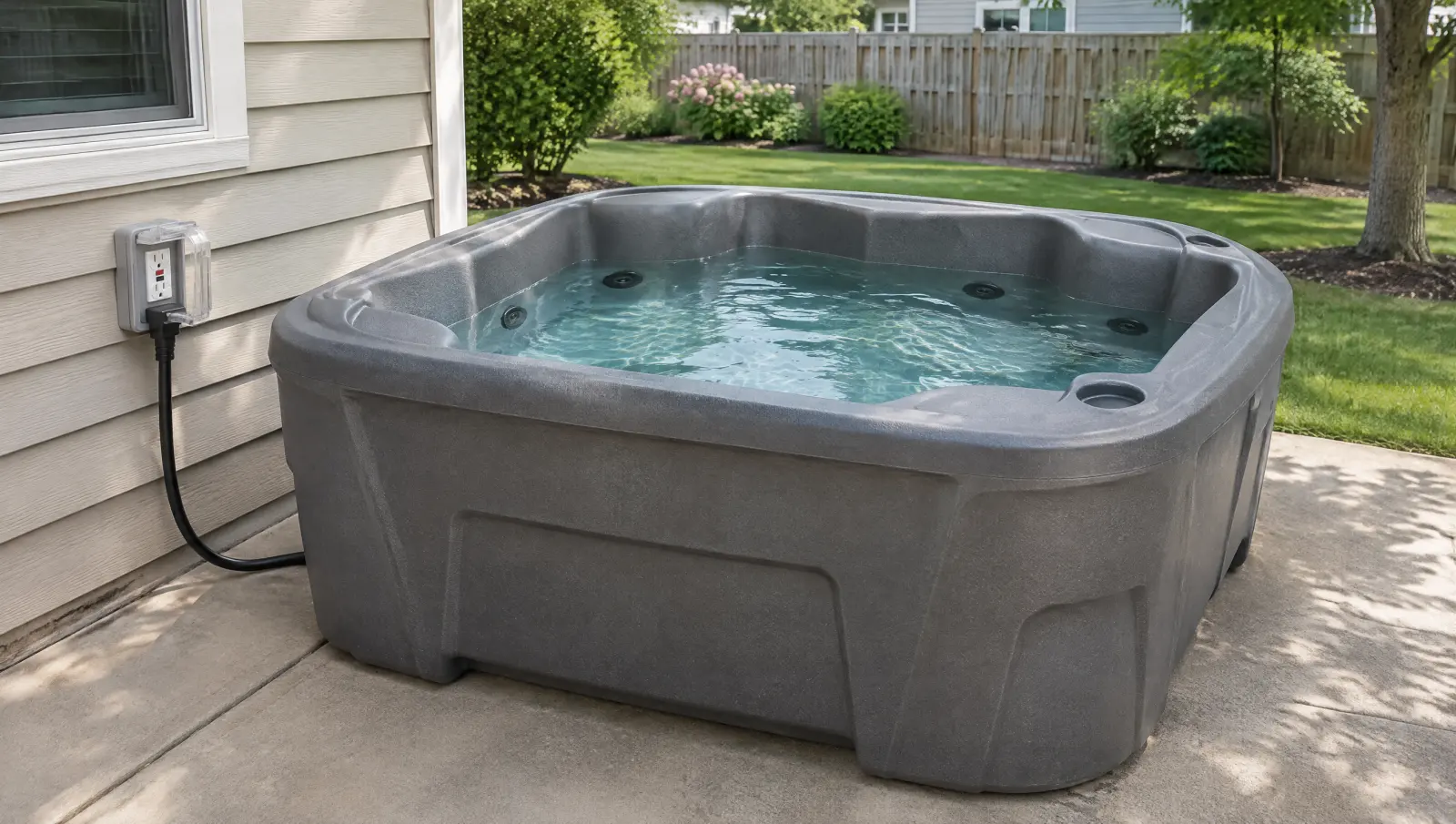
A plug and play hot tub is a self-contained, hard-shell spa that runs on standard 120V household power instead of a hardwired 240V line, so you can set it up without a major electrical upgrade. The trade-off is a smaller heater: it warms up slowly, and on many models the heater and full-speed jets can’t run together. It still needs a dedicated, GFCI-protected 15–20 amp outlet.
Below are five plug and play models we found on Amazon, a quick comparison, and a buying guide on 120V vs. 240V, electrical requirements and placement.
Quick comparison
Scroll sideways to see every column →
| Product | Best for | Seats / jets | Shell | Power (per listing) | Price | Buy |
|---|---|---|---|---|---|---|
| Lifesmart LS350DX | Most jets and seats | 5 / 28 jets + waterfall | Hard shell, full foam insulation | 110–115V plug-in | Check price | |
| Aqualife Current | Standard 15 A outlet | 3–4 / 14 jets | Rigid resin, insulated | 120V/15A, GFCI cord | Check price | |
| Lifesmart 4-Person Round | Small patios | 4 / 13 jets | Hard shell, round | 110–115V, 1 HP pump | Check price | |
| SPECRAFT 3-Person Acrylic | Lounger seats | 3 / 21 jets | Acrylic shell | 110V, dedicated 20A GFCI | Check price | |
| EZLIFE Serenity 2-Person | Couples, light setup | 2 / 90 bubble jets | Rigid foam walls | 120V, 1,350W heater | Check price |
Specs from Amazon listings and manufacturer documentation. Prices change often, so we link to the live listing.
The best plug and play hot tubs
Best for more jets and seats: Lifesmart LS350DX
Lifesmart is one of the most common plug and play brands on Amazon, and the LS350DX is its 5-person model with 28 jets. The listing describes a lounger plus bench seating, a built-in waterfall, multicolor LED lighting and an ozone water care system, with full foam insulation and a locking thermal cover.
Lifesmart 5-Person Plug & Play 28-Jet Hot Tub Spa and Thermal Cover (LS350DX, Sand)
- Seats
- 5 (lounger and bench seats)
- Jets
- 28, plus waterfall
- Size
- 72 x 81 x 34 in
- Power
- 110V plug-in
- Extras
- Ozone, multicolor LED, full foam insulation, locking cover
Specs from the Amazon listing and manufacturer documentation
The roomiest and best-equipped 120V tub in this guide, with ozone and a waterfall. Expect the usual 120V trade-off on heating speed.
Pros
- Most jets and seats of the 120V models here
- Ozone system helps the sanitizer do its job
- Full foam insulation and a locking thermal cover included
Cons
- The listing does not state water capacity, weight or heater wattage
- Largest footprint of the 120V tubs here (72 x 81 in)
- Check your manual for a dedicated circuit: Lifesmart's 115V manual calls for a dedicated 15 amp outlet
Best for a standard 15 amp outlet: Aqualife Current
The Aqualife Current, from Aqualife by Strong Spas, plugs into a standard 120V/15A outlet with a GFCI cord included, seats three to four adults and has 14 jets. The listing gives an empty weight of 300 lb but doesn’t state the water capacity or the heater’s wattage, so ask the seller for both before you plan the base and the circuit.
Aqualife Current 4-Adult Outdoor Hot Tub, Uses Standard Outlet, 14 Hydrotherapy Jets
- Seats
- 3–4 adults
- Jets
- 14
- Size
- 71 x 61 x 29.5 in
- Weight
- 300 lb (empty)
- Power
- 120V/15A with GFCI cord
Specs from the Amazon listing and manufacturer documentation
A rigid resin spa with a tapered, locking cover that runs from a 120V/15A outlet, with the GFCI cord in the box.
Pros
- Runs from a 15 amp circuit, the most common household size
- GFCI cord included
- Heavy-duty, insulated, tapered cover with locking clips
Cons
- The listing doesn’t state water capacity or heater wattage
- Only 14 jets
- Seats three to four, so four adults will be snug
Best for small patios: Lifesmart 4-Person Round
A round shape tucks into a corner of a patio more easily than a big square tub. This 4-person Lifesmart is listed at 270 lb empty, with 13 jets, a 1 HP pump and 110–115V power, plus an underwater LED light and a thermal cover.
Lifesmart 4-Person Plug & Play Round Hot Tub Spa with 13 Jets, Thermal Cover and LED Light (Sand)
- Seats
- 4
- Jets
- 13
- Weight
- 270 lb (empty)
- Size
- 77 x 29 x 66 in (as listed)
- Power / pump
- 110–115V, corded; 1 HP pump
Specs from the Amazon listing and manufacturer documentation
A simple, compact hard-shell spa with its empty weight on the listing. A sensible entry point if you mostly soak for 20–30 minutes.
Pros
- Round shape fits corners and small patios
- Light enough empty to move into place with a few helpers
- Pump size and empty weight stated on the listing
Cons
- Fewest jets of the 4-person models here
- Water capacity isn’t confirmed on the listing, so ask the seller before planning the base
- Other Lifesmart 13-jet listings show different specs, so check the exact model
Best for lounger seats: SPECRAFT 3-Person Acrylic
Not every plug and play tub is rotomolded plastic. The SPECRAFT 3-person has an acrylic shell, the glossy finish you see on traditional spas, with 21 stainless steel jets, lounger seats and a waterfall. Its listing is one of the clearest on electrical needs: it calls for a dedicated 20A GFCI circuit and warns that sharing the circuit may cause problems.
SPECRAFT Acrylic 3 Person Outdoor Hot Tub with 21 Stainless Steel Jets
- Seats
- 3, with loungers
- Jets
- 21 stainless steel, plus waterfall
- Capacity
- 126.8 gallons
- Weight
- 358.3 lb (empty)
- Size
- 77.6 x 66.9 x 29.9 in
- Power / pump
- 110V, dedicated 20A GFCI circuit; 2 HP pump
Specs from the Amazon listing and manufacturer documentation
An acrylic shell with loungers and 21 jets on 120V. Plan for a 20A dedicated circuit rather than any spare outlet.
Pros
- Acrylic shell with lounger seats
- Listing states the circuit it needs, which avoids surprises
- Two filters and a cover included
Cons
- No heater wattage given in the listing
- A newer brand with less track record than Lifesmart or Aqualife
- Smaller water volume than the 4-person tubs
Best for couples: EZLIFE Serenity 2-Person
The EZLIFE Serenity sits between an inflatable and a rotomolded spa. It isn’t inflatable: the listing describes rigid foam walls with a Textilene exterior. It holds 120 gallons, runs on 120V and has 90 bubble jets. Its 1,350W heater is listed as reaching 68–104 °F, and the listing gives a 1-year parts warranty.
EZLIFE Serenity 2-Person Oval Foam Hot Tub (TJN2UL), 120 Gallons
- Seats
- 2
- Jets
- 90 bubble jets
- Capacity
- 120 gallons
- Walls
- Rigid full foam, Textilene exterior
- Heater
- 1,350W, 68–104 °F
- Power
- 120V, standard outlet
- Warranty
- 1 year on parts (listing)
Specs from the Amazon listing and manufacturer documentation
A light, quick-to-set-up option for couples. It uses bubble jets rather than hydrotherapy jets, so think of it as a soaking tub.
Pros
- Smallest water volume here, so it heats and treats faster
- Light, simple setup with a thermal insulated cover
- Heater wattage clearly listed
Cons
- Bubble jets feel gentler than pressurized hydrotherapy jets
- Foam walls are less rigid and durable than a rotomolded shell
- Only a 1-year parts warranty
Looking for an inflatable instead?
Inflatable spas also run on 120V and cost less, but they’re a different product with their own limits. Compare them in our guide to the best inflatable hot tubs.
How we chose these hot tubs
We haven’t soaked in any of these tubs. This guide is built from information you can check: the specs printed on each Amazon listing, owner’s manuals from spa makers (Lifesmart, Cal Spas), electrical and buying guides from spa manufacturers (Jacuzzi, Master Spas, Leisure Time) and summaries of NEC Article 680.
We only included hard-sided 120V tubs (no inflatables) whose listing states the voltage, and we picked one for each common need: most seats, a standard 15 amp outlet, small spaces, loungers and two people. Where a listing leaves out a spec or contradicts itself, we say so in the cons. Every source is listed at the end of the page.
Plug and play vs. 240V hot tubs
The difference comes down to how much power the tub can draw. A 120V spa on a 15–20 amp circuit has a much smaller power budget than a 240V spa on a 40–60 amp breaker.
| | Plug and play (120V) | 240V hot tub | |---|---|---| | Circuit | Dedicated 15–20 amp, GFCI protected | Dedicated 240V line, often 40–60 amp, GFCI protected | | Heater | About 1 kW | About 4 kW | | Heat-up speed | Can take 24 hours or more to reach temperature | About 2–5 °F per hour | | Heater and jets together | Often not at full speed | Yes, on a properly sized breaker | | Installation | Plug into a suitable outlet | Hardwired by a licensed electrician | | Cold climates | Can struggle to hold temperature | Better suited |
Figures come from Jacuzzi and Master Spas. Jacuzzi notes that even a 240V tub on a 40 amp breaker may not run all pumps and the heater at once, and suggests a 50 or 60 amp breaker for that.
Why the heater and jets can’t always run together
On many 120V tubs, the control system switches the heater off while the jet pump runs on high, so the circuit doesn’t overload. For a 20-minute soak that barely matters. During a long, jets-on session on a cold night, though, the water slowly cools. Leisure Time notes that a 120V spa can struggle to keep up in cold weather.
Cold-climate limits
A plug and play tub works year-round in many areas if you keep it running with the cover locked, since the heater only has to maintain temperature. In places with long freezing winters, a 1 kW heater may not keep up with the heat lost through the cover and cabinet. If that’s your climate, ask the maker whether the model can be converted to 240V by an electrician, or look at a 240V spa.
Plug and play hot tub pros and cons
Pros
- Lower installation cost. No 240V hardwired line, as long as you have, or add, a suitable dedicated outlet.
- Easy placement. Lighter, smaller tubs fit patios and decks where a big spa won’t.
- Moveable. You can take it with you when you move, unlike an in-ground spa.
- Hard shell and real cover. Better insulated and more durable than an inflatable.
Cons
- Slow heating from a cold fill, and the water cools during long jets-on sessions.
- Fewer jets and weaker pumps than most 240V spas, as Jacuzzi points out.
- Weaker in cold climates.
- Shorter lifespan on budget models. Jacuzzi says a premium plug and play tub can last 10–15 years or longer, while a budget brand may last only 3–5 years.
Electrical requirements
“Plug and play” means the tub has a factory cord instead of hardwiring. It doesn’t mean any outlet will do.
| Requirement | What it means | |---|---| | Dedicated circuit | 15 or 20 amps, used by nothing else. Match what your tub’s manual specifies. | | GFCI protection | Required by NEC Article 680. It can be built into the cord or provided at the outlet. | | Outdoor outlet | A NEMA 5-15 or 5-20 receptacle in a weatherproof in-use cover, according to Jacuzzi. | | Cord length | Cal Spas, citing NEC 680.42(A)(2), says the cord can’t be longer than 15 ft. | | Outlet distance | Lifesmart’s 115V manual asks for an outlet no closer than 5 ft and no farther than 10 ft from the spa. | | Extension cords | Never. They can overheat and void the warranty. |
Lifesmart’s 115V manual specifies a 15 amp dedicated, grounded outlet that isn’t shared with any other appliance, and warns that an extension cord of any kind will invalidate the warranty. Jacuzzi adds that you should never splice or extend the factory cord.
Have a licensed electrician check the circuit
Electrical rules for hot tubs come from NEC Article 680 plus local amendments, and they vary by city. Before delivery, have a licensed electrician confirm the outlet, breaker, GFCI and location. Press the GFCI test button before each use: the tub should shut off.
Placement, weight and foundation
A plug and play tub is light when empty, but water changes everything. Water weighs about 8.34 lb per gallon, so:
| Water capacity | Water weight (approx.) | |---|---| | 120 gallons | 1,000 lb | | 200 gallons | 1,670 lb | | 220 gallons | 1,835 lb | | 300 gallons | 2,500 lb |
Add the tub itself and the bathers on top. Jacuzzi notes that a fully loaded hot tub can weigh more than 4,000 lb.
- Level, solid base. A poured concrete slab is the classic choice. Jacuzzi stresses the surface must be level, not angled for drainage like many patios.
- Decks need checking. JLC, a trade magazine for builders, notes that most decks are designed for only 50 lb per square foot. In their example, a 7½ × 7½ ft tub needed framing for at least 101 lb per square foot. Have an engineer or qualified builder check a deck first.
- Near the outlet. Place the tub so the factory cord reaches without strain.
- Room for the cover. Leave space behind the tub to fold the cover back or fit a lifter.
- Delivery access. Some tubs ship by freight, so check gates, paths and turns.
How to set up a plug and play hot tub
- Check the circuit first. Confirm a dedicated 15 or 20 amp GFCI-protected outdoor outlet matching your manual, or have one installed.
- Prepare a level base, such as a concrete pad.
- Position the tub so the cord reaches the outlet without an extension cord.
- Fill through the filter well with a garden hose, filter installed, up to the marked level.
- Plug in and test the GFCI, then reset it and set the temperature.
- Heat with the cover locked. On 120V this can take a day or more. Then balance the water and add sanitizer.
Keep it running
Turning a 120V tub off between uses means waiting for it to reheat. Most owners leave it on at a set temperature with a well-fitting cover, which is also what keeps pipes from freezing in winter.
Water care is the same as for any hot tub, just on a smaller volume, so readings change faster. Follow the routine in our hot tub maintenance guide.
Accessories for your hot tub
- Cover: a tight, insulated cover matters even more on a 120V tub, because the heater has little power to spare. See our picks of hot tub covers.
- Steps: the tubs in this guide stand about 28–34 in tall. Compare hot tub steps.
- Chemicals: smaller water volumes need smaller, more careful doses. Start with our list of hot tub chemicals.
A plug and play hot tub is the easiest way into a hard-shell spa, as long as you respect the circuit it needs and the slower heating that comes with 120V. For everything that comes after setup, head back to the complete hot tub maintenance guide.
How we compared
We gathered the Amazon listing and manufacturer documentation for each product, put the specs side by side and matched each one to the job it suits. We don’t test products hands-on: the figures come from the documents listed in Sources. How we research.
- Products compared
- 5
- Sources cited
- 10
- Compared on
- Seats / jets, Shell, Power (per listing)
- Last updated
- Nov 2026
- Hands-on testing
- No
- Paid placements
- None
Sources
- Jacuzzi: 110v vs 220v Hot Tub, What's the Difference? · jacuzzi.com
- Jacuzzi: An Honest Review of Plug and Play Hot Tubs · jacuzzi.com
- Jacuzzi: Hot Tub Wiring and Electrical Requirements · jacuzzi.com
- Jacuzzi: 3 Foundation Types for Hot Tubs · jacuzzi.com
- Master Spas: 110V vs 220V Hot Tubs · masterspas.com
- Leisure Time: Hot Tub Electrical Guide, 220v vs 110v and GFCI Requirements · leisuretimeinc.com
- Lifesmart 115V spa owner's manual, electrical requirements (ManualsOnline) · music.manualsonline.com
- Cal Spas owner's manual, 120 Volt electrical installation (ManualsLib) · manualslib.com
- EC&M: Spas, Hot Tubs, and Hydromassage Tubs (NEC Article 680) · ecmweb.com
- JLC: Successful Hot Tub Planning · jlconline.com
Frequently asked questions
What are the disadvantages of plug and play hot tubs?
The main drawbacks come from the 120V power limit. The heater is small (about 1 kW), so a fresh fill can take a day or more to heat, and many models can't run the heater and full-speed jets together, so the water cools during long soaks. They also tend to have fewer jets and weaker pumps than 240V spas, and they struggle to hold temperature in very cold weather. You still need a dedicated GFCI-protected circuit, so 'plug and play' doesn't always mean no electrical work.
Are plug and play hot tubs worth it?
They're worth it if you want a hard-shell hot tub without paying for a 240V, 40–60 amp hookup, if you soak in shorter sessions, and if your winters are mild. Keep the cover on and the tub running, and the slow heater matters less because it only has to maintain temperature. If you live somewhere with long freezing winters or want long, jets-on sessions for several people, a 240V spa (or a 120V model that can be converted to 240V) is the better fit.
What are the best plug and play hot tubs?
For most buyers, a rotomolded 4–5 person model from an established spa brand is the safest choice. In this guide, the Lifesmart LS350DX is our pick for the most jets and seats, the Aqualife Current for a standard 15 amp outlet with a GFCI cord in the box, and the Lifesmart 4-person round spa for small patios. Whatever you choose, check the voltage, circuit and warranty on the listing first.
How do you install a plug and play hot tub?
Place it on a level, solid base such as a concrete pad, make sure there's a dedicated 15 or 20 amp GFCI-protected outdoor outlet within reach of the factory cord, fill it with a garden hose through the filter well, then plug it in, test the GFCI and let it heat with the cover on. Have a licensed electrician add or check the outlet, since NEC Article 680 and local codes apply to hot tub circuits.
Can you use an extension cord with a plug and play hot tub?
No. Spa manufacturers including Lifesmart, Cal Spas and Jacuzzi tell owners never to use extension cords. An extension cord can overheat, reduces the power reaching the tub (which means slower heating and weaker jets) and can void the warranty. If the outlet is too far away, have an electrician install a dedicated GFCI-protected outlet closer to the tub.
How many people can fit in a plug and play hot tub?
Most plug and play hot tubs seat 2 to 5 adults, and a few larger models are sold for 6–7 people. Bigger tubs hold more water, so they take longer to heat on a 1 kW heater. For four or more regular bathers in a cold climate, look at a model that can be converted to 240V.