On this page
Key takeaways
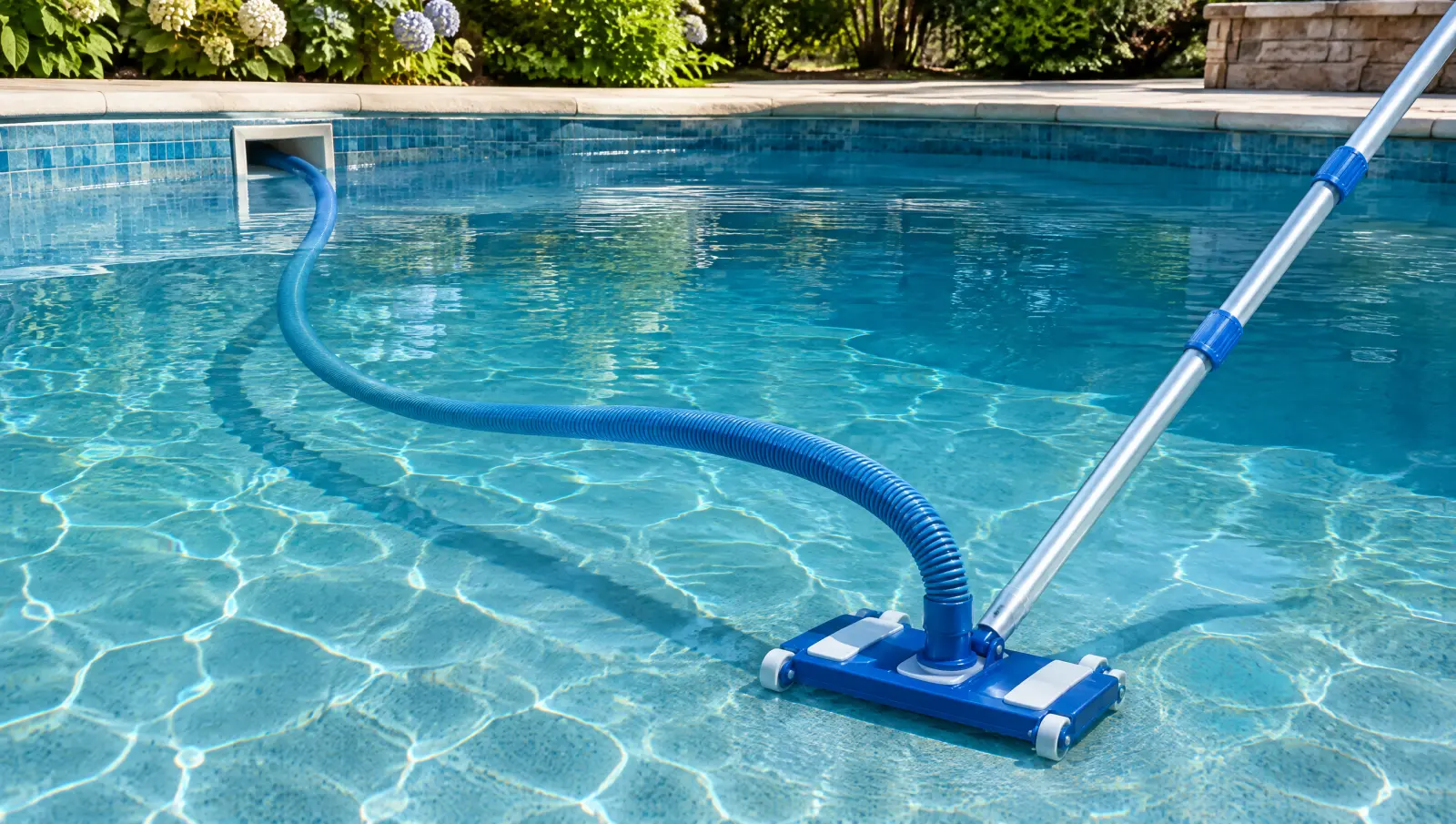
- A manual pool vacuum is three parts: a vacuum head, a hose (usually 1.5 in for inground pools) and a telescopic pole. Your pool pump supplies the suction.
- Match the head to the surface: vinyl liners need a vinyl-safe head with brushes; flexible weighted heads like Poolmaster's 27250 are for plaster, gunite and concrete only, not vinyl (per its listing).
- Prime the hose before connecting it: hold the open end against a return jet until the bubbles stop. Air in the hose makes the pump lose prime.
- Vacuum on Filter for light dirt. Use Waste for algae, heavy silt or floc: it bypasses the filter and sends water out of the pool, so top up as you go.
- Turn the pump off before moving the multiport handle, and backwash when pressure rises 8–10 psi over clean (INYO Pools, Hayward).
The best manual pool vacuum is the head that matches your pool’s surface, on a hose long enough to reach the far end and a sturdy telescopic pole. For vinyl liners, that’s a weighted, brush-lined head like the Poolmaster Deluxe Weighted Vinyl Liner; for plaster, gunite and concrete, a flexible weighted head like the Poolmaster 27250 Commercial hugs the floor better.
Manual vacuums are cheap, have nothing to charge, and do one job no robot can: vacuum to waste, sending dirty water out of the pool instead of through the filter. Below are our picks for each part of the kit, then a step-by-step guide to priming the hose and choosing Filter or Waste.
Our picks at a glance
Scroll sideways to see every column →
| Product | Best for | Part | Surface or fit | Key spec | Price | Buy |
|---|---|---|---|---|---|---|
| Best for vinylPoolmaster Deluxe Weighted Vinyl Liner head | Vinyl inground and above-ground | Vacuum head | Vinyl liner | Brushes, air-relief valves, 1-year warranty | Check price | |
| Best for plasterPoolmaster 27250 Commercial flexible head | Plaster, gunite, concrete | Vacuum head | Gunite, plaster, concrete only (not vinyl) | Flexible, weighted body | Check price | |
| Best hoseSwimline HydroTools vacuum hose | Inground pools | Hose | 1.5 in fittings | 30 ft, kink-resistant swivel cuff | Check price | |
| Best poleSkimlite 5008 telescopic pole | Most pools | Pole | Standard attachments | 8–16 ft, aluminum | Check price | |
| Cordless alternativePool Blaster Max Li | No hose or pump | Battery handheld | Inground and above-ground | 2,200 mAh, submersible to 16 ft | Check price |
Specs from Amazon listings and manufacturer documentation. Prices change often, so we link to the live listing.
What you need to vacuum a pool by hand
A manual pool vacuum is a system, and each part has one job:
| Part | What it does | What to check | |---|---|---| | Vacuum head | Rides along the floor and channels suction | Surface: vinyl-safe or hard-surface; weight; wheels or brushes | | Hose | Carries water and debris to the skimmer or vacuum port | Diameter (1.5 in for most inground, 1.25 or 1.5 in above-ground); length; swivel cuff | | Telescopic pole | Lets you steer the head from the deck | Extended length; lock type; weight | | Skim vac plate (optional) | Seals the hose over the skimmer basket | Fits your skimmer and hose size | | Pump and filter | Provide the suction and catch the dirt | Filter clean; multiport valve if you want to vacuum to waste |
Head and surface. This is the decision that matters most. Hard-surface heads are made for rough plaster, gunite and concrete; Poolmaster’s flexible gunite heads say not to use them on vinyl liners. Vinyl heads ride on brushes so they don’t scuff or snag the liner.
Hose length. Measure from the skimmer (or vacuum port) to the farthest corner of the pool, add the depth at that point, and buy the next size up. Too short and you can’t reach; far too long and the extra hose is heavier to prime and drag.
Pole length. You want to reach the middle of the pool without straining, so measure from the edge to the center line and leave some margin. An 8–16 ft pole covers most residential pools.
Best manual pool vacuum gear of 2026
Best for vinyl pools: Poolmaster Deluxe Weighted Vinyl Liner head
Poolmaster Deluxe Weighted Vinyl Liner Pool Vacuum Head with Air-Relief Valves
Best for: Vinyl-lined inground and above-ground pools
- Surface
- Vinyl liner
- Pool
- Inground and above-ground
- Feature
- Air-relief valves (listing)
- Warranty
- 1 year (listing)
Specs from the Amazon listing and manufacturer documentation
A weighted vacuum head with brushes on the underside, built for liners. The listing describes air-relief valves meant to keep suction steady and prevent liner damage, and gives a 1-year warranty. It's the safe default for any vinyl pool.
Pros
- Brushes protect the liner
- Air-relief valves help keep steady suction
- Works in above-ground pools too
Cons
- Not a flexible head, so it hugs curved transitions less
- Hose and pole sold separately
- Lighter heads can lift off the floor if you move too fast
Best for plaster and gunite: Poolmaster 27250 Commercial flexible head
Poolmaster 27250 Heavy-Duty Flexible Vacuum, Commercial Collection
Best for: Plaster, gunite and concrete pools with curved floors
- Surface
- Gunite, plaster, concrete (not vinyl)
- Body
- Flexible
- Weight
- Integrated weights
- Line
- Poolmaster Commercial Collection
Specs from the Amazon listing and manufacturer documentation
A flexible-body head that bends to follow the floor and the curve into the walls. The listing says it's weighted to stay submerged and is for gunite, plaster and concrete only, not vinyl liners. Its lighter sibling, the Heavy-Duty Gunite Flexible, showed as currently unavailable on Amazon when we checked.
Pros
- Flexes to follow curved floors and coves
- Weighted to stay down
- Sold as a commercial-grade head
Cons
- Never use on vinyl liners
- Hose and pole sold separately
Best hose: Swimline HydroTools 1.5 in x 30 ft
SWIMLINE HYDROTOOLS Swimming Pool Vacuum Hose with Kink-Resistant Swivel Cuff, 1.5 in x 30 ft
Best for: Inground pools where 30 ft reaches the far end from the skimmer
- Diameter
- 1.5 in
- Length
- 30 ft
- Cuff
- Kink-resistant swivel
Specs from the Amazon listing and manufacturer documentation
A 1.5 in hose with a kink-resistant swivel cuff, which keeps the hose from twisting as you work. The listing says it's compatible with vacuum heads, skimmers and filter pump inlets. If 30 ft doesn't reach your farthest corner plus the depth, buy a longer length rather than joining two hoses.
Pros
- Swivel cuff reduces twisting
- Standard 1.5 in fittings
- Also sold in other lengths
Cons
- Too long for small above-ground pools
- Similar-looking listings come in several lengths, so check the title
Best pole: Skimlite 5008 telescopic pole
Skimlite 5008 8 ft to 16 ft Professional Telescopic Pole
Best for: Most residential pools
- Length
- 8–16 ft (listing)
- Material
- Aluminum
Specs from the Amazon listing and manufacturer documentation
An aluminum pole that extends from 8 to 16 ft. That range reaches the middle of most backyard pools. If you want a pole that won't slip under heavy brushing, Skimlite's Dually 9016 (B0B1FB4K5C, also 8–16 ft) adds dual locking.
Pros
- Covers most backyard pools
- Fits standard heads, nets and brushes
- From a maker known for professional poles
Cons
- Single lock; heavy brushing may call for the Dually
- 16 ft may be too short for very wide pools
A skim vac plate, which seals the hose over the skimmer basket so leaves stop there instead of in the pump basket, is a useful add-on. The Poolmaster plate we used to recommend showed as currently unavailable on Amazon when we checked, so check that any replacement plate fits your skimmer and hose size.
Cordless alternative: Pool Blaster Max Li
POOL BLASTER Max Li Cordless Pool Vacuum
Best for: Spot cleaning with no hose, priming or pump
- Battery
- 2,200 mAh (listing)
- Depth
- Submersible to 16 ft (listing)
- Pole
- Standard pole, sold separately
- Warranty
- 1 year (listing)
Specs from the Amazon listing and manufacturer documentation
If priming hoses isn't for you, a battery handheld does the same floor-cleaning job on a pole. This listing is the Max Li: a 2,200 mAh battery, submersible to 16 ft, with a 1-year warranty. It can't vacuum to waste, so keep a manual head for algae and floc cleanups.
Pros
- No hose or priming
- Keeps debris out of the filter
Cons
- Can't vacuum to waste
- Slow for large pools
- Runtime per charge not stated on the listing
How to vacuum a pool manually
These steps follow Swim University’s manual vacuuming guide, with valve rules from INYO Pools and Hayward.
1. Get the filter ready
Run the pump and check the pressure gauge. Hayward says to backwash when pressure rises 8–10 psi over the clean starting pressure; clean a cartridge filter before you start. Empty the skimmer and pump baskets.
2. Prime the hose
This is the step that makes or breaks manual vacuuming. Attach the head to the pole and the hose to the head, and lower the head to the floor. Then hold the open end of the hose against a return jet: the water pushes the air out through the head. Swim University says priming is done when the air bubbles stop. Keep the hose end underwater from here on.
3. Connect to the skimmer
With a skim vac plate, seat it over the basket and press the hose on; Swim University stresses a good seal or suction is lost. Without a plate, remove the basket, cover the hose end with your hand, and push it into the skimmer’s suction hole. If your system has valves for the main drain and skimmers, make sure the vacuum line is the only line open to the pump.
4. Vacuum slowly
Start at the shallow end and work to the deep end in long, slow strokes that overlap slightly. Rushing kicks up dirt and clouds the water. If the head sticks to the floor, switch the pump off for a moment to release it.
5. Filter or Waste?
| Setting | Where the water goes | Use it for | |---|---|---| | Filter | Through the filter and back to the pool | Light, routine dirt | | Waste | Out the waste line, bypassing the filter | Algae after shocking, heavy silt, settled floc | | Backwash | Reversed through the filter to waste | Cleaning the filter, not vacuuming |
INYO Pools describes Waste as the setting for vacuuming after an algae treatment, so debris doesn’t go back through the filter. Hayward describes it as water going from the pump out the waste line without entering the filter tank. Swim University adds: don’t vacuum on Backwash.
Pump off before you move the valve
INYO Pools says to turn the pump off before selecting a valve setting and to press the handle down before turning it. Make it a habit every time you switch between Filter, Waste and Backwash.
On Waste you’re draining the pool as you go, so run a garden hose into the pool and keep the level above the skimmer opening; if it drops, the pump draws air and loses prime. Cartridge filters usually have no multiport valve. Swim University notes that on some cartridge systems you can remove the drain plug and attach a backwash hose; check your filter manual.
6. Finish up
Turn the pump off, set the valve back to Filter, and empty the pump basket. If you vacuumed on Filter, backwash or clean the filter. Top the water up, then test and balance the chemistry. If you’re dealing with algae, the order is brush, vacuum, skim, then shock; see how to shock a pool.
When a manual vacuum beats an automatic cleaner
- After a floc. Settled flocculant should go to waste. Dolphin’s Basic 19 manual says not to run the robot after flocculant or clarifier.
- Algae cleanup. Dead algae is fine and can pass through some filters; Waste sends it out.
- Spot jobs. A pile of sand on the steps or a corner a robot keeps missing.
- Small pools and tight budgets. A head, hose and pole cost a fraction of a robot.
For routine weekly cleaning, an automatic cleaner saves time; our best pool vacuum guide compares every type, and the robotic pool cleaners hub covers robots in depth. Above-ground owners should also see the above-ground pool vacuum picks.
Before you vacuum, skim leaves with a pool skimmer net and loosen dirt with a pool brush; both fit the same telescopic pole.
How we chose this gear
We didn’t test any of these products. We picked a head for each surface type, a hose, a pole and a cordless alternative, using the specs shown on each Amazon listing, which we checked in a browser on November 29, 2026 (we kept only live, in-stock listings): surface compatibility, hose diameter and length, pole length and warranty. Where the listing doesn’t give a spec, we don’t guess. The how-to steps come from Swim University, INYO Pools, Hayward and The Pool Factory. We didn’t analyze customer reviews.
How we compared
We gathered the Amazon listing and manufacturer documentation for each product, put the specs side by side and matched each one to the job it suits. We don’t test products hands-on: the figures come from the documents listed in Sources. How we research.
- Products compared
- 5
- Sources cited
- 6
- Compared on
- Part, Surface or fit, Key spec
- Last updated
- Nov 2026
- Hands-on testing
- No
- Paid placements
- None
Sources
- Swim University: How to Vacuum a Pool Manually · swimuniversity.com
- INYO Pools: How a Multiport Valve Operates · inyopools.com
- Hayward: What are the functions on the multi-port valve? · hayward.com
- Hayward: How to Vacuum Your Above Ground Pool · hayward.com
- The Pool Factory: How to Vacuum Your Above Ground Pool · thepoolfactory.com
- Maytronics: Dolphin Basic 19 User Instructions (8159950) · brand.maytronics.com
Frequently asked questions
What is the best pool vacuum to get?
It depends on your pool and how much work you want to do. For hands-off weekly cleaning, a robot is the most convenient. For the lowest cost and jobs a robot can't do, like vacuuming to waste after algae or a floc, get a manual setup: a head that suits your surface (vinyl-safe for liners, a flexible weighted head for plaster), a 1.5 in hose long enough to reach the far end, and an 8–16 ft telescopic pole. Many owners have both.
How do I vacuum my pool on waste setting?
Prime the hose and connect it to the skimmer or vacuum port. Turn the pump off, set the multiport valve to Waste, then turn the pump back on and vacuum slowly. Waste bypasses the filter and sends water straight out of the pool, so run a garden hose into the pool to keep the level above the skimmer opening. When you're done, turn the pump off, set the valve back to Filter and top up the water.
Is a manual pool vacuum better?
It's better for spot jobs, small pools, vacuuming to waste and tight budgets. It has no motor to fail and goes exactly where you point it. It's worse for routine cleaning: it takes time and effort every week, depends on good pump flow and a primed hose, and sends debris to your filter unless you vacuum to waste. An automatic cleaner plus a manual head for problem days covers both.
What is the best hand held cordless pool vacuum?
Among the models we looked at, the Pool Blaster Max Li is a solid all-rounder: its listing gives a 2,200 mAh battery, submersible to 16 ft, and a 1-year warranty, and it clips to a standard pole. Intex's rechargeable handheld is a complete kit for pools up to 18 ft across. Both trap debris in their own bag or filter and need no hose or pump, but neither can vacuum to waste.
How to vacuum a swimming pool with a hose?
Attach the head to the pole and the hose to the head, lower it to the floor, and prime the hose by holding the open end against a return jet until no more bubbles come out. Seal the hose to a skim vac plate over the skimmer basket, or push it into the skimmer suction hole, then vacuum in slow, overlapping strokes from the shallow end to the deep end.