On this page
Key takeaways
- To shock a pool, test and balance pH first, add the label dose of shock in the evening with the pump running, brush, circulate for at least 8 hours and retest before anyone swims.
- Shock when combined chlorine (total minus free) is above 0.4 ppm, the limit most US health departments set for public pools, and after heavy rain, a pool party, algae or opening the pool.
- How much: the CDC's rule is to raise free chlorine to 10 times the combined chlorine. Label doses run about 1 lb of 68% cal-hypo or 52–104 fl oz of 12.5% liquid chlorine per 10,000 gallons.
- After a chlorine shock, swim only when free chlorine is back in the label range: HTH says 1–4 ppm, usually 8–24 hours later, and In The Swim's cal-hypo listing says at least 24 hours. The Rx Clear non-chlorine (MPS) listing allows swimming after about 10 minutes.
- Never mix two shocks, never pour shock into the skimmer or a tablet feeder, and don't trust a test that reads zero right after shocking: the CDC warns readings above 10 ppm can bleach out.
Step-by-step checklist
-
Test the water
Test free chlorine, total chlorine, pH and cyanuric acid. Subtract free from total chlorine to get combined chlorine.
-
Balance pH
Bring pH to 7.2–7.6 before shocking, because chlorine works poorly at high pH.
-
Clean the pool
Skim debris, brush the walls and floor, empty the skimmer basket and backwash or clean the filter if the pressure is high.
-
Calculate the dose
Work out the pool's gallons and measure the label dose per 10,000 gallons, or enough to raise free chlorine to 10 times the combined chlorine.
-
Wait for evening
Shock after sunset if you use cal-hypo or liquid chlorine, which sunlight breaks down quickly.
-
Add the shock with the pump running
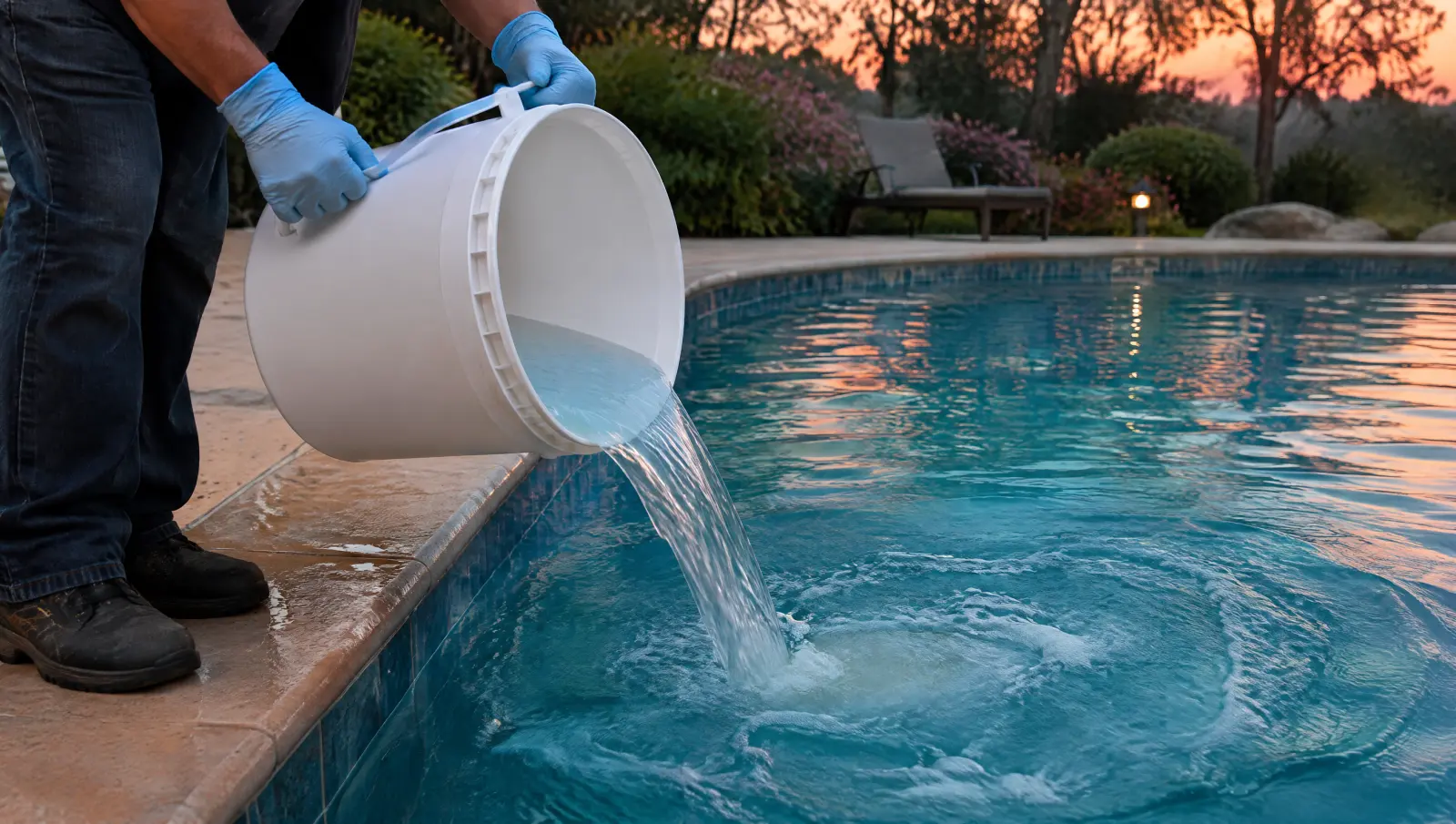
Broadcast granules over the deep end or pour liquid chlorine slowly in front of a return jet. Pre-dissolve only if the label says so, adding shock to water, never water to shock.
-
Brush and circulate
Brush any granules that settle and run the pump and filter for at least 8 hours, ideally overnight.
-
Retest before swimming
Swim only when free chlorine is back in the label's range (HTH: 1–4 ppm) and combined chlorine has dropped.
Retest after the wait time in the guide below before adding anything else.
To shock a pool, test and balance the pH, then add the label dose of shock in the evening with the pump running, brush, let the filter run overnight and retest before anyone swims. How much you add depends on your gallons, the type of shock and the problem: a routine shock targets combined chlorine, algae needs more.
Below you’ll find when a pool actually needs shocking, the step-by-step process, how to work out the dose, how long to wait before swimming and the mistakes that cause most shock accidents. If you’re still choosing a product, start with our best pool shock comparison.
What shocking a pool actually does
Chlorine in your pool is doing two jobs: killing germs and oxidizing everything swimmers leave behind (sweat, urine, oils, sunscreen). When chlorine reacts with that waste, it forms chloramines, also called combined chlorine. The CDC describes chloramines as compounds that off-gas into the air above the water and irritate skin, eyes and airways. They’re the source of the “chlorine smell” people blame on too much chlorine, when the real problem is too little.
Shocking means adding a large dose of oxidizer at once to break those compounds down and restore your free chlorine. To know whether you need it, you need two numbers from your test kit:
- Free chlorine (FC): the chlorine still available to sanitize.
- Total chlorine (TC): free plus combined.
Combined chlorine = total chlorine − free chlorine. That’s the CDC’s formula, and it’s why a test kit that only reads total chlorine can’t tell you when to shock. Our best pool test kit guide covers kits that read both.
When to shock a pool
| Sign or event | Why shock | What to aim for | |---|---|---| | Combined chlorine above 0.4 ppm | Chloramines are building up | Free chlorine at 10 times the combined chlorine (CDC) | | Strong chlorine smell, red eyes | Usually chloramines, not too much chlorine | Test first, then shock | | Free chlorine near zero | Sanitizer ran out; algae can start | Shock, then find out why it dropped | | Heavy rain or storm | Rain dilutes chlorine and washes in debris | Shock after skimming | | Pool party or heavy use | A lot of swimmer waste in one day | Shock that night | | Cloudy water or visible algae | Chlorine is losing ground | A higher dose; HTH says to double it for cloudy water or early algae | | Opening the pool in spring | Months of unsanitized water | Often a double dose or more; follow your label’s start-up directions |
The 0.4 ppm figure comes from public pool rules: the CDC notes that most city, county and state health departments limit combined chlorine to 0.4 ppm or less. It’s a sensible line for a home pool too.
Do you need to shock every week?
HTH, a shock manufacturer, recommends shocking at least once a week during swim season. That’s a reasonable default if you don’t test often. If you do test, let the numbers decide: when free chlorine holds in range and combined chlorine stays near zero, the water doesn’t need a weekly shock, and shocking anyway mostly costs money (and, with dichlor, adds stabilizer you’ll later have to drain out).
What you need
- Shock sized for your pool (see the options below).
- A test kit that reads free and total chlorine, pH and cyanuric acid (CYA).
- Chemical-resistant gloves and goggles. The CDC lists safety goggles, gloves and a mask.
- A pool brush, and a clean bucket used only for that one product if your label says to pre-dissolve.
- Your pool’s volume in gallons. If you don’t know it, the pool volume calculator works it out from length, width and depth.
Which shock to use
Cal-hypo and liquid chlorine are the go-to choices for a full shock: both disinfect and neither adds stabilizer. Non-chlorine shock is for clearing chloramines between chlorine shocks when you want to swim soon; it doesn’t kill algae.
In The Swim Pool Shock (68% cal-hypo granular, 6 x 1 lb)
- Strength
- 68% calcium hypochlorite (title); 65% available chlorine (description)
- Dose
- 1 lb per 10,000 gal weekly, for 5–10 ppm (listing)
- Swim after
- At least 24 hours (listing)
Specs from the Amazon listing and manufacturer documentation
Cal-hypo in pre-measured 1 lb bags. The listing doses 1 lb per 10,000 gallons weekly to keep chlorine at 5–10 ppm, says to pre-dissolve the granules so they don't discolor a liner and to wait at least 24 hours before swimming. The title says 68% cal-hypo but the description gives 65% available chlorine, so check the bag.
Pros
- Easy to dose: one bag per 10,000 gallons
- No stabilizer, so weekly use won't raise CYA
Cons
- Raises calcium hardness and pH
- Granules left on a vinyl floor can bleach it
CPDI Champion Pool Shock Liquid Chlorine (12.5%, 1 gal)
- Active ingredient
- 12.5% sodium hypochlorite
- Dose
- 52–104 fl oz per 10,000 gal (5–10 ppm)
- Leaves behind
- A little salt; no CYA or calcium
Specs from the Amazon listing and manufacturer documentation
Ready-to-use 12.5% sodium hypochlorite. The listing gives 52–104 fl oz per 10,000 gallons for 5–10 ppm of available chlorine.
Pros
- Nothing to dissolve and nothing to settle on a liner
- Best fit for pools with high calcium or high CYA
Cons
- Heavy: a strong shock can take most of a gallon per 10,000 gallons
- Loses strength in storage
Rx Clear Chlorine-Free Pool Shock (36.2% MPS)
- Active ingredient
- 36.2% potassium monopersulfate
- Dose
- 1 lb per 10,000 gal
- Swim after
- About 10 minutes, per the listing
Specs from the Amazon listing and manufacturer documentation
Potassium monopersulfate oxidizer for chloramines and swimmer waste. The listing doses 1 lb per 10,000 gallons and says swimming can resume after about 10 minutes. It doesn't disinfect, so it won't fix algae.
Pros
- Adds no chlorine, CYA or calcium
- Short wait, useful after a party
Cons
- Not a sanitizer: free chlorine must still be in range
- Can show up as combined chlorine on DPD tests, per Trouble Free Pool
How to shock a pool, step by step
Hands-on time is about 20 minutes. The rest is waiting while the pump runs overnight.
1. Test the water
Test free chlorine, total chlorine, pH and CYA, and calculate combined chlorine. Write the numbers down: you’ll use them to size the dose and to check the result in the morning.
2. Balance the pH
HTH recommends bringing pH to 7.2–7.6 before shocking; the CDC’s range for pools is 7.0–7.8. Chlorine is much weaker at high pH, so shocking water at 8.0 wastes a good part of the dose. If you need to adjust, see how to lower pH, and let the acid circulate before you add shock. Never add acid and chlorine at the same time.
3. Clean the pool
Skim out leaves, brush the walls and floor to loosen algae and film, and empty the skimmer basket. If the filter pressure is high, backwash or clean it now. Debris left in the water uses up chlorine you meant for chloramines.
4. Calculate the dose
Start from the label’s dose per 10,000 gallons and scale it to your pool. For a 25,000-gallon pool, multiply by 2.5. The next section explains how to size a dose by test results instead of by the label alone, and the pool chemical calculator does the math for any volume.
5. Wait for evening
Cal-hypo and liquid chlorine are unstabilized. Swim University warns that a daytime dose will burn off in the sun before it has a real chance to work, and HTH also tells owners to shock in the evening. Dichlor and non-chlorine shock can go in during the day.
6. Add the shock with the pump running
- Granules: broadcast them evenly over the deep end, away from the wind, with the pump running. HTH says to add its shock directly without pre-dissolving; In The Swim recommends pre-dissolving in vinyl pools. Follow your label. If you pre-dissolve, fill the bucket with water first, then add the granules.
- Liquid chlorine: pour it slowly into the water in front of a return jet, close to the surface to avoid splashing.
- Never pour shock into the skimmer, a floater or a tablet feeder.
7. Brush and circulate
Brush any granules that settle right away so they don’t bleach or stain the surface. Run the pump and filter for at least 8 hours, ideally overnight, as HTH directs.
8. Retest before swimming
In the morning, test again. Free chlorine should be on its way down and combined chlorine should be near zero. If free chlorine dropped to nearly nothing overnight, something is still consuming it, most often algae; shock again and keep testing.
A zero reading right after shocking may be wrong
The CDC warns that above 10 ppm, a chlorine test can partially or totally bleach out and show a falsely low or zero reading. If your strip or drops come up blank right after a shock, dilute the sample with tap water and retest, or wait a few hours.
How much shock does a pool need?
There are two ways to size a dose. The label method is simplest; the test-based method uses less chemical and works better for algae.
By the label
| Product type (example) | Label dose per 10,000 gal | For 20,000 gal | For 30,000 gal | |---|---|---|---| | 68% cal-hypo (In The Swim) | 1 lb | 2 lb | 3 lb | | 12.5% liquid chlorine (Champion) | 52–104 fl oz (5–10 ppm) | 104–208 fl oz | 156–312 fl oz | | Dichlor, 56% (In The Swim, superchlorination) | 21 oz | 42 oz | 63 oz | | Non-chlorine MPS (Rx Clear) | 1 lb | 2 lb | 3 lb |
Doses come from each product’s Amazon listing. For cloudy water or early algae, HTH’s shocking guide says to double the dose. For a spring opening or heavy algae, size the dose from your test results (below) rather than the weekly label dose.
By your test results
- To clear chloramines: the CDC’s rule is to raise free chlorine to 10 times the combined chlorine level. With combined chlorine at 0.5 ppm, aim for 5 ppm of free chlorine.
- For algae or a big contamination: the target depends on your stabilizer. Trouble Free Pool’s chart sets its shock (“SLAM”) level at 12 ppm with CYA 30 and 20 ppm with CYA 50, because CYA slows chlorine down. That’s why a pool with high CYA struggles to clear algae with a label dose.
To turn a ppm target into an amount, it helps to know roughly what each product delivers in 10,000 gallons. By our arithmetic from the listed strength: about 8 ppm per pound of cal-hypo with 65% available chlorine and about 1 ppm per 10 fl oz of 12.5% liquid chlorine.
Example: a 20,000-gallon pool tests at 2 ppm free and 2.6 ppm total chlorine, so combined chlorine is 0.6 ppm. The target is 6 ppm free chlorine, an increase of 4 ppm. With 12.5% liquid chlorine that’s about 80 fl oz (20 fl oz per ppm at 20,000 gallons); with 68% cal-hypo (65% available chlorine), about 1 lb. These are our calculations from the listed strengths; check your own product’s label, since strengths vary.
How long after shocking a pool can you swim?
There’s no single number, because it depends on the shock and on how much chlorine is left. Sources agree on one thing: test, don’t guess.
| Shock type | When you can swim | Source | |---|---|---| | Non-chlorine MPS | About 10 minutes (Rx Clear); 15 minutes per Swim University | Product listing; Swim University | | In The Swim cal-hypo | At least 24 hours | Product listing | | Cal-hypo or liquid chlorine | When free chlorine is back at 1–4 ppm, typically 8–24 hours | HTH | | Any chlorine shock | At least 8 hours and free chlorine at 5 ppm or less | Swim University | | Your label | Whatever re-entry range it states | Product label |
The CDC doesn’t publish a waiting time for home pools after shocking. Its guidance sets the floor: at least 1 ppm of free chlorine, or 2 ppm in pools with stabilizer, with pH 7.0–7.8. Once the shock has done its job, our everyday target is about 7.5% of your CYA reading (3–5 ppm for most pools at CYA 30–50). On the high side, guidance differs. HTH says never to swim above 4 ppm, while Trouble Free Pool considers swimming safe up to its shock level for your CYA. The cautious choice is to follow the product’s label and wait until free chlorine is back in its range. If it’s slow to come down, see how to lower chlorine.
Should you shock a pool at night?
Yes, for chlorine shocks without stabilizer. Sunlight’s UV breaks chlorine down quickly, so a dose added at noon can lose much of its strength before it reaches the chloramines and algae you meant it for. Evening shocking gives it the whole night to work, with the pump running.
The exceptions are dichlor, which carries its own stabilizer (Swim University notes CYA protects chlorine from the sun’s UV), and non-chlorine shock, which isn’t chlorine at all. Even with those, evening is a convenient habit: nobody’s swimming and the pump has hours to circulate.
Common pool shocking mistakes
- Mixing products. Pouring two different shocks together, or putting them in the same bucket or scoop. The CDC says never to mix different pool chemicals, and chlorine plus acid can create toxic gas.
- Adding shock to the skimmer or a tablet feeder. Trichlor tablets sitting in a skimmer or chlorinator plus a pound of shock is a dangerous combination. New York’s health department describes a homeowner who dumped five 1-lb bags of shock into a chlorinator and caused chlorine gas and an explosion. HTH also says not to add shock to the skimmer, floater or feeder.
- Shocking in daylight with unstabilized chlorine, then wondering why the numbers barely moved.
- Skipping the pH check. HTH lists shocking unbalanced water as a top mistake: it wastes product and gives worse results.
- Adding water to the chemical. If you pre-dissolve, it’s always water first, shock second. The CDC warns the reverse can cause a violent, potentially explosive reaction.
- Leaving granules on the floor. They can bleach vinyl and plaster. Brush them right away.
- Adding algaecide at the same time. HTH warns that algaecide added while chlorine is high gets deactivated. Wait until chlorine is back in range.
- Shocking every week with dichlor. Each dose adds stabilizer, which only comes out when you replace water. Our pool stabilizer guide explains how to keep it in range.
- Storing opened bags. HTH notes that partially used bags degrade quickly. Use the whole bag or close it tightly and store it dry.
- Swimming too soon. Retest first, every time.
Pool shock safety
The CDC estimates a median of about 4,535 emergency department visits a year in the US for pool chemical injuries (2008–2017), and at least 56% of injuries happened at a residence.
Before you open the bag
- Never mix chemicals, and never mix chlorine with acid: the CDC warns it can create toxic gas.
- Add chemical to water, never water to chemical.
- Wear goggles and gloves, open containers away from your face and stand upwind when you broadcast. Handle muriatic acid with full protection.
- One product at a time. Let pH adjustments circulate before you shock.
- Store separately, closed, dry, cool and out of the sun, in the original containers, liquids below dry products, locked away from kids and pets.
When to call a pool professional
Most shocking problems are fixed by testing more and dosing to your CYA. Call a pool service or CPO if:
- Free chlorine disappears overnight after several shocks, even with clean, clear water.
- CYA is far above the 30–50 ppm range and you can’t replace enough water yourself.
- The water stays green or cloudy after several days of holding shock level with the filter running.
- The pump, filter or a salt cell isn’t running properly, so you can’t circulate the shock.
- You see stains or etching on the surface after shocking.
How we put this guide together
We don’t own a pool and haven’t tested these products ourselves. Product doses were checked against the Amazon listings on November 29, 2026. This guide is built from sources you can check: the CDC’s home pool guidance for chlorine and pH, its chloramines guidance for combined chlorine and breakpoint chlorination, the CDC’s pool chemical injury report, Trouble Free Pool’s chlorine and CYA chart, shocking guides from HTH and Swim University, the New York State Department of Health, and the Amazon listing directions for each product we mention. Where sources disagree, as they do on waiting times and pre-dissolving, we show both and point you to the label. Every source is listed at the end of the page. For how shocking fits into the rest of your water care, see our pool chemicals guide.
Sources
- CDC: Home Pool and Hot Tub Water Treatment and Testing · cdc.gov
- CDC: Chloramines and Pool Operation · cdc.gov
- CDC: Use Pool Chemicals Safely (poster, PDF) · cdc.gov
- CDC MMWR: Pool Chemical Injuries in Public and Residential Settings, 2008–2017 · cdc.gov
- Trouble Free Pool: The Free Chlorine and Cyanuric Acid Relationship · troublefreepool.com
- Trouble Free Pool: The ABCs of Pool Water Chemistry · troublefreepool.com
- HTH: How to Shock a Pool · hthpools.com
- HTH: How Much Shock Do I Add to My Swimming Pool · hthpools.com
- Swim University: How Long to Wait to Swim After Shocking a Pool · swimuniversity.com
- New York State Department of Health: Swimming Pool Chemicals · healthweb-back.health.ny.gov
Frequently asked questions
Do you run the pool pump while shocking?
Yes. Keep the pump and filter running while you add shock and for at least 8 hours afterward, ideally overnight, so the chlorine spreads through the whole pool instead of sitting in one spot. HTH's directions call for the pump running during application and the filter running at least 8 hours.
How do you dissolve granular shock?
Only if the label tells you to. Some labels, like In The Swim's for vinyl pools, recommend pre-dissolving; HTH says never to pre-dissolve its shock and to broadcast it instead. If you do pre-dissolve, fill a clean bucket with pool water first and then add the granules (never water onto chemical), stir with a clean stick and pour it around the edge with the pump running.
Do I really need to shock my pool every week?
Not always. HTH recommends shocking at least once a week in swim season, but the real signals are a test result and an event: combined chlorine above about 0.4 ppm, free chlorine near zero, a strong chlorine smell, cloudy or green water, heavy rain or a big pool party. If your free chlorine stays in range and combined chlorine stays near zero, a weekly shock isn't strictly necessary.
How long after shocking a pool can you swim?
With non-chlorine (MPS) shock, the Rx Clear listing allows swimming after about 10 minutes and Swim University says 15. With chlorine shock, wait until a test shows free chlorine back in the range the label gives: HTH says 1–4 ppm, typically 8–24 hours; In The Swim's cal-hypo listing says at least 24 hours; Swim University suggests at least 8 hours and 5 ppm or less. Test rather than going by the clock.
Should I shock my pool at night or during the day?
At night for cal-hypo and liquid chlorine. They're unstabilized, and sunlight breaks chlorine down so quickly that much of a daytime dose is lost before it works. Stabilized dichlor and non-chlorine MPS can be added during the day.
How do I make my pool water crystal clear?
Keep free chlorine at about 7.5% of your stabilizer (CYA) reading, which is 3–5 ppm for most pools at CYA 30–50 and never below the CDC minimum of 2 ppm with stabilizer, keep pH at 7.2–7.8, shock when combined chlorine climbs or after heavy use, brush the walls, keep the skimmer and filter clean and run the pump long enough each day. Clear water is the result of that routine, not of a single product.