On this page
Key takeaways
- To lower pH in a pool, add muriatic acid (hydrochloric acid) or dry acid (sodium bisulfate) with the pump running, then retest. Aim for 7.2–7.8, ideally 7.4–7.6.
- The CDC warns that chlorine kills germs less effectively as pH rises, especially above 8.0.
- HASA's general guide for muriatic acid is about 1 quart per 20,000 gallons (roughly a pint per 10,000), diluted at 10 parts water to 1 part acid. Retest after 30–60 minutes.
- Dry acid in small steps: the Leisure Pool pH Decreaser listing says 12 oz per 10,000 gallons lowers pH by about 0.1. Leslie's Dry Acid listing gives an alkalinity dose but no pH dose, so follow its label.
- Always add acid to water, never water to acid, and never let acid and chlorine touch. Both acids also lower total alkalinity.
Step-by-step checklist
-
Test pH and total alkalinity
Read pH and total alkalinity with a test kit or strips. Act if pH is above 7.8.
-
Put on protective gear
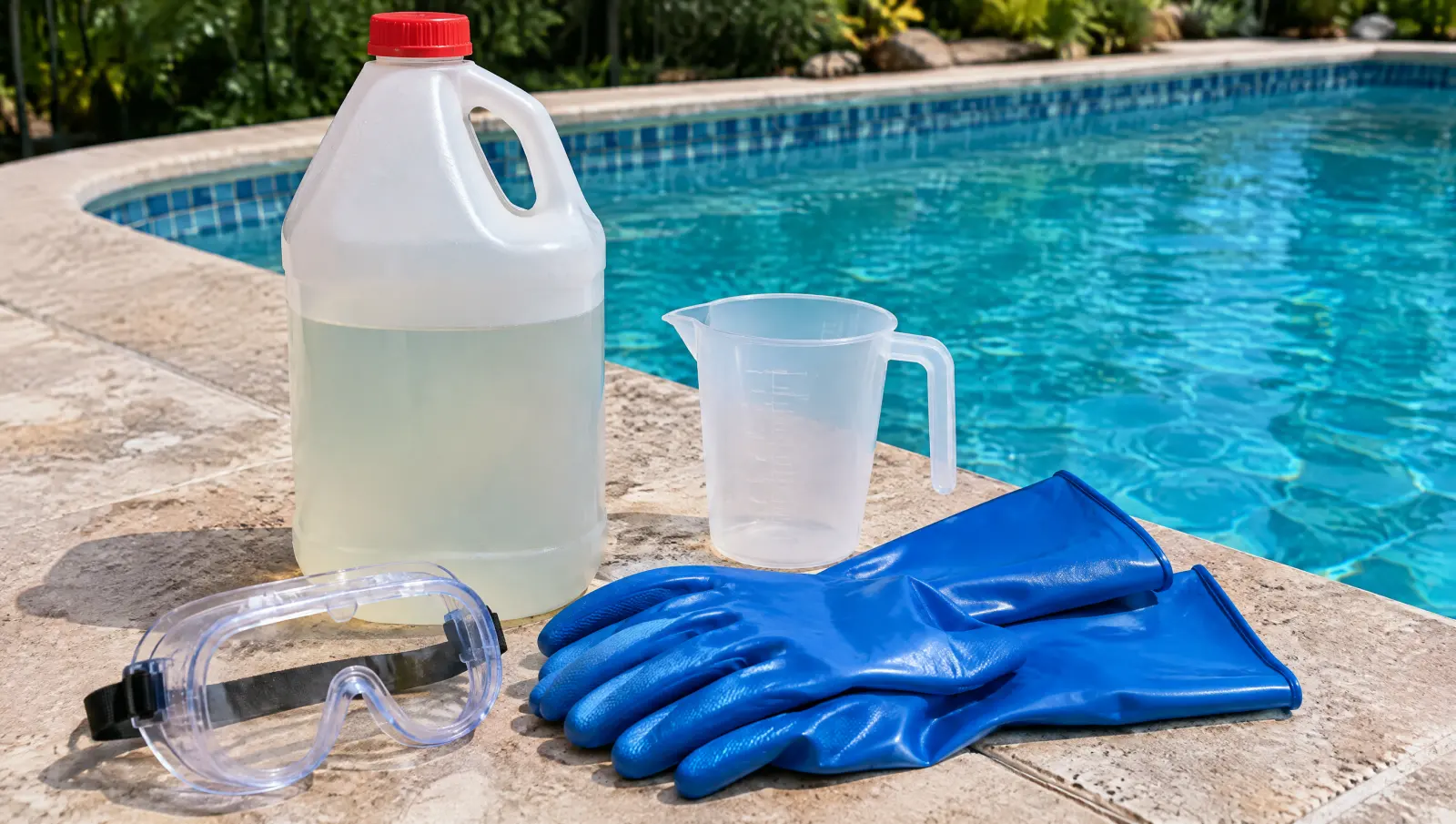
Wear chemical-resistant gloves and safety goggles, and work outdoors with the wind at your back.
-
Measure the dose
Scale the label dose to your pool's gallons. For a large correction, plan to add it in stages (HASA suggests 25% increments).
-
Dilute the acid in pool water
Fill a plastic bucket with pool water and add the acid to the water, never water to acid. HASA recommends 10 parts water to 1 part muriatic acid; stir dry acid until fully dissolved.
-
Pour it in with the pump running
Pour slowly and low to the surface around the deep end, away from the skimmer, steps, ladders and lights.
-
Circulate and retest
Keep the pump running and retest after 30–60 minutes. Follow the label's wait time before swimming.
-
Repeat in small steps
If pH is still above 7.6, add another partial dose and retest. Stop at 7.4–7.6.
Retest after the wait time in the guide below before adding anything else.
To lower pH in a pool, add muriatic acid or dry acid (sodium bisulfate) with the pump running, wait 30–60 minutes and retest until pH is back between 7.2 and 7.8. Dilute the acid in a bucket of pool water first, always pouring acid into water, and dose in small steps because both acids also pull total alkalinity down.
If your pH keeps climbing back up, the acid isn’t the problem: something in the pool is driving it. Below you’ll find the usual causes of high pH, how muriatic acid and dry acid compare, label doses per 10,000 gallons, and a safe step-by-step method.
What pH should a pool be?
Keep pool pH at 7.2–7.8, ideally 7.4–7.6. The CDC recommends 7.0–7.8 for pools and hot tubs, and FROG and Arm & Hammer both give 7.2–7.8 for pools.
High pH matters mostly because of chlorine. The CDC explains that as pH goes up, chlorine’s ability to kill germs decreases, especially above 8.0. You can have a “normal” chlorine reading and still not have the protection you think you have.
| Reading | What it means | What to do | |---|---|---| | 7.2–7.8 | Target range | Leave it | | 7.8–8.0 | High; chlorine weakening | Lower toward 7.4–7.6 | | Above 8.0 | Chlorine much less effective (CDC) | Lower it before swimming | | Below 7.2 | Low | See how to raise pH |
What causes high pH in a pool?
pH rises naturally in most pools. Orenda explains that carbon dioxide constantly escapes from pool water, and the less CO2 in solution, the higher the pH. Anything that speeds up that escape, or adds something alkaline, pushes pH up faster.
| Cause | Why it raises pH | What helps | |---|---|---| | Salt chlorine generator (SWG) | Orenda: hydrogen bubbles from the cell drive off CO2 | Keep alkalinity at the low end; acid regularly | | New plaster | Curing plaster releases calcium hydroxide (pH 12.6, per Orenda); Trouble Free Pool says it pushes pH up for 6–18 months | Expect frequent acid; follow your builder’s startup plan | | Aeration | Waterfalls, fountains, spa spillovers, jets and splashing drive off CO2 | Turn features off while balancing | | High total alkalinity | Trouble Free Pool: higher alkalinity makes pH drift up faster | Lower alkalinity | | Cal hypo or liquid chlorine | HASA: they carry alkaline compounds that raise pH temporarily | Retest pH after chlorinating | | Too much pH increaser | FROG lists overdosing increaser as a cause | Dose increaser in small steps | | Fill water | Your source water may have high pH or alkalinity | Test after topping up |
The two big ones for most owners are a salt system and high alkalinity. If you have both, pH will climb every week, and lowering alkalinity is what slows it down. Trouble Free Pool recommends a lower alkalinity range (50–90 ppm) for pools on a salt system or liquid chlorine; check your salt cell manufacturer’s guidance before going below the usual 80–120 ppm.
Effects of high pH
Arm & Hammer lists the effects of pH above 7.8 as cloudy water, chlorine that’s less effective against germs, damage to vinyl liners, dry itchy skin and rashes, and mineral scale in pipes. FROG adds that scale on filters, pipes and equipment can restrict circulation, raise system pressure and strain your equipment.
Orenda notes that above 8.2, calcium carbonate is harder to keep dissolved, which is when scale and cloudiness really start.
Muriatic acid vs dry acid
Both lower pH and total alkalinity. The differences are in handling.
| | Muriatic acid | Dry acid | |---|---|---| | Chemical | Hydrochloric acid, commonly 31.45% (HASA) | Sodium bisulfate | | Form | Liquid | Granules | | Strength | Strong; small doses | Milder per scoop; larger doses | | Fumes | Yes; corrosive fumes | No fumes (HASA) | | Handling | Splash and fume risk; store away from metal and chlorine | Dust; easier to store and transport (HASA) | | Must dilute? | Yes, 10 parts water to 1 part acid (HASA) | Dissolve fully in a bucket of water (Orenda) | | Also lowers alkalinity | Yes | Yes | | Leaves behind | Chloride (salt) | Sulfate |
Choose muriatic acid if you lower pH often (salt pools, new plaster) and are comfortable handling a corrosive liquid. It’s strong, so you buy and store less of it. It’s usually bought locally, at a pool supply or hardware store, because it’s rarely shipped, and strengths vary, so check the percentage on the label before you dose.
Choose dry acid if you only need occasional corrections, have nowhere safe to store liquid acid, or simply prefer not to handle fuming acid. It’s sold as “pH decreaser,” “pH down” or “pH minus.”
Low-fume or “buffered” muriatic acids are often sold at a lower strength than standard 31.45% acid, and a weaker acid needs a larger dose. Always read the strength on the jug.
How much muriatic acid to lower pH?
There’s no single number: the dose depends on your pool’s volume, how far pH has to move, the acid’s strength and your alkalinity. Higher alkalinity resists the change, so it takes more acid.
As a starting point, HASA’s general guide is about 1 quart of muriatic acid per 20,000 gallons, which works out to roughly 1 pint (16 fl oz) per 10,000 gallons. HASA recommends adding large doses in 25% increments, retesting 30 minutes after each one. For dry acid, use the label on your product: Leisure Pool’s listing gives a per-0.1 pH dose, while Leslie’s gives only an alkalinity dose. We don’t pick a specific muriatic acid: the jug we checked on Amazon doesn’t state its strength or a dose, and liquid acid is rarely shipped, so buy it locally and dose from the label on the jug you bring home.
| Product | Dose per 10,000 gallons | Source | |---|---|---| | Muriatic acid (HASA, general guide) | About 16 fl oz (1 qt per 20,000 gal) | HASA | | Leisure Pool pH Decreaser (100% sodium bisulfate) | 12 oz lowers pH about 0.1 | Product listing | | Leslie’s Dry Acid | No pH dose on the listing; 2 lb lowers alkalinity about 10 ppm | Product listing |
For any other volume, or to factor in your alkalinity, use the pool chemical calculator. Not sure of your gallons? Start with the pool volume calculator.
Acid safety
Read this before you open the acid
- Wear chemical-resistant gloves and safety goggles. The CDC recommends both for any pool chemical. Muriatic acid burns skin and eyes on contact.
- Always add acid to water, never water to acid. The CDC warns that adding water to a pool chemical can cause a violent, potentially explosive reaction.
- Never mix acid and chlorine, not in a bucket, a scoop or the same spot in the pool. The CDC says this can create toxic gases. Add them separately, hours apart if possible.
- Never mix different pool chemicals with each other or with anything else.
- Work outdoors with good ventilation and the wind at your back. Don’t lean over the bucket and breathe the fumes.
- Open one container at a time and close it before opening another.
- Store acid separately from chlorine, in its original container, upright, away from metal and out of reach of children.
- Keep a hose running nearby to rinse any splash off skin or surfaces right away.
Orenda also recommends rinsing the outside of the acid bottle in pool water after pouring to remove drips, and never pouring acid into the skimmer.
How to lower pH in a pool, step by step
Hands-on time is about 15 minutes per dose. Keep children and pets away while you work.
1. Test pH and total alkalinity
Read both. If alkalinity is above 120 ppm, plan for more acid and expect pH to drift back up; see how to lower alkalinity. Strips are fine for a quick read; compare options in our best pool test strips guide.
2. Put on your protective gear
Gloves, goggles, closed shoes and clothes you don’t mind ruining. Have the hose ready.
3. Measure the dose
Measure the label dose for your gallons, or start with HASA’s guide for muriatic acid (and check the strength on your jug first). For a big drop (say from 8.2 to 7.5), split it into stages. If you’re using dry acid, a small-step dose like the one below makes it hard to overshoot.
Leisure Pool pH Decreaser (100% sodium bisulfate, 10 lb)
- Chemical
- 100% sodium bisulfate
- Dose
- 12 oz per 10,000 gal ≈ −0.1 pH
- Size
- 10 lb
Specs from the Amazon listing and manufacturer documentation
Plain sodium bisulfate granules with a small-step dose: the listing says 12 oz per 10,000 gallons may lower pH by about 0.1. Handy when pH is only slightly high and you want to creep down rather than overshoot.
Pros
- Per-0.1 dose makes small corrections easy to plan
- No fumes
Cons
- Big corrections take several pounds
- Same sulfate buildup as any dry acid
4. Dilute the acid in pool water
Fill a clean plastic bucket about halfway with pool water. Then add the acid to the water, slowly, never the other way around. HASA recommends 10 parts water to 1 part muriatic acid; Orenda says at least 10:1, which means no more than 1 quart of acid in 2.5 gallons of water. For dry acid, Orenda says to fill the bucket about three-quarters with pool water, add no more than 5 lb of acid, and stir until it’s fully dissolved, since undissolved granules can damage the pool surface.
Leslie's Dry Acid pH Down (sodium bisulfate, 10 lb)
- Chemical
- Sodium bisulfate
- pH dose
- Not stated on listing; follow the label
- Alkalinity
- 2 lb per 10,000 gal = −10 ppm
- Swimming
- Safe after 4 hours of circulation (listing)
- Size
- 10 lb
Specs from the Amazon listing and manufacturer documentation
Granular sodium bisulfate for pH and alkalinity. The listing doesn't give a pH dose; it says 2 lb per 10,000 gallons lowers total alkalinity by about 10 ppm, aims for pH 7.4–7.6, and that swimming is safe after 4 hours of circulation. For pH, follow the label and add it in small steps.
Pros
- No fumes, easier to store than liquid acid
- Clear swim wait and alkalinity dose on the listing
Cons
- Larger doses than muriatic acid for the same change
- Adds sulfate to the water over time
5. Pour it in with the pump running
With the pump on, pour the diluted acid slowly and close to the surface around the deep end. HASA says to stay away from lights, ladders, rails, steps and the skimmer. Never pour it into the skimmer.
6. Circulate and retest
Trouble Free Pool says acid lowers pH within about 30 minutes with the pump running, and HASA says to retest after 30 minutes to an hour. Before swimming, follow the product’s wait time; the Leslie’s listing says to allow 4 hours of circulation.
7. Repeat in small steps
If pH is still above 7.6, add another partial dose and retest. Stop at 7.4–7.6. Going too far drops you below 7.2, and then you’re adding soda ash to undo it.
How to keep pH from rising again
- Lower alkalinity if it’s high. It’s the most common reason pH climbs back within days.
- Cut aeration while you’re balancing: turn off waterfalls and fountains, and point returns down.
- On a salt system, test pH at least weekly and expect to add acid regularly.
- Use a solar cover when the pool isn’t in use; Trouble Free Pool notes it slows pH rise.
- Retest after chlorinating with cal hypo or liquid chlorine.
- Test regularly. The CDC recommends testing pH and chlorine at least twice a day, and more often when the pool has many swimmers.
Common mistakes
- Pouring acid into the skimmer. It goes straight through your pump, filter and heater.
- Adding water to acid. Always acid to water.
- Pouring acid and chlorine back to back in the same spot, or using the same bucket for both.
- Dumping a full dose at once. Add large corrections in stages and retest.
- Using baking soda to “fix” pH. It raises pH.
- Chasing pH while ignoring alkalinity. If alkalinity is high, pH will keep rising.
- Swimming right away. Follow the label’s wait time.
When to call a pool professional
Call a pool pro if:
- pH is above 8.2 and won’t come down after several measured doses.
- It’s a new plaster pool. Startup chemistry is specialized and mistakes can damage the finish.
- You see scale on tile, in the heater or on the salt cell.
- You’re not comfortable handling muriatic acid. A pro or dry acid is the safer route.
- Someone has splashed acid in their eyes or inhaled fumes: rinse with water and get medical help right away.
For the rest of your water balance, start at the pool water chemistry hub.
How we put this guide together
We don’t own a pool and haven’t tested these products ourselves. This guide is built from sources you can check: the CDC’s pool pH and chemical-safety guidance, acid-handling procedures from HASA (a pool chemical maker) and Orenda, Trouble Free Pool’s reference articles on pH and alkalinity, Arm & Hammer and FROG pool guides, and the dosing directions on each product’s Amazon listing. Where a product listing doesn’t state a dose or strength, we say so and point you to the label. Every source is listed at the end of the page.
Sources
- CDC: Home Pool and Hot Tub Water Treatment and Testing · cdc.gov
- CDC: Use Pool Chemicals Safely (poster) · cdc.gov
- HASA: How to Lower the pH in Pool Water Safely · hasa.com
- Orenda: How to properly use acid to reduce pH and alkalinity · procedures.orendatech.com
- Orenda: What Causes a High pH in a Swimming Pool? · blog.orendatech.com
- Trouble Free Pool: Lower Total Alkalinity (acid and aeration) · troublefreepool.com
- Trouble Free Pool: The ABCs of Pool Water Chemistry · troublefreepool.com
- Arm & Hammer: What is the proper pool pH and how to get it · armandhammer.com
- FROG: Pool pH Made Simple: Why It Matters and How to Fix It · frogproducts.com
Frequently asked questions
What happens if pool water pH is too high?
Chlorine stops working well. The CDC says chlorine's ability to kill germs drops as pH rises, especially above 8.0. Arm & Hammer adds cloudy water, dry itchy skin, vinyl liner damage and scale in pipes, and FROG notes that scale on filters and equipment can restrict circulation and strain the pump. Lower it back to 7.4–7.6.
Does baking soda lower pH in pools?
No. Baking soda (sodium bicarbonate) raises pH slightly and raises total alkalinity a lot, so it makes high pH worse. To lower pH, use an acid: muriatic acid or sodium bisulfate (dry acid), sold as pH decreaser, pH down or pH minus.
How to lower pH in pool quickly?
Muriatic acid is the fastest. Dilute the measured dose in a bucket of pool water (acid into water), pour it around the deep end with the pump running, and retest in 30–60 minutes. Trouble Free Pool says acid lowers pH within about 30 minutes with the pump running. For a big correction, add it in stages rather than all at once.
Should I add chlorine if pH is high?
Lower the pH first. Chlorine is less effective at high pH, and HASA notes that liquid chlorine and calcium hypochlorite carry alkaline compounds that temporarily push pH up further. Add the acid, let it circulate, retest, and then add chlorine separately. Never mix chlorine and acid or pour them at the same spot at the same time: the CDC warns this can create toxic gases.
What are pH levels in pools?
Keep pool pH between 7.2 and 7.8, with 7.4–7.6 as the ideal. The CDC's recommended range for pools and hot tubs is 7.0–7.8. Below 7.0, pipes are more likely to corrode; above 8.0, chlorine loses much of its germ-killing ability.
Is 9.5 pH too high for pool water?
Yes, far too high. It's well above the CDC's 7.8 upper limit and above the 8.0 point where the CDC says chlorine loses effectiveness. Stay out of the pool, test total alkalinity, and lower pH in stages with acid, retesting between doses. A reading that high in a new plaster pool or after a large dose of pH increaser is a reason to ask a pool professional.