On this page
Key takeaways
- The only practical way to lower total alkalinity in a pool is to add acid (muriatic acid or dry acid). Acid lowers pH too, so you then aerate the water to bring pH back up without raising alkalinity again.
- Aim for total alkalinity of 80–120 ppm and pH of 7.2–7.8. During the process, let pH fall to about 7.0–7.2, then aerate until it climbs back to about 7.4–7.6.
- Dose reference per 10,000 gallons: about 26 fl oz of 31.4% muriatic acid or 2.1 lb of sodium bisulfate lowers alkalinity by roughly 10 ppm (National Swimming Pool Foundation table).
- Work in stages: no more than about 20 ppm of alkalinity per dose, and no more than 1 quart of acid per 10,000 gallons at a time. Each cycle typically takes alkalinity down 10–20 ppm.
- Expect it to take days to a couple of weeks, depending on how far you need to go and how much aeration you can create.
Step-by-step checklist
-
Test alkalinity and pH
Read total alkalinity and pH with a drop test kit or test strips, and confirm your pool's volume in gallons.
-
Calculate the acid dose
Use about 26 fl oz of 31.4% muriatic acid per 10,000 gallons for each 10 ppm drop, or follow your product label. Don't plan to drop more than about 20 ppm in one dose or add more than 1 quart per 10,000 gallons at a time.
-
Get ready
Put on chemical splash goggles and acid-resistant gloves, turn the pump on, turn the heater off or bypass it, and keep swimmers out of the pool.
-
Dilute and add the acid
Fill a plastic bucket with pool water, then slowly add the measured acid to the water (never water to acid). Pour it slowly in front of a return jet or around the deep end with the pump running, then brush the pool.
-
Circulate and check pH
Run the pump for at least 30 minutes and test pH. You want it around 7.0–7.2. If it's still higher, add a smaller dose and test again.
-
Aerate to raise pH
Run waterfalls, fountains, spa spillovers or returns aimed at the surface, or an air compressor, until pH rises back to about 7.4–7.6. Don't use pH increaser or baking soda.
-
Retest alkalinity
Test total alkalinity after 24 hours of circulation to see how much it dropped.
-
Repeat until alkalinity is in range
Repeat the acid-then-aerate cycle until total alkalinity is within 80–120 ppm (or your salt cell's range), then balance pH to 7.2–7.8.
Retest after the wait time in the guide below before adding anything else.
To lower alkalinity in a pool, add acid (muriatic acid or dry acid) in measured doses with the pump running, then aerate the water to bring the pH back up. Acid lowers both total alkalinity and pH; aeration raises only the pH, so repeating the acid-then-aerate cycle walks alkalinity down to 80–120 ppm while pH ends up where it belongs.
Below you’ll find what high alkalinity does to your pool, how much acid to use per 10,000 gallons, the full step-by-step method, how to aerate, and how long it takes.
What high alkalinity does to your pool
Total alkalinity (TA) is the amount of dissolved bicarbonate and carbonate in the water. It acts as a buffer for pH. Orenda, a pool chemistry company, points out that alkalinity mainly buffers against pH dropping; it doesn’t stop pH from rising. So when TA is high, pH tends to climb and every correction takes more acid.
Most manufacturers and pool chemistry guides, including FROG, put the target at 80–120 ppm. Above that, you start to see these effects:
| Effect of high alkalinity | Why it happens | |---|---| | pH keeps creeping up | High TA pushes pH upward and resists your corrections (“pH lock”) | | Chlorine feels weaker | Chlorine is less effective when pH sits above 7.8 | | Cloudy water | Calcium comes out of solution at high pH and TA | | Scale on tile, heater, salt cell | The same calcium deposits as crusty white scale | | Clogged filter and strained pump | Scale builds up in pipes and the filter | | More acid every week | More buffer means more acid to move pH |
AquaDoc, a pool chemical maker, describes the same pattern: pH that drifts upward, weaker chlorine above pH 7.8 and calcium scale on tile, heaters and salt cells.
What’s the right number for your pool?
- Most pools: 80–120 ppm.
- Pools using trichlor tablets: the upper end of the range. Trichlor is acidic and slowly eats alkalinity, so Orenda recommends higher TA for trichlor pools.
- Saltwater, liquid chlorine or cal hypo pools: these chlorines have a high pH, so these pools often run happier at the low end. Orenda says salt pools can do well around 60 ppm in season if the rest of the water balance is right. If your salt cell manual gives a range, follow it.
For the full picture of how alkalinity fits with pH, chlorine and calcium, see our pool chemicals guide.
Can you lower alkalinity without lowering pH?
Not directly. Anything that lowers alkalinity is an acid, and acid lowers pH too. What you can do is end up with lower alkalinity and normal pH, which is what most people searching this question actually want.
Here’s how it works:
- Acid converts alkalinity into dissolved carbon dioxide. Orenda explains that acid turns bicarbonate into carbonic acid (dissolved CO2). Total alkalinity drops and so does pH.
- Aeration drives that CO2 out of the water. As the CO2 leaves, pH rises. Trouble Free Pool and AquaDoc both note that aeration raises pH without raising alkalinity.
- Repeat. Each cycle removes another chunk of alkalinity for good.
That’s why this guide pairs acid with aeration instead of acid with a pH increaser. If you raise pH with soda ash or baking soda, you put the alkalinity right back.
About the 'deep-end pour' method
Some older guidance, including an Indiana Department of Health handout, describes pouring acid in one spot in the deep end to create a pocket of very low pH that burns off alkalinity with less effect on overall pH. Orenda advises against “slugging” acid this way because concentrated acid sinks and can damage surfaces. The acid-and-aeration method below gets you to the same place with less risk to plaster and liners.
Muriatic acid vs. dry acid
| | Muriatic acid | Dry acid (sodium bisulfate) | |---|---|---| | Form | Liquid, typically 31.45% hydrochloric acid | Granules | | Dose to lower TA 10 ppm per 10,000 gal | About 26 fl oz (31.4%) | About 2.1 lb | | Fumes | Strong; handle outdoors | None, but dust can irritate | | What it leaves behind | Chloride (salt) | Sulfates, which build up | | Best for | Big alkalinity corrections, salt and plaster pools | Small corrections, people who’d rather not handle liquid acid |
Doses are from the Water Chemistry Adjustment Guide published by the Indiana Department of Health, adapted from the National Swimming Pool Foundation (NSPF) Pool & Spa Operator Handbook. Trouble Free Pool recommends avoiding dry acid in plaster pools and pools with saltwater chlorine generators, because sulfates can only be removed by draining water. Low-fume or “buffered” acids are diluted or blended, so their doses differ: always use the label of the product you bought.
How much muriatic acid to lower alkalinity
These are reference amounts per 10,000 gallons. For other volumes, multiply by your gallons ÷ 10,000, or use our pool chemical calculator. Not sure of your volume? Start with the pool volume calculator.
| Lower TA by | Muriatic acid (31.4%) | Sodium bisulfate | |---|---|---| | 10 ppm | 26 fl oz | 2.1 lb | | 30 ppm | 2.4 qt | 6.4 lb | | 50 ppm | 1 gal | 10.5 lb |
Source: NSPF table via the Indiana Department of Health. Amounts are rounded; your product label comes first.
Don’t add it all at once. Two limits keep the pH from crashing:
- Orenda says not to lower TA by more than 20 ppm in a single dose.
- The Indiana guidance says not to add more than 1 quart of acid per 10,000 gallons at one time, and to retest 12 hours later before the next adjustment. One quart (32 fl oz) works out to roughly a 12 ppm drop, so the two limits line up.
Example: a 20,000-gallon pool with TA at 160 ppm and a target of 100 ppm needs a 60 ppm drop. That’s about 26 × 2 × 6 = 312 fl oz (about 2.4 gallons) of muriatic acid in total. At no more than 2 quarts per dose for 20,000 gallons, plan on about five acid-and-aerate cycles.
Acid safety: read this before you open the jug
- Wear chemical splash goggles and acid-resistant gloves. The CDC’s pool chemical safety poster calls for safety equipment such as goggles and gloves, and for handling chemicals in a well-ventilated area. Work outdoors and stand upwind.
- Never mix acid with chlorine. The CDC warns this can create toxic gas. Don’t use the same bucket or scoop for both, and never add them to the pool at the same time.
- Always add acid to water, never water to acid. Fill the bucket with pool water first. Adding water to acid can cause a violent reaction.
- Never mix different pool chemicals together, and open one container at a time.
- Store acid apart from chlorine and other pool chemicals, tightly closed and out of reach of children, as the product label directs.
- Keep swimmers out while you’re adding acid, and follow the label’s wait time before anyone gets in.
How to lower alkalinity in a pool, step by step
This is the acid-and-aeration method used by Trouble Free Pool, AquaDoc and Orenda. Each cycle takes a few hours of attention spread over a day.
1. Test alkalinity and pH
Read total alkalinity and pH before adding anything, and write the numbers down. A drop test kit with an acid demand test is the most useful tool here: it tells you how much acid a sample needs, which helps you size the first dose. Test strips also read TA, just less precisely. Compare options in our best pool test kit guide.
Taylor K-2006 Complete Pool Test Kit (FAS-DPD)
- Tests
- FC/CC (FAS-DPD), pH, acid/base demand, TA, CH, CYA
- Method
- Drop titration
- Use
- Pools and spas
Specs from the Amazon listing and manufacturer documentation
FAS-DPD drop-test kit that covers everything this job needs: free and combined chlorine, pH, acid and base demand, total alkalinity, calcium hardness and cyanuric acid. The acid demand test is handy for sizing an acid dose.
Pros
- Titration gives a more precise alkalinity reading than a color strip
- Acid demand test helps you avoid overshooting pH
Cons
- Slower than dipping a strip
- Reagents run out and need refills
2. Calculate the dose
Work out how far you need to go (current TA minus target) and how much acid that takes for your gallons, using the table above or your product label. Then cut it into stages: no more than about 20 ppm per dose and no more than 1 quart per 10,000 gallons at a time.
3. Get ready
- Put on goggles and gloves.
- Turn the pump on and leave it running.
- If you have a heater, turn it off or bypass it. Trouble Free Pool recommends this so the heater isn’t exposed to low-pH water.
- Keep everyone out of the pool.
4. Dilute and add the acid
Measure the acid with a plastic measuring cup. Fill a plastic bucket with pool water, then slowly pour the acid into the water. Orenda recommends at least a 10:1 dilution, and more is better.
Pour the diluted acid slowly in front of a return jet or walk it around the deep end, then brush the pool. Muriatic acid is heavier than water, and Orenda notes that undiluted acid sinks to the floor, where it can etch plaster or damage a liner.
We don’t pick a specific muriatic acid here. The jug we checked on Amazon doesn’t state its strength or a dose, and liquid acid is rarely shipped anyway, so most owners buy it locally at a pool supply or hardware store. Check the percentage on the label before you use the table above: it assumes 31.4% acid, and a weaker or low-fume acid needs more.
If you’d rather not handle liquid acid at all, dry acid does the same job at a higher dose and adds sulfates:
Leslie's Dry Acid pH Down (sodium bisulfate, 10 lb)
- Active ingredient
- Sodium bisulfate
- TA dose
- 2 lb per 10,000 gal ≈ −10 ppm
- Swim wait
- 4 hours of circulation (per listing)
- Size
- 10 lb
Specs from the Amazon listing and manufacturer documentation
Granular sodium bisulfate for lowering pH and total alkalinity. The listing gives 2 lb per 10,000 gallons to lower total alkalinity by about 10 ppm, close to the NSPF figure of 2.1 lb, and targets of pH 7.4–7.6 and alkalinity 80–120 ppm.
Pros
- No fumes and easier to store and measure than liquid acid
- Good for small top-up corrections
Cons
- Adds sulfates, which only come out by draining water
- Takes roughly 1 lb of product per 5 ppm, so large corrections use a lot
5. Circulate and check pH
Run the pump for at least 30 minutes, then test pH. Trouble Free Pool and AquaDoc both aim for about 7.0–7.2 at this stage. If pH is still above that, add a smaller dose and test again after another 30 minutes.
Don’t push pH below 7.0. That’s the bottom of the CDC’s recommended range for pools (7.0–7.8), and lower pH can etch plaster and corrode metal.
6. Aerate to bring pH back up
Now create as much surface turbulence as you can (the methods are in the next section). Keep aerating until pH climbs back to about 7.4–7.6. That can take several hours or overnight.
Don’t add pH increaser, soda ash or baking soda during this process. Trouble Free Pool warns that raising pH with chemicals puts the alkalinity back.
7. Retest alkalinity after 24 hours
AquaDoc recommends waiting 24 hours before retesting total alkalinity. Compare it with your starting number to see how much one cycle removed. Each cycle typically lowers TA by 10–20 ppm.
8. Repeat until alkalinity is in range
Repeat steps 4–7 until TA is within 80–120 ppm (or your salt cell’s range). Then fine-tune pH to 7.2–7.8; our guide to how to lower pH covers small pH corrections. If you overshoot and TA drops below 80 ppm, bring it back up with sodium bicarbonate: see how to raise alkalinity.
How to aerate a pool
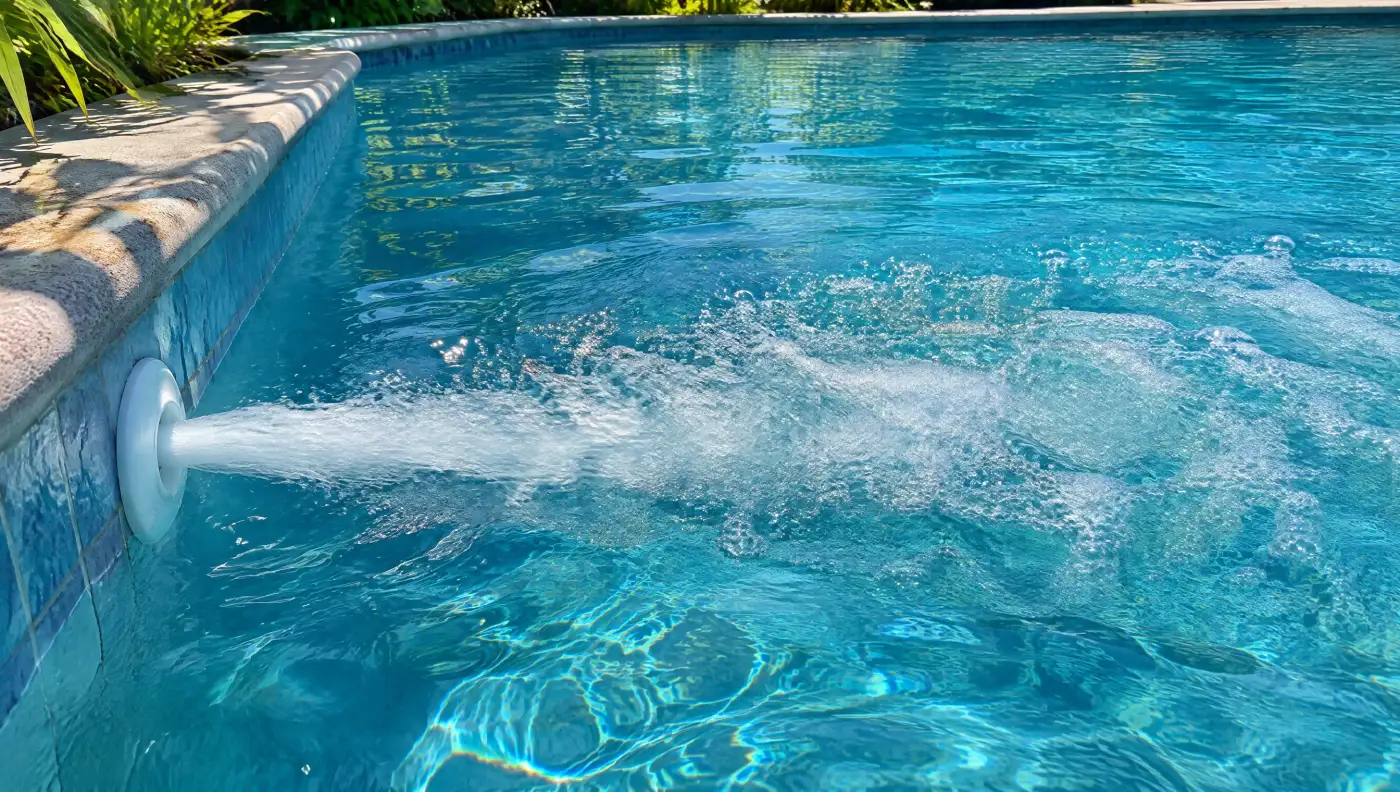
Aeration is the half of this method that most people underdo. The more CO2 you drive out, the faster pH rises and the sooner you can add the next dose. Trouble Free Pool notes that many small bubbles work better than a few big splashes.
- Aim the return jets up so they break the surface.
- Run waterfalls, fountains, deck jets or a spa spillover.
- Turn on spa jets or air blowers if you have a pool and spa combo.
- Use an air compressor or pond aerator with a hose or air stone in the deep end. AquaDoc and Orenda both list air compressors and diffusers.
- Let people swim and splash once the label’s wait time has passed; swimmers aerate too.
- Take the cover off. Orenda notes that covered pools trap CO2, which keeps pH low.
If you build a DIY aeration rig with a sump pump, Trouble Free Pool warns to keep swimmers out of the pool whenever the pump is in the water, even unplugged.
How long does it take to lower alkalinity?
| Situation | What to expect | |---|---| | One acid-and-aerate cycle | TA down about 10–20 ppm (AquaDoc) | | Strong aeration, 30,000-gallon pool | About 10 ppm in 12 hours (reported by Trouble Free Pool members) | | TA from 180 to 100 ppm | About 4–6 cycles over 1–2 weeks (AquaDoc) | | Weak aeration or covered pool | Slower; pH takes longer to recover between doses |
Trouble Free Pool sums it up: depending on your aeration and how far TA needs to fall, it can take days or even weeks. These are general expectations from pool chemistry guides, not guarantees.
Common mistakes
- Adding all the acid at once. The pH crashes, you risk etching the surface, and alkalinity doesn’t drop any faster.
- Pouring undiluted acid in one spot. It sinks and concentrates on the floor. Dilute it and spread it around.
- Raising pH with soda ash or baking soda between doses. That undoes your work. Aerate instead.
- Fixing pH before alkalinity. Alkalinity pulls pH back, so you end up doing it twice.
- Mixing acid and chlorine in the same bucket or adding them together. That can release toxic gas.
- Using the wrong dose for “low-fume” acid. These products are weaker or blended, so follow their label, not the 31.4% table.
- Not retesting. Test pH 30 minutes after each dose and TA after 24 hours.
When to call a pool professional
Most high alkalinity is a do-it-yourself fix. Call a pool service or your local pool store’s water lab if:
- Your fill water itself is very high in alkalinity, so every top-off brings it back. A pro can help you plan a routine or talk through options for the fill water.
- pH won’t come up even after a day or more of strong aeration, or it keeps dropping below 7.0.
- You see etching, rough patches or staining on plaster or a vinyl liner.
- You’re not comfortable handling muriatic acid. A service tech can do the acid additions for you.
- Your heater or salt cell shows scale or error codes.
How we put this guide together
We don’t own a pool and haven’t tested these products ourselves. This guide is built from sources you can check: the CDC’s pool water and chemical safety guidance, the NSPF dose table as published by the Indiana Department of Health, water chemistry articles from Orenda, Trouble Free Pool, AquaDoc and FROG, and the Amazon listing details for each product we mention. Target ranges match our pool chemicals guide. Where sources disagree, we note it and lean toward the more cautious option. Every source is listed at the end of the page.
Sources
- Indiana Department of Health: Adjusting Chemical Levels in a Swimming Pool (Water Chemistry Adjustment Guide, adapted from the NSPF Pool & Spa Operator Handbook) · in.gov
- CDC: Home Pool and Hot Tub Water Treatment and Testing · cdc.gov
- CDC: Use Pool Chemicals Safely (poster) · cdc.gov
- Orenda Technologies: How to Lower Total Alkalinity Without Lowering pH Too Much · ask.orendatech.com
- Orenda Technologies: Total Alkalinity's Role in Water Chemistry · blog.orendatech.com
- Trouble Free Pool: Lower Total Alkalinity · troublefreepool.com
- AquaDoc: How to Lower Alkalinity in a Pool Without Losing Control of pH · mavaquadoc.com
- FROG: Pool Alkalinity Made Easy: What It Is and How to Keep It Balanced · frogproducts.com
Frequently asked questions
How do you fix high alkalinity in a pool fast?
There's no instant fix. The fastest safe approach is to add a measured dose of muriatic acid with the pump running, let pH drop to about 7.0–7.2, and then aerate hard (waterfalls, fountains, returns aimed at the surface, an air compressor) until pH climbs back to 7.4–7.6. Repeat once or twice a day. With strong aeration, Trouble Free Pool reports members lowering alkalinity about 10 ppm in 12 hours in a 30,000-gallon pool. Dumping in a large amount of acid at once doesn't speed things up; it just crashes the pH.
Do I adjust alkalinity or pH first?
Alkalinity first. Total alkalinity is the buffer that holds pH in place, so if you fix pH first, alkalinity will pull it back out of range. Bring alkalinity into the 80–120 ppm range, then fine-tune pH to 7.2–7.8.
How do you lower alkalinity without lowering pH?
You can't add acid without lowering pH, but you can end up with lower alkalinity and normal pH. Add acid to lower both, then aerate. Aeration drives carbon dioxide out of the water, which raises pH without adding alkalinity back. Repeat the acid-then-aerate cycle until alkalinity reaches your target.
Can baking soda lower alkalinity in a pool?
No. Baking soda is sodium bicarbonate, the same chemical sold as alkalinity increaser, so it raises alkalinity. To lower alkalinity you need an acid: muriatic acid or sodium bisulfate (dry acid).
What happens if alkalinity is too high in a pool?
High alkalinity makes pH hard to control and lets it drift upward. Chlorine works less well at high pH, calcium is more likely to come out of solution as scale on tile, heaters and salt cells, and the water can turn cloudy. You'll also need more acid every time you try to bring pH down.
Is muriatic acid or dry acid better for lowering alkalinity?
Both work. Muriatic acid is the usual choice for big alkalinity corrections because it's concentrated and adds nothing but chloride. Dry acid (sodium bisulfate) is easier to handle and has no fumes, but it adds sulfates that build up over time, which Trouble Free Pool warns can affect plaster and saltwater chlorine generators. Sulfates only come out by draining water.