On this page
Key takeaways
- To raise alkalinity in a pool, add sodium bicarbonate. Pool "alkalinity increaser" and household baking soda are the same chemical: Leslie's alkalinity increaser listing says 100% sodium bicarbonate, and so does the title of In The Swim's 10 lb bag.
- Dose: about 1.4–1.5 lb per 10,000 gallons raises total alkalinity by roughly 10 ppm (NSPF table: 1.4 lb; product labels: 1.5 lb).
- Target 80–120 ppm. Adjust alkalinity before pH, because alkalinity is the buffer that holds pH in place.
- Don't raise it more than about 50 ppm at one time. Start with half to three-quarters of the calculated dose, circulate at least 6 hours, then retest.
- If alkalinity is 50 ppm or lower, test for metals before adding baking soda, as Indiana's health department advises.
Step-by-step checklist
-
Test alkalinity and pH
Read total alkalinity and pH with test strips or a drop kit, and confirm your pool's volume in gallons.
-
Calculate the dose
Use about 1.5 lb of sodium bicarbonate per 10,000 gallons for each 10 ppm you want to add (or your product label). Don't plan more than about 50 ppm in one go.
-
Start with part of the dose
Measure half to three-quarters of the calculated amount. You can add the rest after retesting.
-
Run the pump
Turn on the pump so the water is circulating while you add the product.
-
Broadcast it over the deep end
Sprinkle the sodium bicarbonate in wide arcs across the deep end or walk it around the pool. Avoid windy days and don't dump it in one spot.
-
Circulate at least 6 hours
Leave the pump running for at least 6 hours, or overnight, so the product dissolves and mixes through the pool.
-
Retest and top up
Retest alkalinity 6–24 hours later. If it's still below your target, add the remaining dose and circulate again.
-
Adjust pH last
Once alkalinity is in the 80–120 ppm range, adjust pH to 7.2–7.8.
Retest after the wait time in the guide below before adding anything else.
To raise alkalinity in a pool, add sodium bicarbonate, sold as baking soda or as pool “alkalinity increaser.” About 1.5 lb per 10,000 gallons raises total alkalinity by roughly 10 ppm; broadcast it over the deep end with the pump running, circulate for at least 6 hours, retest, and adjust pH only once alkalinity is in the 80–120 ppm range.
Below you’ll find what low alkalinity does, why baking soda and alkalinity increaser are interchangeable, a dose chart for common pool sizes, the step-by-step method and the mistakes that waste product.
What low alkalinity does to a pool
Total alkalinity (TA) is the dissolved bicarbonate and carbonate in the water. It’s the buffer that keeps pH from swinging. Orenda, a pool chemistry company, explains that alkalinity mainly protects pH from dropping. So when TA is low, pH becomes jumpy and tends to slide toward acidic.
The usual target is 80–120 ppm, the range FROG and most product labels give. Below about 80 ppm, you start to see these problems:
| Effect of low alkalinity | What you’ll notice | |---|---| | pH swings | pH changes a lot after a small dose of acid, chlorine or rain | | Acidic water | pH keeps drifting below 7.2 | | Corrosion | Corroded ladders, rails and heater parts | | Surface damage | Etched or rough plaster | | Eye and skin irritation | Swimmers complain of stinging eyes and itchy skin | | Weaker sanitizing | Chlorine is harder to keep working well when pH won’t hold |
FROG lists the same set: pH swings, equipment corrosion, surface damage, skin and eye irritation and reduced sanitizer effectiveness. The Indiana Department of Health adds that with low alkalinity, a small amount of acid or soda ash causes a large pH change, which makes pH hard to control.
What causes low alkalinity
- Acid additions. Muriatic acid and dry acid lower alkalinity along with pH. Orenda describes acid as converting alkalinity into dissolved CO2.
- Trichlor tablets. Trichlor is very acidic, so it slowly eats alkalinity. That’s why Orenda recommends the higher end of the range for trichlor pools.
- Rain and fresh water. Heavy rain or a big top-off with soft water dilutes alkalinity.
- Overcorrecting high alkalinity. If you just ran the acid-and-aeration process in how to lower alkalinity and went too far, this guide brings it back.
What’s the right number for your pool?
- Most pools: 80–120 ppm.
- Trichlor pools: the upper end, around 100–120 ppm, since the tablets keep pulling it down.
- Saltwater, liquid chlorine or cal hypo pools: these chlorines have a high pH, so these pools often do best at the low end. Orenda says salt pools can run around 60 ppm in season if the rest of the water balance is right. If your salt cell manual gives a range, follow it.
Our pool chemicals guide shows how alkalinity fits with pH, chlorine, calcium and stabilizer.
Alkalinity increaser vs. baking soda: same chemical
This is the most common question, and the answer is simple: pool alkalinity increaser is sodium bicarbonate, and so is baking soda. Leslie’s alkalinity increaser listing says 100% sodium bicarbonate, as does the title of In The Swim’s 10 lb bag, and the Arm & Hammer baking soda listing gives the same ingredient. The Indiana Department of Health guidance also calls sodium bicarbonate “baking soda” outright.
| | Baking soda | Alkalinity increaser | Soda ash (pH increaser) | |---|---|---|---| | Chemical | Sodium bicarbonate | Sodium bicarbonate | Sodium carbonate | | Raises alkalinity | Yes | Yes | Yes | | Raises pH | Slightly | Slightly | Strongly | | Dose for +10 ppm TA per 10,000 gal | 1.4–1.5 lb | 1.4–1.5 lb | 14 oz (NSPF) | | Where to buy | Grocery or warehouse store | Pool store, Amazon | Pool store, Amazon |
What actually differs between baking soda and alkalinity increaser:
- Bag size. Pool products come in 10–50 lb pails and bags; grocery boxes are often 1 lb, with larger bags at warehouse stores.
- Price per pound. Compare unit prices. Whichever is cheaper per pound for the amount you need is the better buy.
- Form. Pool products are often sold as granules; grocery baking soda is a fine powder. Both dissolve.
Just make sure the label says sodium bicarbonate and nothing else. Don’t confuse it with soda ash (sodium carbonate), which is sold as pH increaser: the Indiana guidance stresses that they are not the same. Soda ash raises pH much more and can cloud the water if you use it to fix alkalinity.
How much baking soda to raise alkalinity
The reference figure is 1.4 lb of sodium bicarbonate per 10,000 gallons for each 10 ppm of alkalinity, from the National Swimming Pool Foundation (NSPF) table published by the Indiana Department of Health. Most product labels and Arm & Hammer round it to 1.5 lb. The chart below uses 1.5 lb.
| Pool volume | +10 ppm | +20 ppm | +30 ppm | +40 ppm | |---|---|---|---|---| | 10,000 gal | 1.5 lb | 3 lb | 4.5 lb | 6 lb | | 15,000 gal | 2.25 lb | 4.5 lb | 6.75 lb | 9 lb | | 20,000 gal | 3 lb | 6 lb | 9 lb | 12 lb | | 25,000 gal | 3.75 lb | 7.5 lb | 11.25 lb | 15 lb | | 30,000 gal | 4.5 lb | 9 lb | 13.5 lb | 18 lb |
Calculated from 1.5 lb per 10,000 gallons per 10 ppm. Follow your product’s label if it differs.
For any other size, multiply the dose by your gallons ÷ 10,000, or let the pool chemical calculator do it. If you don’t know your volume, start with the pool volume calculator.
Example: an 18,000-gallon pool with TA at 60 ppm and a target of 90 ppm needs +30 ppm. That’s 1.5 × 1.8 × 3 = about 8.1 lb of sodium bicarbonate. Following Arm & Hammer’s advice, add 4–6 lb first, retest, then add the rest if needed.
Weigh it, don't guess
Doses are by weight, not volume. A kitchen or bathroom scale and a bucket are all you need. A standard 1 lb box of baking soda is exactly 1 lb, which makes small pools easy.
Raise alkalinity before pH
Alkalinity is the buffer; pH is what it buffers. If you adjust pH while alkalinity is low, pH won’t hold. The Indiana guidance lists the order to adjust chemicals as chlorine, then total alkalinity, then pH, and FROG and most product labels say the same: alkalinity first.
How that plays out in practice:
- TA low, pH normal or low: add sodium bicarbonate. It raises alkalinity and nudges pH up slightly, which often fixes both. Retest, then fine-tune pH.
- TA low, pH high: raise TA with sodium bicarbonate first, let it circulate, then bring pH down with a small acid dose. Our guide on how to lower pH covers that step.
- TA and pH both very low: the Indiana guidance suggests soda ash until pH comes into range, then sodium bicarbonate for any remaining alkalinity. See how to raise pH.
How to raise alkalinity in a pool, step by step
1. Test alkalinity and pH
Read total alkalinity and pH and write them down. Test strips are fine for this: alkalinity is one of the pads on most multi-way strips. A drop kit gives a more precise number if you’re close to a boundary. Compare strips in our best pool test strips guide.
AquaChek 7-Way Pool and Spa Test Strips (100 strips)
- Tests
- pH, TA, FC, TC, bromine, hardness, CYA
- Read time
- About 15 seconds (listing)
- Count
- 100 strips
Specs from the Amazon listing and manufacturer documentation
Seven readings in one dip: total alkalinity, pH, free and total chlorine, bromine, total hardness and cyanuric acid. The listing says you read the strip against the chart after about 15 seconds.
Pros
- Fast enough to check alkalinity before and after every dose
- Covers the other readings you need to balance afterward
Cons
- Color matching is less precise than a drop test
- Keep the bottle closed and dry or the pads degrade
2. Calculate the dose
Subtract your current TA from your target and use the chart above. If you need more than about 50 ppm, split it into two or more rounds: the Indiana guidance says not to raise alkalinity more than about 50 ppm at one time.
If TA is at or below 50 ppm, the same guidance says to test for metals in the water before adding baking soda or soda ash. Metals such as copper or iron can come out of solution and stain.
3. Start with part of the dose
Arm & Hammer suggests adding one-half to three-quarters of the calculated amount if you’re new to pool chemicals, then retesting and adding more if needed. Overshooting means you’ll need acid to bring it back down, which also lowers pH.
4. Run the pump
Turn on the pump and keep it running. Circulation spreads the sodium bicarbonate through the whole pool and helps it dissolve.
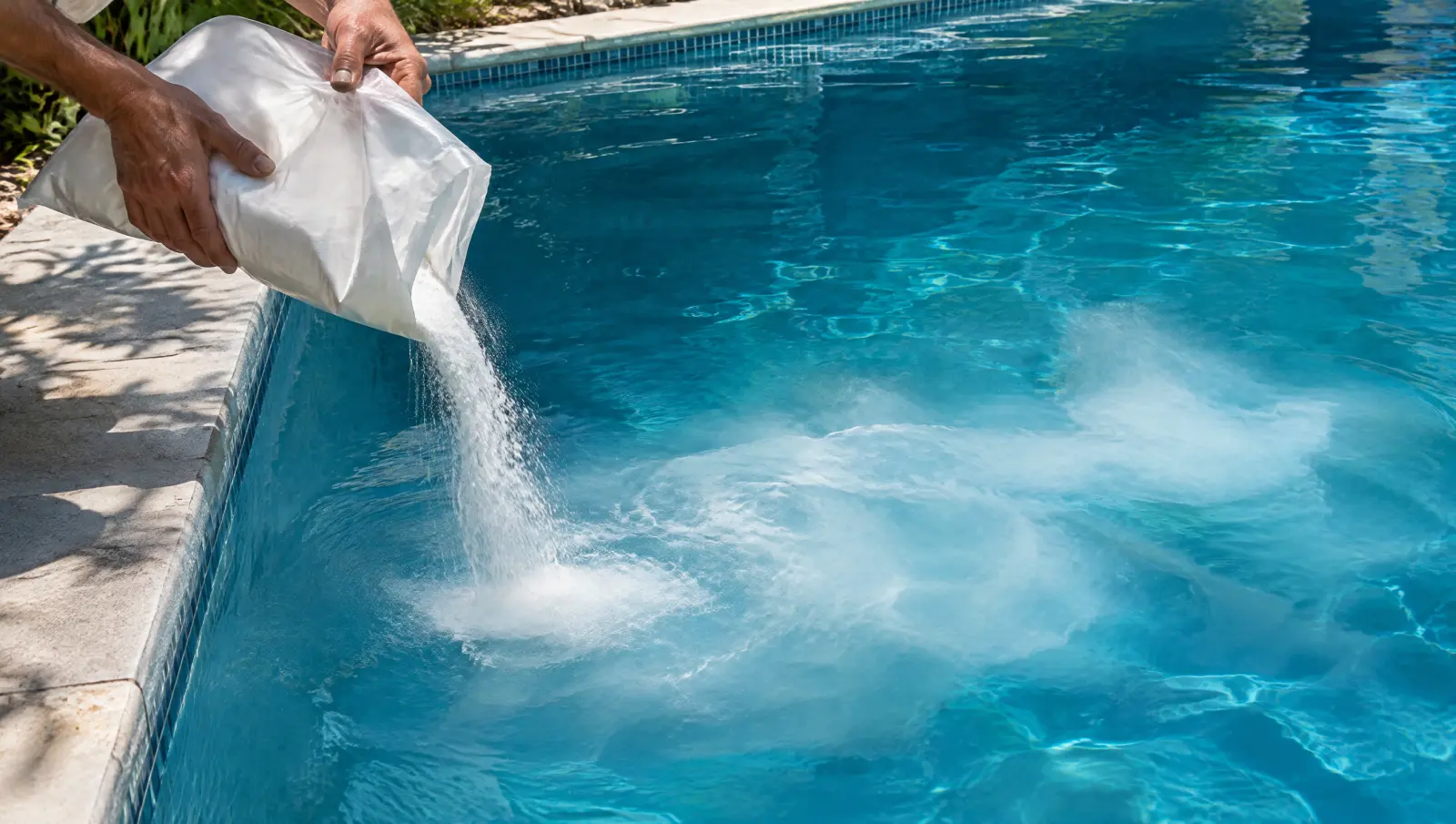
5. Broadcast it over the deep end
Sprinkle the powder across the surface in wide arcs, focusing on the deep end, or walk it around the pool. Don’t dump it in one pile, and avoid windy days: Arm & Hammer notes the powder can blow away.
In The Swim Alkalinity Increaser (sodium bicarbonate, 25 lb)
- Active ingredient
- Sodium bicarbonate
- Dose
- 1.5 lb per 10,000 gal = +10 ppm
- Target (listing)
- 90–120 ppm
- Size
- 25 lb pail
Specs from the Amazon listing and manufacturer documentation
Sodium bicarbonate in a 25 lb pail. The listing gives 1.5 lb per 10,000 gallons to raise alkalinity by 10 ppm, with a 90–120 ppm target.
Pros
- Enough for a large correction in a 20,000–30,000-gallon pool
- One pail covers several 10 ppm corrections even in a 20,000-gallon pool
Cons
- More than a small above-ground pool needs
- Chemically the same as baking soda, so compare price per pound
Leslie's Alkalinity Increaser (sodium bicarbonate, 10 lb)
- Active ingredient
- 100% sodium bicarbonate (listing)
- Dose
- Not stated on listing; follow the bag
- Size
- 10 lb
Specs from the Amazon listing and manufacturer documentation
A 10 lb bag of 100% sodium bicarbonate sized for smaller corrections. The Amazon listing doesn't print a dose, so follow the bag; sodium bicarbonate is the same chemical as above, so the 1.5 lb per 10 ppm figure is a fair starting point to check against it.
Pros
- Practical size for above-ground pools and small top-ups
- Same dose math as every other sodium bicarbonate product
Cons
- No dose on the Amazon listing, so you rely on the printed label
- A large correction can use most of the bag
6. Circulate at least 6 hours
FROG and Arm & Hammer both say to let the water circulate for at least 6 hours before retesting. Running the pump overnight is easiest. If the water looks slightly hazy while the powder dissolves, keep the pump running.
7. Retest and top up
Arm & Hammer suggests retesting 6–24 hours after adding it. If alkalinity is still below target, add the rest of the dose (or another round of up to about 50 ppm) and circulate again.
8. Adjust pH last
With alkalinity in range, check pH and adjust to 7.2–7.8. The CDC’s recommended range for pools is 7.0–7.8, and 7.4–7.6 is the usual sweet spot. Then check chlorine.
Chemical safety
Sodium bicarbonate is one of the mildest pool chemicals, but the same rules apply to everything you add:
- Never mix pool chemicals together, dry or dissolved. The CDC warns that chlorine and acid together can create toxic gas, so don’t follow up with acid from the same scoop or bucket.
- Add the product to water, never water to the product, if a label tells you to pre-dissolve.
- Wear safety glasses and gloves, handle chemicals in a well-ventilated area and keep dust out of your face. The CDC’s pool chemical safety poster calls for safety equipment such as goggles and gloves.
- If you lower pH afterward with muriatic acid, dilute it in a bucket of pool water first and add it with the pump running.
- Store chemicals separately, closed and dry, and especially keep acid away from chlorine.
Low alkalinity: problems and fixes at a glance
| What you see | Likely cause | Fix | |---|---|---| | TA below 80 ppm, pH bouncing | Low buffer | Sodium bicarbonate, 1.5 lb per 10,000 gal per 10 ppm | | TA low, pH high | Low buffer plus high-pH chlorine or recent soda ash | Raise TA first, then lower pH with acid | | TA and pH both low | Acid overdose, trichlor, heavy rain | Soda ash for pH, then sodium bicarbonate for TA | | TA drops every week | Trichlor tablets or regular acid use | Keep TA at the upper end; recheck weekly | | TA at or below 50 ppm | Severe drop | Test for metals, then raise in steps of up to 50 ppm |
Common mistakes
- Using soda ash to raise alkalinity. It’s a pH increaser. It raises pH far more than baking soda and can cloud the water.
- Adding the whole dose at once. Start with half to three-quarters, retest, then top up.
- Retesting too soon. Give it at least 6 hours of circulation, or you’ll read a partly mixed pool and overdose.
- Fixing pH first. Without enough alkalinity, pH won’t stay put.
- Dumping it in one spot near the skimmer. Broadcast it widely over the deep end.
- Measuring by cups instead of weight. Doses are in pounds; weigh it.
- Paying extra for the label. Alkalinity increaser and plain baking soda are the same chemical. Compare price per pound.
When to call a pool professional
Raising alkalinity is one of the easiest pool chemistry jobs. Get help from a pool service or a pool store’s water lab if:
- Alkalinity falls again within days even though you’re not using acid or trichlor.
- You see stains, etching or corrosion on plaster, ladders or heater parts.
- Your TA is very low and metals test positive: a pro can help you treat the metals first.
- The water stays cloudy for more than a day after adding baking soda; calcium or pH may be too high.
How we put this guide together
We don’t own a pool and haven’t tested these products ourselves. This guide is built from sources you can check: the CDC’s pool water and chemical safety guidance, the NSPF dose table as published by the Indiana Department of Health, Arm & Hammer’s pool guidance for baking soda, water chemistry articles from FROG and Orenda, and the Amazon listing details for each product we mention. Target ranges match our pool chemicals guide. Where sources disagree, we note it and lean toward the more cautious option. Every source is listed at the end of the page.
Sources
- Indiana Department of Health: Adjusting Chemical Levels in a Swimming Pool (Water Chemistry Adjustment Guide, adapted from the NSPF Pool & Spa Operator Handbook) · in.gov
- CDC: Home Pool and Hot Tub Water Treatment and Testing · cdc.gov
- CDC: Use Pool Chemicals Safely (poster) · cdc.gov
- Arm & Hammer: Maintain Your Pool with Baking Soda · armandhammer.com
- FROG: Pool Alkalinity Made Easy: What It Is and How to Keep It Balanced · frogproducts.com
- Orenda Technologies: Total Alkalinity's Role in Water Chemistry · blog.orendatech.com
Frequently asked questions
Do I adjust pH or alkalinity first?
Alkalinity first. Total alkalinity buffers pH, so if you fix pH while alkalinity is low, it will swing out of range again. Bring alkalinity to 80–120 ppm with sodium bicarbonate, let it circulate, retest, and only then fine-tune pH to 7.2–7.8.
Does baking soda raise pH or alkalinity more?
Alkalinity. Sodium bicarbonate raises total alkalinity a lot and pH only slightly, which is why it's the standard alkalinity increaser. If you need to raise pH substantially, soda ash (sodium carbonate) is the stronger pH raiser; it also adds alkalinity.
What does low alkalinity do to a pool?
Low alkalinity leaves pH unstable, so it bounces around and tends to drift low and acidic. That can corrode metal equipment, etch plaster, irritate eyes and skin, and make chlorine less effective. Small amounts of acid or chlorine can also cause big pH swings.
What is the cheapest way to raise the alkalinity in my pool?
Plain baking soda. It's the same chemical as pool alkalinity increaser (sodium bicarbonate), so the only differences are bag size, grain and price. Compare the price per pound, buy a bag large enough for your pool, and make sure the label says 100% sodium bicarbonate with nothing added.
How long does it take for baking soda to raise alkalinity?
It starts working as soon as it dissolves, but give it time to mix through the whole pool. FROG and Arm & Hammer both say to circulate at least 6 hours before retesting, and Arm & Hammer suggests retesting between 6 and 24 hours after adding it.
Is 40 ppm alkalinity good for a pool?
No, 40 ppm is low for almost any pool. The usual target is 80–120 ppm; even salt pools, which can run lower, are usually kept around 60 ppm or more. At 50 ppm or below, Indiana's health department advises testing for metals before adding baking soda, then raising alkalinity in steps of no more than about 50 ppm.