On this page
Key takeaways
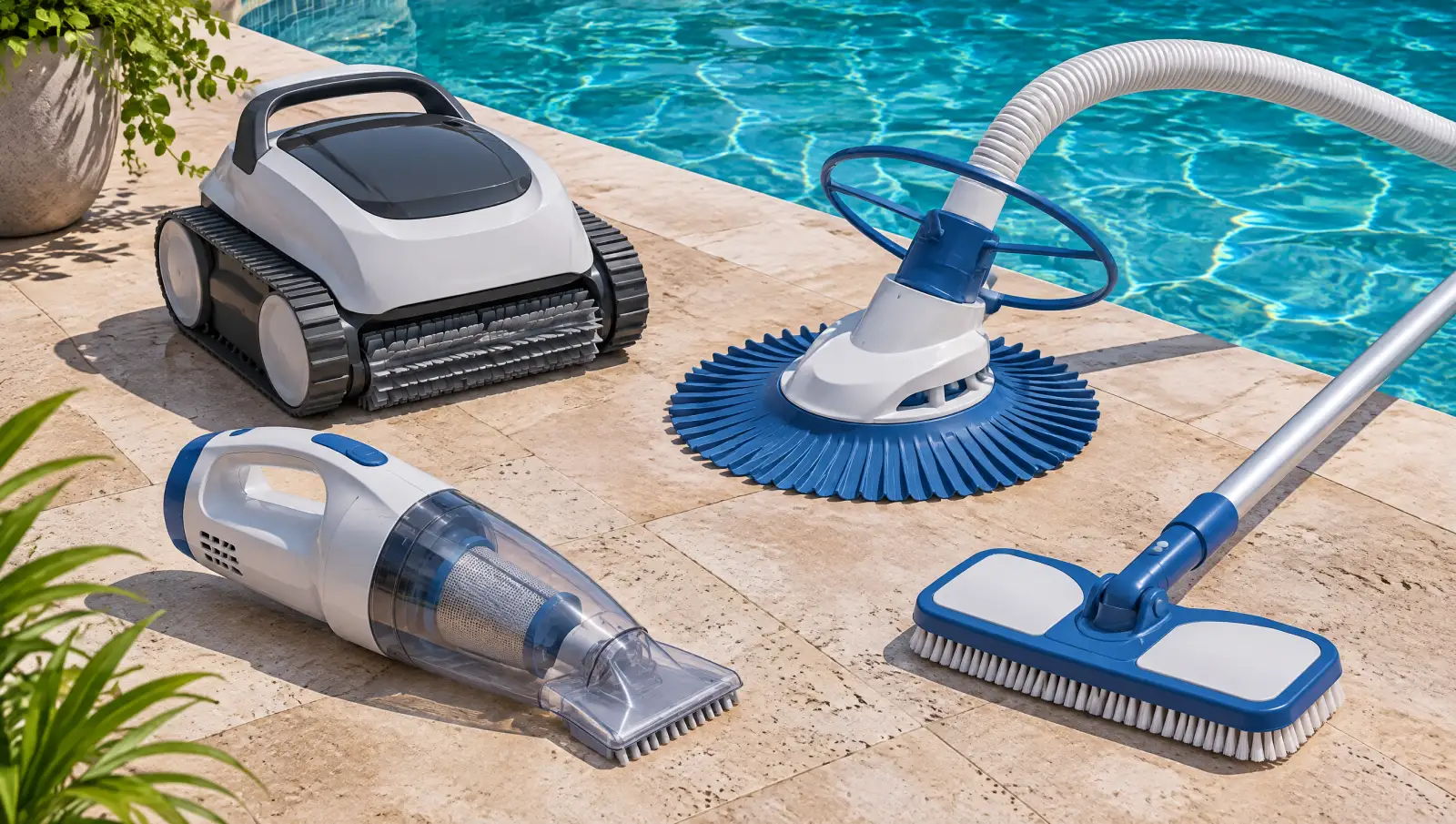
- There are five kinds of pool vacuum: robotic, suction-side, pressure-side, handheld battery and manual. Only robots and handhelds carry their own motor; suction and pressure cleaners run off your pool's plumbing.
- A robotic cleaner has its own pump and filter, so your pool pump and filter aren't involved. Maytronics puts a cycle at 1.5–4 hours.
- A suction-side cleaner plugs into the skimmer or a suction port and sends debris to your pool filter; the Hayward PoolVac XL is rated for pools up to 20 x 40 ft and needs no booster pump.
- A pressure-side cleaner runs on return-line pressure and bags its own debris, but most need a booster pump (the Polaris Vac-Sweep 280 does).
- Handheld battery vacuums need no hose or pump (the Pool Blaster Max Li is submersible to 16 ft, per its listing); a manual vacuum head on a pole is the cheapest option and the only one that can vacuum to waste.
The best pool vacuum depends on how much work you want to do: a robotic cleaner like the Dolphin Nautilus CC Plus Wi-Fi is the most hands-off option for an inground pool, a suction-side cleaner like the Hayward PoolVac XL is the cheaper automatic option that runs off your pump, and a manual vacuum head on a pole is still the tool for spot jobs and vacuuming to waste. Handheld battery vacuums fill the gap for steps, corners and small pools.
Below we compare all five types, explain what powers each and where the debris ends up, and give one pick per type. Every spec comes from the manufacturer or the Amazon listing, and we say which.
Our picks at a glance
Scroll sideways to see every column →
| Product | Best for | Type | Powered by | Debris goes to | Pool it suits | Key spec | Price | Buy |
|---|---|---|---|---|---|---|---|---|
| Best roboticDolphin Nautilus CC Plus Wi-Fi | Hands-off inground cleaning | Robotic, corded | Own motor, deck power supply | Robot filter | Inground, up to 40 ft (Maytronics US) | About 2 h cycle, floor and walls | Check price | |
| Best cordless robotWYBOT C1 | No cable, mid-size pools | Robotic, cordless | Battery | Robot filter (180 µm, WYBOT) | Inground, up to 1,615 sq ft (WYBOT) | Floor, walls, waterline, steps; up to 150 min per cycle | Check price | |
| Best suction-sideHayward PoolVac XL (vinyl) | Automatic cleaning on a budget | Suction-side | Your pool pump | Your pool filter | Inground, up to 20 x 40 ft | 40 ft hose, no booster pump | Check price | |
| Best pressure-sidePolaris Vac-Sweep 280 | Leafy inground pools | Pressure-side | Return line + booster pump | Its own bag | Inground, all surfaces | 31 ft hose, cleans in 3 h or less | Check price | |
| Best handheld batteryPool Blaster Max Li | Spot cleaning, steps, small pools | Handheld battery | Rechargeable battery (2,200 mAh) | Its own bag | Inground and above-ground | Submersible to 16 ft | Check price | |
| Best manualPoolmaster Deluxe Weighted Vinyl Liner head | Spot jobs, vacuuming to waste | Manual | Your pool pump | Filter or waste line | Vinyl inground and above-ground | Air-relief valves, 1-year warranty | Check price |
Specs from Amazon listings and manufacturer documentation. Prices change often, so we link to the live listing.
Robot makers such as Maytronics and WYBOT also sell on their own websites. We link only to Amazon listings and don’t show prices, because they change constantly.
The five types of pool vacuum
Before picking a model, pick the type. The main differences are what powers the vacuum, where the dirt ends up and how much of your time it takes.
| | Robotic | Suction-side | Pressure-side | Handheld battery | Manual | |---|---|---|---|---|---| | Power | Own motor (cable or battery) | Your pool pump | Return-line pressure, usually a booster pump | Rechargeable battery | Your pool pump | | Debris goes to | Robot’s own filter | Pool filter and pump basket | Cleaner’s bag | Vacuum’s bag or canister | Pool filter, or out the waste line | | Pump must run? | No | Yes | Yes | No | Yes | | Your effort | Lift out, rinse filter | Clean filter more often | Empty bag | Push it around | Push it around, prime the hose | | Best at | Weekly floor and wall cleaning | Fine dirt, sand | Leaves and larger debris | Steps, corners, small pools | Spot jobs, algae, floc cleanup |
Robotic cleaners are self-contained. Maytronics, which makes Dolphin robots, says a robot runs on its own low-voltage power supply and that the pool’s pump and filtration system “are not involved at any point.” Cycles run 1.5 to 4 hours depending on pool size and mode. Robots cost the most up front.
Suction-side cleaners attach to your skimmer or a dedicated suction port and wander the pool on the water your pump pulls through them. Everything they pick up goes to your pump basket and filter, so you’ll clean or backwash the filter more often. Hayward says the PoolVac XL is powered by the existing filtration system and does not need a booster pump.
Pressure-side cleaners connect to a return line and use the water pushed back into the pool to drive the cleaner and lift debris into a bag. Polaris says a booster pump is a necessary component for most pressure-side cleaners, and the Vac-Sweep 280 lists one as required. Because debris goes into the bag, the pool filter stays cleaner, which helps with leaves.
Handheld battery vacuums clip to a telescopic pole and run on a rechargeable battery with a small onboard pump and bag. They don’t use your pool’s plumbing at all. They’re great for steps, corners, spas and small pools, and as a sidekick to a robot.
Manual vacuums are a vacuum head on a telescopic pole connected by a hose to your skimmer or vacuum port. Your pump provides the suction. It’s the cheapest setup, and it’s the only one that lets you send the dirty water straight out of the pool with the multiport valve on Waste. Our manual pool vacuum guide explains how.
Best pool vacuums of 2026: our picks
Best robotic: Dolphin Nautilus CC Plus Wi-Fi
Dolphin Nautilus CC Plus Wi-Fi Robotic Pool Cleaner
Best for: Inground pools up to 40 ft where you want to do the least work
- Type
- Robotic, corded with anti-tangling swivel
- Pool
- Inground, up to 40 ft (Maytronics US spec page)
- Cycle
- About 2 hours (listing)
- Cleans
- Floor and walls; waterline scrubbing listed as "No"
- Filter
- Ultra-fine filter kit
- Weight
- 20.8 lb robot (Maytronics); 34.6 lb (listing)
- Warranty
- 1 year (Maytronics US spec page)
Specs from the Amazon listing and manufacturer documentation
The mainstream corded Dolphin: a cycle of about 2 hours, wall climbing with a scrubber brush, an ultra-fine filter kit and an anti-tangling swivel, controlled from an app over Wi-Fi with a weekly timer. It doesn't touch your pool pump or filter. Maytronics' US spec page doesn't list waterline scrubbing and gives a 1-year warranty.
Pros
- Fully independent of your pump and filter
- Never needs charging
- App control and weekly timer
- Swivel cuts cable tangling
Cons
- Costs far more than suction or manual options
- No waterline scrubbing on the US spec page
- Short warranty for the price
- You lift it out and rinse the filter after each run
For more robots by pool type, see our robotic inground pool cleaner picks.
Best cordless robot: WYBOT C1
WYBOT C1 Cordless Robotic Pool Vacuum for Inground Pools
Best for: Mid-size pools where you want no cable at a lower cost than flagship robots
- Type
- Robotic, cordless
- Cleans
- Floor, walls, waterline and steps (listing)
- Runtime
- Up to 150 min (WYBOT)
- Pool
- Up to 1,615 sq ft, 9.8 ft deep (WYBOT)
- Filter
- 180 µm (WYBOT)
- Slopes
- Up to 45° (listing)
- Charging
- About 3 hours (listing)
- Warranty
- 2 years (WYBOT)
Specs from the Amazon listing and manufacturer documentation
A lower-cost cordless robot. Its listing says it cleans the floor, walls, waterline and steps, handles slopes up to 45° and recharges in about 3 hours, WYBOT's product page adds a cycle of up to 150 minutes, pools up to 1,615 sq ft and 9.8 ft deep, a 180 µm filter and a 2-year warranty.
Pros
- No cable to tangle
- Short charge time
- Cleans steps as well as walls and waterline
Cons
- Rated for pools up to 1,615 sq ft, so not for large pools
- Battery will lose capacity over the years
- Several C1 listings and variants; check the title
Our cordless robotic pool cleaner guide compares more battery robots.
Best suction-side: Hayward PoolVac XL
Hayward PoolVac XL Suction Pool Cleaner for Vinyl Inground Pools (W32025ADV)
Best for: Inground pools where you want an automatic cleaner that runs with the pump
- Type
- Suction-side
- Pool
- Inground vinyl, up to 20 x 40 ft (listing)
- Hose
- 40 ft (listing)
- Connects to
- Skimmer or dedicated suction port
- Cleans
- Floor, walls and coves
- Booster pump
- Not required
- Warranty
- 1 year (listing; Hayward lists 1 year on parts for this W3 Open Line version; other versions differ)
Specs from the Amazon listing and manufacturer documentation
A classic suction cleaner that Hayward says connects to the skimmer or suction port in under 10 minutes with no tools, runs on your existing filtration system and needs no booster pump. It cleans the floor, walls and coves, steered by Hayward's AquaPilot system to limit hose tangles. This listing is the vinyl version; Hayward says it isn't recommended for concrete or gunite, where it wears prematurely, so plaster pools need the concrete version.
Pros
- Lives in the pool and runs whenever the pump runs
- No booster pump to buy or power
- No bag to empty
- Concrete version sold separately (B07SQ2MPL8)
Cons
- Sends all debris to your pump basket and filter
- Needs enough pump flow; Hayward includes a flow gauge to check it
- Random pattern, not mapped
- Wall climbing can depend on pool shape and surface
Best pressure-side: Polaris Vac-Sweep 280
Polaris Vac-Sweep 280 Pressure-Side In-ground Pool Cleaner
Best for: Inground pools with a booster pump (or room for one) and lots of leaves
- Type
- Pressure-side
- Power
- Return-line pressure; booster pump required (sold separately)
- Hose
- 31 ft feed hose
- Debris
- Single-chamber filter bag
- Inlet
- 2.25 in (listing)
- Surfaces
- All pool surfaces (listing)
- Cleaning time
- 3 hours or less (listing)
Specs from the Amazon listing and manufacturer documentation
The long-running Polaris pressure cleaner: two venturi jets lift debris into its own single-chamber bag, so leaves stay out of your pool filter. The listing says it cleans in three hours or less, takes a 2.25 in inlet and works on all pool surfaces. The big catch is the booster pump, which it requires and which is sold separately.
Pros
- Debris goes into the bag, not your filter
- Handles leaves well
- Works on all common surfaces
Cons
- Needs a booster pump, which adds cost and electricity
- Bag must be emptied
- Random cleaning pattern
- Warranty not shown on this listing; the Black Max version (B001D97CL2), for dark pools, lists 1 year
How Polaris robots stack up against Dolphin is covered in Dolphin vs Polaris.
Best handheld battery vacuum: Pool Blaster Max
POOL BLASTER Max Li Cordless Pool Vacuum for Inground and Above Ground Pools
Best for: Steps, corners, spas and small pools, or touch-ups between robot runs
- Type
- Handheld battery
- Battery
- 2,200 mAh (listing)
- Depth
- Submersible to 16 ft (listing)
- Pool
- Inground and above-ground
- Pole
- Standard telescopic pole, sold separately
- Warranty
- 1 year (listing)
Specs from the Amazon listing and manufacturer documentation
A hoseless, rechargeable vacuum that clips to a standard telescopic pole. This listing is the Max Li version: a 2,200 mAh battery, submersible to 16 ft, with a 1-year warranty. It needs no hose, pump or filter connection, which makes it the quickest way to clean one dirty step. Water Tech sells several Max versions (HD, CG, Li), so check the title.
Pros
- No hose or pump needed
- Fast for spot cleaning
- Works in spas and small pools too
Cons
- Too slow to vacuum a large pool every week
- Runtime per charge not stated on the listing
- Pole not included
- Several similar versions under different listings
More handhelds and above-ground options are in our above-ground pool vacuum guide.
Best manual: Poolmaster Deluxe Weighted Vinyl Liner head
Poolmaster Deluxe Weighted Vinyl Liner Pool Vacuum Head with Air-Relief Valves
Best for: Vinyl pools that need spot vacuuming or vacuuming to waste
- Type
- Manual vacuum head
- Surface
- Vinyl liner (inground and above-ground)
- Feature
- Air-relief valves (listing)
- Warranty
- 1 year (listing)
- Needs
- Hose, telescopic pole, running pump
Specs from the Amazon listing and manufacturer documentation
A weighted head with brushes made for vinyl liners. The listing describes air-relief valves meant to keep suction steady and protect the liner, and gives a 1-year warranty. Pair it with a 1.5 in hose, such as the Swimline HydroTools 30 ft hose (B0032JSQL6), and a telescopic pole. For plaster or gunite, Poolmaster's 27250 Commercial flexible head (B006H4CED4) is the hard-surface option.
Pros
- Cheapest way to vacuum a pool
- Can vacuum to waste after algae or floc
- Nothing to charge or break down
Cons
- Slow and takes effort every time
- Hose and pole sold separately
- Depends on good pump flow and a primed hose
How to choose a pool vacuum
Work through these in order:
- How much time will you put in? If the answer is “none,” you want a robot. If you’re fine emptying a filter more often, a suction cleaner saves money. If you’ll vacuum by hand once a week, a manual head is enough.
- What’s your pool? Inground pools suit all five types. Above-ground pools usually have smaller pumps, so suction and pressure cleaners are less common; robots made for above-ground pools, handhelds and vinyl-safe manual heads fit better.
- What’s your surface? Vinyl liners need vinyl-safe heads and cleaners; several suction cleaners and manual heads come in separate vinyl and concrete versions, like the PoolVac XL.
- What debris do you get? Leaves favor pressure cleaners with bags and robots with big baskets. Fine sand and silt favor robots with fine filters, or vacuuming to waste.
- What’s already plumbed in? A pressure cleaner needs a booster pump unless you already have one. A suction cleaner needs a skimmer or suction port and enough flow.
- What will it cost to run? Suction and pressure cleaners need the pool pump (and a booster pump, for pressure) running while they clean. A robot uses its own low-voltage supply.
After a floc, vacuum to waste
If you use flocculant to clear cloudy water, the settled debris should go out of the pool, not through the filter or a robot. Dolphin’s Basic 19 manual says not to run the robot after liquid flocculants or clarifiers. Use a manual vacuum with the multiport valve on Waste instead.
Vacuuming and water chemistry
A vacuum removes dirt; it doesn’t sanitize. Brush, vacuum and skim before you shock, so the chlorine isn’t spent on debris, and take a robot out of the water while you shock. Day to day, keep free chlorine in step with your stabilizer: about 7.5% of your cyanuric acid level, which works out to roughly 3–5 ppm for most outdoor pools. Our how to shock a pool guide has the full steps, and the pool chemicals guide covers the ranges.
The rest of the cleaning kit
- A pool skimmer net catches leaves before they sink.
- A pool brush handles steps, corners and algae spots that vacuums miss.
- Our hub on robotic pool cleaners explains how robots work and how to maintain one.
How we chose these vacuums
We didn’t test any of these vacuums in a pool. We picked one model for each type of pool vacuum, favoring products whose maker publishes the specs that decide fit: pool size, power source, where debris goes, hose length, runtime and warranty. Specs come from manufacturer pages (Maytronics, Hayward, Polaris, WYBOT) and WYBOT’s warranty policy, and from each Amazon listing, which we checked in a browser on November 29, 2026 (we kept only live, in-stock listings); where they disagree, we say so. The cleaning steps come from Swim University’s manual vacuuming guide and INYO Pools’ multiport valve guide. We didn’t analyze customer reviews. Every source is listed at the end of the page.
How we compared
We gathered the Amazon listing and manufacturer documentation for each product, put the specs side by side and matched each one to the job it suits. We don’t test products hands-on: the figures come from the documents listed in Sources. How we research.
- Products compared
- 6
- Sources cited
- 10
- Compared on
- Type, Powered by, Debris goes to, Pool it suits, Key spec
- Last updated
- Nov 2026
- Hands-on testing
- No
- Paid placements
- None
Sources
- Maytronics: What Is a Robotic Pool Cleaner? · maytronics.com
- Hayward: PoolVac XL Suction Cleaner, Vinyl Pools (W32025ADV) · hayward.com
- Polaris: Vac-Sweep 280 pressure cleaner · polarispool.com
- Polaris: Pressure-Side Pool Cleaners · polarispool.com
- Maytronics: Dolphin Nautilus CC Plus w/ Wi-Fi (US specifications) · maytronics.com
- WYBOT: C1 Cordless Robotic Pool Cleaner product page · wybotpool.com
- WYBOT: Warranty & Refund Policy · wybotpool.com
- Maytronics: Dolphin Basic 19 User Instructions (8159950) · brand.maytronics.com
- Swim University: How to Vacuum a Pool Manually · swimuniversity.com
- INYO Pools: How a Multiport Valve Operates · inyopools.com
Frequently asked questions
Do cordless pool vacuums really work?
Yes, within their limits. Cordless robots clean the floor (and usually walls) on a battery, then need recharging (about 3 hours for the WYBOT C1, per its listing). Handheld battery vacuums such as the Pool Blaster Max Li suit spot cleaning, steps and small pools. They catch debris in their own bag or basket, so you have to empty it often, and none of them balance chemicals or replace brushing.
Is there a pool vacuum that picks up algae?
Any vacuum can pick up dead algae once you've brushed and shocked the pool, but where the debris goes matters. Fine dead algae can pass back through some filters, so for a real bloom the standard approach is a manual vacuum with the multiport valve on Waste, which sends the water out of the pool instead of through the filter. Robots work for routine cleanup, but take them out while you shock and don't run them after adding flocculant.
What is the number one rated pool vacuum?
There isn't one that's best for every pool, because the types solve different problems. For hands-off cleaning of an inground pool, a robot like the Dolphin Nautilus CC Plus Wi-Fi is the usual starting point. For a cheaper automatic option that runs with your pump, a suction cleaner like the Hayward PoolVac XL works. For spot cleaning or vacuuming to waste, a manual head and hose is still the right tool.
What vacuum do professional pool cleaners use?
We haven't surveyed pool service companies, so we can't say what most of them carry. What we can say is that manufacturers sell commercial or professional lines of exactly the tools a route needs: manual vacuum heads (such as Poolmaster's Commercial Collection), heavy-duty telescopic poles, leaf rakes, and commercial-grade battery vacuums (Water Tech sells a CG version of the Pool Blaster Max). Those manual tools also let a technician vacuum to waste, which a robot can't do.
Which is better, Polaris or Dolphin robotic pool cleaner?
Neither brand wins across the board. Dolphin (Maytronics) makes only robotic cleaners; Polaris makes robots plus suction-side and pressure-side cleaners like the Vac-Sweep 280. Compare specific models: pool size rating, cycle time, waterline cleaning, filter fineness, cable swivel and warranty. Our Dolphin vs Polaris guide goes model by model.
Is a manual pool vacuum better?
It's better for some jobs and worse for others. A manual vacuum is cheap, has no motor to fail, reaches exactly where you point it and can vacuum to waste after an algae treatment or a floc. It's also slow, takes effort every time, and depends on your pump and a properly primed hose. For weekly cleaning, most owners prefer an automatic cleaner and keep a manual head for spot jobs.