On this page
Key takeaways
- Best overall: LaMotte ColorQ 2X PRO 7, a photometer that reads free and total chlorine, pH, alkalinity, calcium hardness and cyanuric acid with a numeric result and no color matching.
- "Digital" doesn't automatically mean more accurate. A photometer runs real reagent chemistry; a strip reader is only as good as the strip; a smart monitor uses test pads. The CDC still calls a DPD test the most accurate home method.
- Hands-off option: WaterGuru SENSE 3 tests free chlorine, pH, alkalinity, CYA and hardness daily; its cassette lasts about 1 month.
- pH pens need two-point calibration with fresh buffer. Hanna recommends buffers that bracket your reading, so 7.01 and 10.01 for pool water around pH 7.5.
- Whatever you use, test free chlorine and pH often: the CDC says at least twice a day, and keep free chlorine at 1 ppm or more (2 ppm with stabilizer; in practice about 7.5% of your CYA reading) and pH at 7.0–7.8.
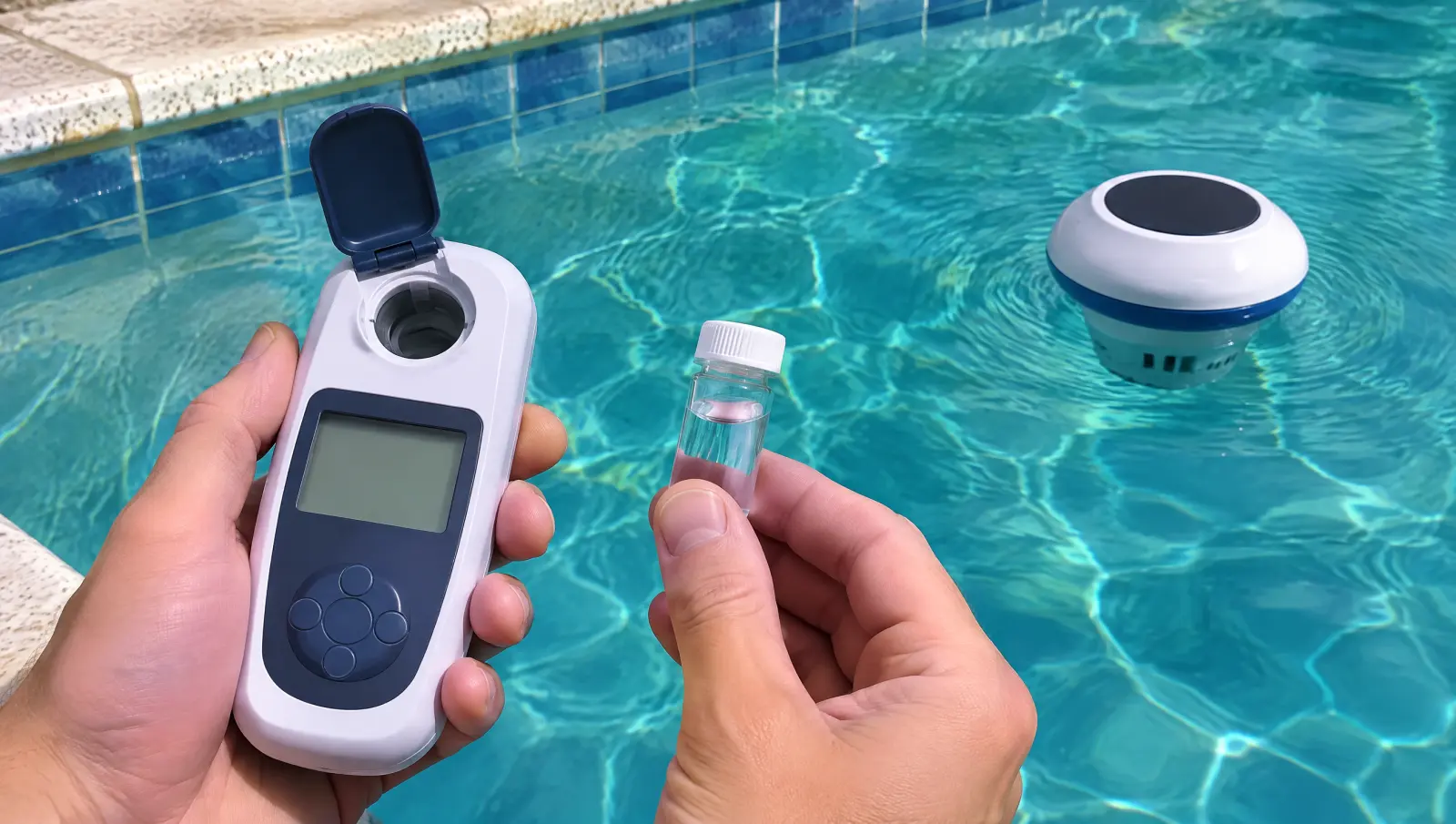
The best digital pool tester for most owners who want lab-style numbers is the LaMotte ColorQ 2X PRO 7, a handheld photometer that reads seven tests without color matching. If you’d rather not test by hand at all, the WaterGuru SENSE 3 checks the water every day from the skimmer.
Below you’ll find a quick comparison, a review of each pick, how accurate each type really is, how to calibrate and care for them, and when plain strips or a drop kit are still the better choice.
Digital pool testers compared
Scroll sideways to see every column →
| Product | Best for | Type | Reads | Upkeep | Price | Buy |
|---|---|---|---|---|---|---|
| LaMotte ColorQ 2X PRO 7 | Best overall, accuracy | Photometer (liquid + tablet reagents) | Free and total chlorine, bromine, pH, alkalinity, calcium hardness, CYA | Reagent refills; clean tubes | Check price | |
| WaterGuru SENSE 3 | Hands-off daily monitoring | Smart skimmer monitor (Wi-Fi, solar) | Free chlorine, pH, alkalinity, CYA, hardness, temperature, flow | New cassette about monthly | Check price | |
| Hanna HI98107 pHep | pH only, on a budget | pH pen | pH | Calibrate with buffer; keep electrode moist | Check price |
Specs from Amazon listings and manufacturer documentation. Prices change often, so we link to the live listing.
The best digital pool testers
LaMotte ColorQ 2X PRO 7 (2086), waterproof Bluetooth photometer
- Tests and ranges
- Free and total chlorine 0–10 ppm, bromine 0–22 ppm, pH 6.5–8.5, alkalinity 0–300 ppm, calcium hardness 0–600 ppm, CYA 0–150 ppm
- Reagents
- Liquid for chlorine and pH (144 tests each); TesTabs tablets for alkalinity, hardness, CYA (100 each)
- Build
- Waterproof, Bluetooth, 2 AA batteries
- Warranty
- 1 year (user guide)
Specs from the Amazon listing and manufacturer documentation
A handheld photometer: you add reagent to a sample and the meter measures the color with light and shows a number. It covers the seven readings a pool needs, and LaMotte publishes NSF accuracy certifications for its chlorine, pH and cyanuric acid tests.
Pros
- Numeric results for every test, no color judging
- Covers calcium hardness and CYA, which strips and monitors handle less well
- Published NSF accuracy levels per test
Cons
- Takes several minutes for a full panel
- Ongoing reagent cost; tubes must be kept clean and unscratched
The PRO 7 is the closest thing to a pool-store test at home. LaMotte’s NSF table lists free chlorine (tablet) at level L1 for pools, liquid pH at L2 and cyanuric acid at L3. Two practical notes from the user guide: store and use reagents at 68–75°F for the most accurate results, and expect the cyanuric acid test to read high in cold water and low in warm water, since it works best with samples at 70–80°F.
It also handles over-chlorinated water better than a strip. When a result is out of range, the meter flags it and LaMotte says to dilute 1:1 with distilled water and double the result, the same trick we use in how to lower chlorine in a pool.
What about strip readers? A digital strip reader, such as the AquaChek TruTest, is the other common way to get a number from a strip: you dip the strip, slide it into the meter and it reads the pads for you. The TruTest reader is currently unavailable on Amazon (only its refill strips are listed), so we haven’t included it as a pick. Even when it’s in stock, a reader can’t make a strip as precise as a drop test: Taylor rates strips at half the gap between two color standards, and a reader can only report what the pad shows. See our best pool test strips for strip options.
WaterGuru SENSE 3 Smart Pool Monitor (solar powered)
- Tests
- Free chlorine, pH, total alkalinity, CYA, calcium hardness, temperature, flow
- Frequency
- Daily
- Consumable
- C5 cassette, about 1 month of daily tests
- Power
- Solar, about 1 hour of full sun a day; USB-C charging
Specs from the Amazon listing and manufacturer documentation
Mounts in the skimmer and tests the water once a day, sending results and treatment steps to your phone. It covers five chemistry readings plus temperature and pump flow, which is more than most smart monitors.
Pros
- No manual testing day to day
- No subscription fee, according to WaterGuru
- Pump flow and temperature alerts
Cons
- Uses test pads, so it isn't a lab instrument; verify with a manual test
- Fits 8-inch skimmers without an adapter; above-ground pools and spas need the Float Ring, sold separately (listing)
WaterGuru says its free chlorine and pH pads are matched against the Taylor K-1515A test kit, while the alkalinity and hardness pads are unmodified from the strip maker and the CYA pad is a hybrid. In plain terms: treat chlorine and pH as its main job and the other readings as useful trends. The cassette, not the device, is the running cost, so price a year of cassettes before you buy.
Hanna HI98107 pHep pocket pH tester
- Range / resolution
- pH 0.0–14.0 / 0.1 pH
- Accuracy
- ±0.1 pH in Hanna's description; ±0.2 pH in its spec table (at 77°F)
- Calibration
- 1 or 2 points with pH 4.01, 7.01, 10.01 buffers
- Battery
- CR2032, about 1,000 hours
Specs from the Amazon listing and manufacturer documentation
A simple, waterproof pH pen from a lab-instrument maker. It reads pH only, so it's a supplement, not a full tester, but it's a quick way to check pH without reagents.
Pros
- No reagents for pH
- Two-point calibration with standard buffers
- Long battery life
Cons
- pH only: no chlorine reading
- Needs regular calibration and a moist electrode; electrode warranty is 6 months
Hanna’s own documents disagree slightly on accuracy (±0.1 vs ±0.2 pH), so plan on ±0.2. For pool water that you want between 7.2 and 7.8, that’s good enough to tell you which direction to adjust, not to split hairs at 7.4 versus 7.5.
Types of digital pool testers
“Digital pool tester” covers four very different tools. Knowing which one you’re looking at matters more than the brand.
| Type | How it works | What it’s good at | Main limitation | |---|---|---|---| | Photometer (LaMotte ColorQ, PoolLab) | You add reagent; a light sensor measures the color and shows a number | The most complete and precise home readings | Takes time; reagents expire | | Strip reader (AquaChek TruTest) | A meter reads a test strip’s pads | Removes color-matching error | Only as accurate as the strip | | Smart monitor (WaterGuru) | Floats or sits in the skimmer and tests automatically | Daily trends and alerts without effort | Pads or sensors drift; cassettes cost money | | pH, ORP or multi-probe pen | An electrode measures directly | Instant pH without reagents | Must be calibrated; most can’t measure free chlorine in ppm |
A word on ORP and “chlorine” pens
ORP (oxidation-reduction potential) is a voltage, in mV, that rises with sanitizing power. It isn’t the same as free chlorine in ppm. NSW Health notes that stabilizer (cyanuric acid) lowers the ORP of free chlorine, so in an outdoor stabilized pool the same chlorine level can read very differently. Even public pools that use in-line ORP sensors still record them alongside DPD chlorine tests, according to the CDC’s Model Aquatic Health Code. Cheap “7-in-1” pens that claim to read chlorine are usually estimating it from ORP; use a DPD test for the actual number.
How accurate is a digital pool tester?
Accuracy depends on the chemistry inside, not the screen on top.
| Method | Accuracy (published) | Source | |---|---|---| | Test strips (by eye) | Half the distance between two color standards | Taylor | | Drop test | ±1 drop, about 10% | Taylor | | Photometer | NSF level per test (e.g., free chlorine L1 for pools) | LaMotte | | pH pen | ±0.1–0.2 pH | Hanna | | Smart monitor | Chlorine and pH pads matched against a Taylor kit | WaterGuru |
The CDC’s bottom line for home pools: a DPD test kit gives the most accurate results, test strips are less accurate, and whatever you use, follow the manufacturer’s directions. Taylor adds that for meters you should check the specification sheet that comes with the instrument, and that any test can be fooled by chlorine above 10 ppm, which bleaches the sample.
Calibration and care
| Tester | What to do | Source | |---|---|---| | Photometer | Blank (zero) the meter with plain pool water before each test; keep tubes clean, dry outside and unscratched; replace stained tubes; use reagents at room temperature | LaMotte user guide | | Strip reader | Use strips before the date on the label and replace strips and reagents seasonally | Taylor | | Smart monitor | Replace the cassette on schedule (about monthly for WaterGuru’s C5); make sure the pump is running so water reaches the sensor | WaterGuru | | pH pen | Two-point calibration with fresh buffer each time; use buffers that bracket your sample (7.01 and 10.01 for pool water); keep the electrode moist with storage solution | Hanna manual |
Hanna’s manual is blunt about pens: “Calibration is only as good as the buffers being used.” Opened buffer sachets change over time, so use fresh buffer for each calibration. Store the pen with a few drops of storage solution (or pH 4.01 or 7.01 buffer) in the cap so the electrode never dries out.
Digital vs strips vs drop kit
| | Test strips | Digital tester | Drop kit (e.g., Taylor K-2006) | |---|---|---|---| | Time per full test | Under a minute | Seconds (reader, pen) to 10+ minutes (photometer) | Several minutes | | Result | Color range | A number | A drop count or color match | | Reads calcium and CYA | Some strips | Photometers and some monitors | Yes | | Running cost | Strips | Strips, reagents, cassettes or buffer | Reagents | | Best for | Quick routine checks | Removing color guesswork, daily trends | Accuracy on a budget |
Our take: a digital tester is worth it if you struggle to read colors, want automatic daily data, or test enough that a photometer’s precision pays off. If you test twice a week and your water is usually stable, good strips plus a drop kit in the cabinet cover you for less. Compare kits in our best pool test kit guide.
How to use a digital photometer
These steps follow LaMotte’s ColorQ user guide; your meter’s own procedure always comes first.
- Prepare the tubes. Use clean tubes with dry outsides. LaMotte suggests soaking new chlorine tubes overnight in lightly chlorinated water (2–10 ppm) before first use, then rinsing.
- Collect a sample from elbow depth, away from returns and feeders, before adding any chemicals.
- Blank the meter with a tube of plain pool water, capped to keep out stray light.
- Add reagent and mix by inverting the tube. Tap out small bubbles: they interfere with the reading.
- Read and log. If the meter flags a result as out of range, dilute 1:1 with distilled water, retest and double it.
- Clean up right away. Leftover reagent can stain tubes and throw off the next test.
What to do with the numbers
| Reading | Target | Source | |---|---|---| | Free chlorine | At least 1 ppm; at least 2 ppm with stabilizer. Our target: about 7.5% of your CYA reading (3–5 ppm for most pools at CYA 30–50) | CDC; Trouble Free Pool chart | | pH | 7.0–7.8 (7.4–7.6 ideal) | CDC; Taylor | | Total alkalinity | 80–120 ppm | Taylor | | Calcium hardness | 200–400 ppm (plaster); lower for vinyl and fiberglass | Taylor; see our calcium hardness guide |
The CDC recommends testing free chlorine and pH at least twice a day, more often with heavy use. That’s where a smart monitor or a fast reader earns its keep.
Chemical safety when you adjust
- Never mix pool chemicals, and never put chlorine and acid in the same bucket or feeder: the CDC warns it can release toxic gas.
- Add chemicals to water, never water to chemicals.
- Wear goggles and gloves; handle muriatic acid with splash protection and ventilation.
- Store chlorine and acids apart, closed, dry and locked away. Keep test reagents away from kids too.
How we chose these digital pool testers
We don’t own a pool and haven’t tested these products ourselves. To choose them, we:
- Covered each type of digital tester a home owner is likely to consider: a photometer, a strip reader, a smart monitor and a pH pen. The one strip reader we looked at, the AquaChek TruTest, was listed as currently unavailable on Amazon when we checked, so it’s described but not picked.
- Checked each product on amazon.com for the exact model and used only specs stated on the listing or in the manufacturer’s documentation. We don’t list prices because they change daily.
- Read the manufacturer documents for accuracy and calibration: LaMotte’s product page and user guide, AquaChek’s TruTest strip specs, WaterGuru’s FAQ and Hanna’s product page and manual. Where a maker gives two different numbers, we show both.
- Used CDC and Taylor guidance for testing frequency, target ranges and how strips and drop tests compare. All sources are listed at the end.
Whichever you buy, the routine matters more than the gadget: test on a schedule, fix alkalinity, then pH, then chlorine, and confirm surprising numbers with a second method. For the full picture, head back to our pool chemicals guide.
How we compared
We gathered the Amazon listing and manufacturer documentation for each product, put the specs side by side and matched each one to the job it suits. We don’t test products hands-on: the figures come from the documents listed in Sources. How we research.
- Products compared
- 3
- Sources cited
- 12
- Compared on
- Type, Reads, Upkeep
- Last updated
- Nov 2026
- Hands-on testing
- No
- Paid placements
- None
Sources
- CDC: Home Pool and Hot Tub Water Treatment and Testing · cdc.gov
- LaMotte: ColorQ 2x PRO 7 (2086) product page · lamotte.com
- LaMotte: ColorQ 2x PRO 7 user guide (PDF) · lamotte.com
- AquaChek: TruTest Test Strip Refill · aquachek.com
- WaterGuru: Frequently Asked Questions · waterguru.com
- Hanna Instruments: pHep HI98107 pocket pH tester · hannainst.com
- Hanna Instruments: HI98107 instruction manual · documentation.hannainst.com
- Taylor Technologies: Technical and Support FAQs · taylortechnologies.com
- Trouble Free Pool: Chlorine/CYA Chart · troublefreepool.com
- NSW Health: Stabiliser (cyanurate) use in outdoor swimming pools · health.nsw.gov.au
- CDC: Model Aquatic Health Code, 5th Edition (2024), PDF · cdc.gov
- CDC MMWR: Pool Chemical Injuries in Public and Residential Settings, 2008–2017 · cdc.gov
Frequently asked questions
What is the best way to test pool water?
For accuracy, a DPD-based test: the CDC says a DPD test kit gives the most accurate home results, and test strips are less accurate. A digital photometer such as the LaMotte ColorQ runs DPD chemistry and shows a number instead of a color. For convenience, strips or a strip reader work for quick daily checks, with a drop kit or photometer to confirm anything that looks off.
Do electronic pool testers work?
The good ones do, within their specs. Photometers use the same reagent chemistry as drop kits and publish accuracy ratings: LaMotte lists NSF accuracy levels for each ColorQ test. Strip readers remove color-matching guesswork but can't be more accurate than the strip. Cheap multi-probe pens are best treated as rough indicators unless the maker publishes accuracy and calibration specs.
What is the most accurate pool tester?
For home use, a photometer or a FAS-DPD drop kit. Taylor rates drop tests at ±1 drop (about 10%) and strips at half the gap between two color blocks. A photometer like the LaMotte ColorQ 2X PRO 7 reads numerically and carries NSF accuracy certifications for free chlorine, combined chlorine, pH and cyanuric acid. Accuracy also depends on fresh reagents and clean sample tubes.
What is the best pool water monitor?
If you want automatic daily readings, look for a monitor that measures free chlorine and pH at minimum, and ideally CYA, alkalinity and hardness. The WaterGuru SENSE 3 covers all five plus temperature and flow, runs on solar power and charges no subscription fee, though you buy a new cassette roughly monthly. Check it against a manual test now and then.
Are digital pool testers better than test strips?
A photometer is more precise than strips because it measures color with a light sensor and reports a number. A strip reader gives you a number from a strip, which removes your color-matching error but not the strip's own limits. If you only need quick checks two or three times a week, good strips are fine; if you're chasing a stubborn problem, a photometer or drop kit is worth it.