On this page
Key takeaways
- To raise calcium hardness in a pool, add calcium chloride (sold as calcium hardness increaser). Health-department tables put it at about 1 lb of 100% calcium chloride (or 1.25 lb of 77%) per 10,000 gallons for each 10 ppm.
- Targets: 200–400 ppm for plaster, concrete and gunite pools; 175–225 ppm is a common target for vinyl and fiberglass. Some fiberglass makers want it lower, so check your warranty.
- The only practical way to lower calcium hardness is to drain part of the water and refill with softer water. No chemical removes calcium.
- Hardness is one input of the saturation index. Taylor says an index of −0.3 or less trends toward etching and +0.5 or more toward scale.
- Adjust calcium last, after total alkalinity and pH, and don't add it within hours of baking soda or soda ash.
Step-by-step checklist
-
Test calcium hardness, pH and alkalinity
Test calcium hardness with a drop kit or strip, and test pH and total alkalinity at the same time. Adjust alkalinity and pH first.
-
Work out the ppm rise
Subtract your current reading from your target. Most plaster pools aim for 200–400 ppm; vinyl and fiberglass often aim for 175–225 ppm or follow the manufacturer.
-
Calculate the dose
Use your product label per 10,000 gallons, or about 1 lb of 100% calcium chloride per 10,000 gallons per 10 ppm, then multiply by your pool volume ÷ 10,000.
-
Add it with the pump running
Broadcast it over the deep end or follow the label's dissolving directions, adding large doses in portions. Never add water to the product.
-
Circulate and retest
Run the pump for several hours or overnight, then retest calcium hardness, pH and alkalinity before adding more.
Retest after the wait time in the guide below before adding anything else.
To raise calcium hardness in a pool, add calcium chloride, sold as calcium hardness increaser: about 1 lb of 100% calcium chloride per 10,000 gallons raises hardness by roughly 10 ppm. To lower it, the only practical method is to drain part of the water and refill with softer water.
Below: the right level for your pool surface, how to calculate and add the dose, how to lower hardness by dilution, and how calcium fits into the scaling-versus-etching balance (LSI and CSI).
Chemical safety rules
- Never mix pool chemicals in a bucket, scoop or feeder. The CDC warns that chlorine and acid together can release toxic gas.
- Add chemicals to water, never water to chemicals. Calcium chloride gets hot when it dissolves, so add it slowly and keep your face away from the bucket.
- Wear goggles and gloves and read the full label before each use. Use muriatic acid only with splash protection and good ventilation.
- Store chlorine and acids apart, in their original closed containers, dry, cool and out of reach of kids and pets.
What should calcium hardness be?
Calcium hardness is the amount of dissolved calcium in the water, in ppm. Water “wants” a certain amount of calcium: too little and it takes calcium from plaster and grout; too much and calcium comes out of the water as scale.
| Pool surface | Target calcium hardness | Source | |---|---|---| | Plaster, concrete, gunite, pebble | 200–400 ppm | Taylor Technologies (industry range for pools) | | Vinyl liner | 175–225 ppm | Swim University (common industry target) | | Fiberglass | 175–225 ppm is common; some makers want it much lower | Swim University; River Pools recommends below 120 ppm | | Hot tubs (for comparison) | 150–250 ppm | Taylor Technologies |
Plaster is the surface that truly needs calcium, because low-calcium water etches it. Vinyl and fiberglass contain no calcium to dissolve, so the risk there runs the other way: scale and staining when hardness, pH and alkalinity are all high. River Pools’ fiberglass care guide goes as far as telling owners not to add calcium at all and to keep it below 120 ppm. If your pool is under warranty, your manufacturer’s number wins.
Product labels vary too. One calcium increaser listing on Amazon gives 200–300 ppm for vinyl and 250–400 ppm for fiberglass, which is the opposite of River Pools’ advice. When labels and pool makers disagree, follow the pool maker.
Signs your calcium is off
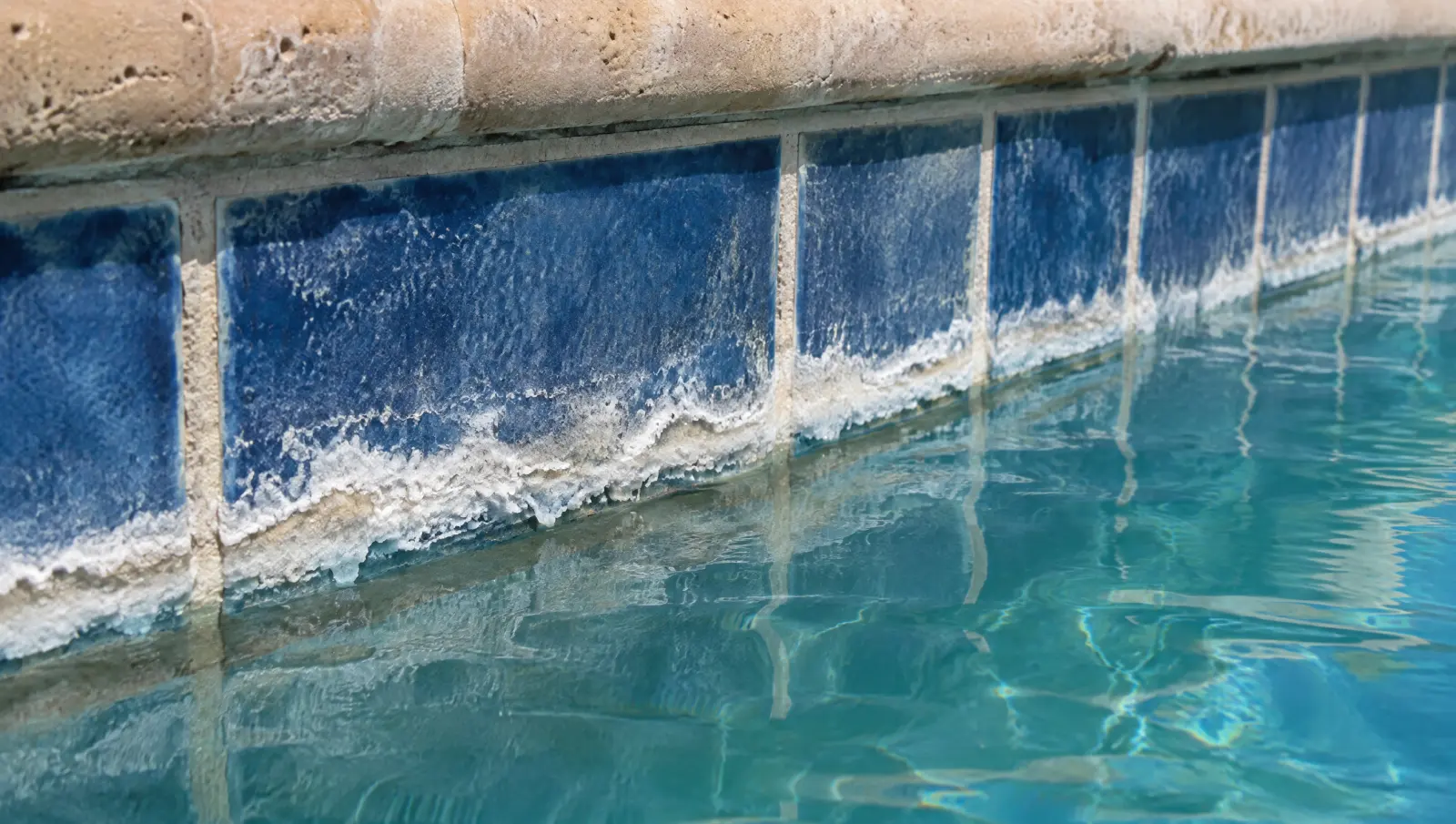
| Symptom | Likely cause | Fix | |---|---|---| | Rough, pitted or etched plaster; plaster dust; grout washing out | Calcium too low (aggressive water) | Raise calcium hardness; check pH and alkalinity | | Colored water or stains from metal | Low calcium or low pH corroding metal parts | Balance the water; see a pro if a heater is involved | | White, crusty scale at the waterline or on fittings | Calcium too high, often with high pH | Lower pH and alkalinity; partial drain | | Cloudy water that won’t clear with shock | High calcium with high pH or alkalinity | Lower pH; partial drain | | Scale on heater coils or salt cell plates | High saturation index in the warmest spots | Lower pH and alkalinity; clean the cell |
Taylor notes that as water gets warmer, less calcium can stay dissolved. That’s why heaters and salt cells scale first, and why a heated pool is less forgiving of high calcium.
Test before you add anything
Calcium hardness needs a real test, not a guess. A drop kit like the Taylor K-2005 includes a calcium hardness test, and many test strips have a “total hardness” pad. Compare options in our best pool test kit guide.
- Test monthly. The CDC’s Model Aquatic Health Code requires public pools to test calcium hardness monthly and check the saturation index monthly; that’s a sensible schedule for a home pool too.
- Test after any big water change: a refill, heavy rain or a long run of top-offs.
- Test your fill water once. If your tap water is already hard, you’ll rarely need to add calcium, and diluting a hard pool won’t help much.
How to raise calcium hardness, step by step
1. Balance alkalinity and pH first
Taylor’s guidance is to adjust calcium hardness last, after pH and total alkalinity. Get alkalinity to 80–120 ppm and pH to 7.2–7.8 first; our guide on how to raise alkalinity covers that step. Taylor also warns not to add calcium chloride within hours of soda ash or baking soda, or the water may turn cloudy.
2. Work out how many ppm you need
Target minus current reading. A plaster pool at 150 ppm aiming for 250 ppm needs a 100 ppm rise. A vinyl pool at 120 ppm aiming for 200 ppm needs 80 ppm.
3. Calculate the dose per 10,000 gallons
Calcium chloride comes in two common strengths: 100% (anhydrous) and 77% (hydrated, often flakes). The weaker one needs about a quarter more product. These are the amounts from two state and county health department tables:
| Rise in calcium hardness | 100% calcium chloride per 10,000 gal | 77% calcium chloride per 10,000 gal | |---|---|---| | 10 ppm | 0.9 lb (Indiana) to 1.0 lb (Yakima County) | 1.2 lb (Indiana) to 1.25 lb (Yakima County) | | 30 ppm | 2.8 lb | 3.6 lb | | 50 ppm | 4.6 lb | 6.0 lb |
Product labels land in the same range: the Pool Mate listing says 8 oz raises hardness 10 ppm in 5,000 gallons (1 lb per 10,000 gallons), AquaDoc’s says 1.2 lb per 10,000 gallons for 10 ppm, and In The Swim’s 25 lb pail (94% calcium chloride) says 6 lb per 10,000 gallons raises it about 50 ppm when hardness is under 150. Use the rate on the bag you bought.
Worked example (18,000-gallon vinyl pool, 120 → 200 ppm):
- Rise needed: 200 − 120 = 80 ppm.
- At 1 lb per 10 ppm per 10,000 gallons: 8 lb for 10,000 gallons.
- Volume factor: 18,000 ÷ 10,000 = 1.8, so 8 × 1.8 = 14.4 lb of 100% calcium chloride.
The pool chemical calculator does this math for any volume. Not sure of your gallons? Start with the pool volume calculator.
4. Add it in portions with the pump running
Labels differ on method, so follow yours:
- Broadcast it over the deep end with the pump running. Taylor recommends this rather than pre-dissolving, because calcium chloride generates heat as it dissolves.
- Pre-dissolve it if your label says to. Fill the bucket with pool water first, then add the product slowly: never the other way around.
Either way, don’t dump a large dose at once. Indiana’s guidelines say to add large amounts gradually, in thirds over a 2-hour period. Keep swimmers out while you add it.
5. Circulate and retest
Swim University suggests running the pump for at least 8 hours and retesting the next day; AquaDoc’s listing says to retest after two hours and allows swimming after 15 minutes. Retest calcium, pH and alkalinity before adding more, because adding calcium nudges the saturation index up.
Pool Mate Premium Calcium Hardness Increaser (100% calcium chloride, 8 lb)
- Active ingredient
- 100% calcium chloride
- Dose (listing)
- 8 oz per 5,000 gal raises 10 ppm
- Target (listing)
- Vinyl 200–300 ppm; fiberglass or painted 250–400 ppm
- Size
- 8 lb
Specs from the Amazon listing and manufacturer documentation
Full-strength calcium chloride, so the math is simple: the listing says 8 oz raises hardness 10 ppm in 5,000 gallons, which is 1 lb per 10 ppm per 10,000 gallons.
Pros
- Matches the health-department rate for 100% calcium chloride
- An 8 lb bag covers about an 80 ppm rise in 10,000 gallons
Cons
- Its target ranges for vinyl and fiberglass are higher than some pool makers allow
- An 8 lb bag runs out fast in a large plaster pool
MAV AquaDoc Pool Calcium Hardness Increaser (calcium chloride, 5 lb)
- Active ingredient
- Calcium chloride
- Dose (listing)
- 1.2 lb per 10,000 gal raises 10 ppm
- Target (listing)
- 200–400 ppm
- Size
- 5 lb
Specs from the Amazon listing and manufacturer documentation
A 5 lb calcium chloride for smaller corrections. The listing gives 1.2 lb per 10,000 gallons for each 10 ppm, says not to add it on the same day as a pH or alkalinity product, to retest after two hours, and that swimming is fine after 15 minutes.
Pros
- Clear timing advice: separate from pH and alkalinity changes
- Short 15-minute wait before swimming (listing)
Cons
- Only about a 40 ppm rise in 10,000 gallons per bag
- Purity isn't stated as 100%, so the dose is a little higher
How to lower calcium hardness
There’s no chemical that takes calcium out of pool water. The Indiana Department of Health’s chemistry guide says it plainly: the only way to reduce calcium hardness is to remove some of the pool water.
Partial drain and refill
The new level is a weighted average of what stays and what you add:
New hardness = pool hardness × (1 − share replaced) + fill-water hardness × share replaced
| Starting level | Fill water | Share replaced | New level | |---|---|---|---| | 600 ppm | 150 ppm | 25% | About 490 ppm | | 600 ppm | 150 ppm | 33% | About 450 ppm | | 600 ppm | 150 ppm | 50% | About 375 ppm | | 500 ppm | 300 ppm | 50% | About 400 ppm |
The last row shows the catch: if your tap water is hard, you have to replace a lot of water for a small drop. Swim University suggests filling through a hose filter to remove some of the minerals.
Before you drain
Check your pool manufacturer’s instructions on how far the water can be lowered. Vinyl liners can shift and in-ground shells can be stressed by groundwater if drained too far. After refilling, rebalance alkalinity, pH, stabilizer and chlorine.
If you can’t replace water
During drought restrictions, Taylor suggests lowering the saturation index instead: bring pH and alkalinity down with acid (unless they’re already low) so the high calcium is less likely to form scale. It doesn’t remove calcium; it just keeps it in solution. A scale and stain control product can also help, and River Pools recommends one for fiberglass pools above 120 ppm.
Scaling vs etching: LSI and CSI
Calcium hardness doesn’t act alone. Whether water deposits scale or eats plaster depends on a saturation index, which combines several readings into one number. Taylor lists the inputs as calcium hardness, pH, total alkalinity (corrected for cyanuric acid), water temperature and, to a lesser degree, total dissolved solids.
Two versions are common:
- LSI (Langelier Saturation Index): the classic formula, used by Taylor’s free calculator and its Watergram.
- CSI (Calcite Saturation Index): the version used by Trouble Free Pool’s Pool Math app. It’s calculated differently and can give a slightly different number.
| Index reading | What it means | Source | |---|---|---| | −0.3 or lower | Water trends corrosive: etching, pitting, metal corrosion | Taylor | | −0.3 to +0.3 | Balanced | Taylor LSI calculator; Trouble Free Pool CSI (plaster and tile-line pools) | | −0.3 to 0.0 | Suggested for salt chlorine generator pools, to limit scale on the cell | Trouble Free Pool | | +0.5 or higher | Water trends toward scale and cloudiness | Taylor |
Trouble Free Pool notes that adjusting pH usually moves the index more than anything else, and that vinyl and most fiberglass pools can tolerate a wider band because they contain no calcium to etch. That’s why the fix for scale is often lowering pH and alkalinity, not just calcium.
For plaster pools, keep calcium in range and the index near zero. A pool at 250 ppm calcium can still etch if pH and alkalinity are low, or scale if pH is 8.0 and the water is warm.
Common mistakes
- Adding calcium to a fiberglass pool by habit. Check your manufacturer first; some want it low.
- Adding calcium right after baking soda or soda ash. Taylor warns this can cloud the water. Space them out.
- Using cal-hypo shock in a pool that’s already hard. Calcium hypochlorite adds calcium with every dose. Liquid chlorine doesn’t.
- Pouring water onto calcium chloride. It heats up. Add the product to water, slowly.
- Chasing calcium before pH. Fix alkalinity and pH first, then calcium.
- Ignoring fill water. Evaporation leaves calcium behind, so hard tap water slowly pushes hardness up every season.
When to call a pool professional
- Plaster is visibly etching or pitting even though your readings look normal (have a pool store confirm your calcium and alkalinity).
- Scale is building up on a heater or heat exchanger: a scaled heater loses efficiency and can fail.
- Your fill water is so hard that a partial drain can’t bring the pool into range.
- The pool is new plaster: startup chemistry is specific, and your builder’s instructions come first.
How we put this guide together
We don’t own a pool and haven’t tested these products ourselves. This guide is built from sources you can check: Taylor Technologies’ calcium hardness and saturation index guidance, dosing tables from the Indiana Department of Health and Yakima County, River Pools’ fiberglass care guide, Trouble Free Pool’s CSI article, the CDC’s Model Aquatic Health Code for testing frequency, the CDC’s pool chemical injury report for safety rules, and the Amazon listing directions for each product we mention. Where sources disagree, we say so and point you to the manufacturer of your pool. Every source is listed at the end of the page.
Calcium is one of five numbers that keep a pool balanced. For the rest, see our pool chemicals guide.
Sources
- Taylor Technologies: Understanding and Managing Calcium Hardness in Pool & Spa Water · taylortechnologies.com
- Taylor Technologies: Free Digital LSI Calculator (target ranges) · taylortechnologies.com
- Indiana Department of Health: Adjusting Chemical Levels in a Swimming Pool (PDF) · in.gov
- Yakima County: Dosages Required to Chemically Treat 10,000 Gallons of Water (PDF) · yakimacounty.us
- Swim University: Calcium Hardness in Pools · swimuniversity.com
- River Pools: Fiberglass Pool Care Guide (PDF) · riverpoolsandspas.com
- Trouble Free Pool: Calcium Saturation Index (CSI) · troublefreepool.com
- CDC: Model Aquatic Health Code, 5th Edition (2024), PDF · cdc.gov
- CDC MMWR: Pool Chemical Injuries in Public and Residential Settings, 2008–2017 · cdc.gov
- CDC: Use Pool Chemicals Safely (poster, PDF) · cdc.gov
Frequently asked questions
How much calcium do I need to add to my pool?
Work out how many ppm you need, then use your product's label. Health-department tables give about 0.9–1.0 lb of 100% calcium chloride, or 1.2–1.25 lb of 77% calcium chloride, per 10,000 gallons for every 10 ppm. Example: raising a 20,000-gallon pool from 150 to 250 ppm is 100 ppm, so about 10 lb × 2 = 20 lb of 100% calcium chloride. Add it in portions and retest.
Does shocking a pool raise calcium hardness?
Only if the shock contains calcium. Calcium hypochlorite (cal-hypo) shock adds calcium every time you use it, which is why fiberglass maker River Pools tells owners to avoid it. Liquid chlorine (sodium hypochlorite), dichlor and non-chlorine shock don't add calcium.
Does baking soda increase calcium hardness in pools?
No. Baking soda (sodium bicarbonate) raises total alkalinity, not calcium hardness. Taylor also warns not to add calcium chloride within hours of baking soda or soda ash, because the water can turn cloudy.
What is the cheapest way to increase calcium hardness in my pool?
Plain calcium chloride in a larger bag is usually the cheapest per pound, and "calcium hardness increaser" is simply calcium chloride under another name. Check the strength on the label: 100% (anhydrous) needs less product than 77% (hydrated) for the same rise. If your tap water is hard, normal top-offs will also raise hardness over time.
How do I lower calcium hardness in my pool?
Drain part of the water and refill with water that has lower hardness. The Indiana Department of Health puts it plainly: removing some of the pool water is the only way. Test your fill water first: if it's also hard, dilution won't get you far. If you can't replace water, Taylor suggests lowering pH and alkalinity to reduce the scaling tendency instead.
What should calcium hardness be in a pool?
Taylor gives 200–400 ppm as the industry range for pools. Plaster, concrete and gunite need to stay in that range to avoid etching. Vinyl and fiberglass pools are commonly kept at 175–225 ppm, but follow your manufacturer: River Pools, for example, recommends below 120 ppm for its fiberglass pools.